¶ Exercise Starter Kit (1 week)
Minimum effective dose for longevity
- Consistent Zone 2 aerobic activity (e.g., brisk walking, light cycling).
- Regular strength training (2-3 days/week).
- Short bursts of high-intensity interval training (HIIT) or steep hill walks (1-2 days/week).
- Daily focus on balance and mobility.
¶ At a Glance
This starter kit provides a structured, evidence-based approach to initiating an exercise regimen optimized for longevity. It emphasizes a progressive, sustainable plan covering key physiological domains: cardiorespiratory fitness (Zone 2, VO2 max), muscular strength, balance, mobility, recovery, and injury prevention.
¶ Quick Wins for the Week
- Assess Readiness: Pre-activity screening using the PAR-Q+ protocol establishes the clinical threshold for exercise clearance before beginning structured physical training.[1][2]
- Schedule: Dedicate specific times for exercise in your calendar, treating them as non-negotiable appointments.
- Walk Daily: Aim for at least 30 minutes of walking on most days. This builds an aerobic base, improves subjective sleep quality, and aids recovery.[3][4]
- Bodyweight Strength: Perform simple bodyweight exercises (squats, push-ups against a wall/knee, planks) 2-3 times this week.
- Balance Practice: Stand on one leg for 30 seconds while brushing your teeth, switching legs halfway.
¶ Core Longevity Exercise Routines
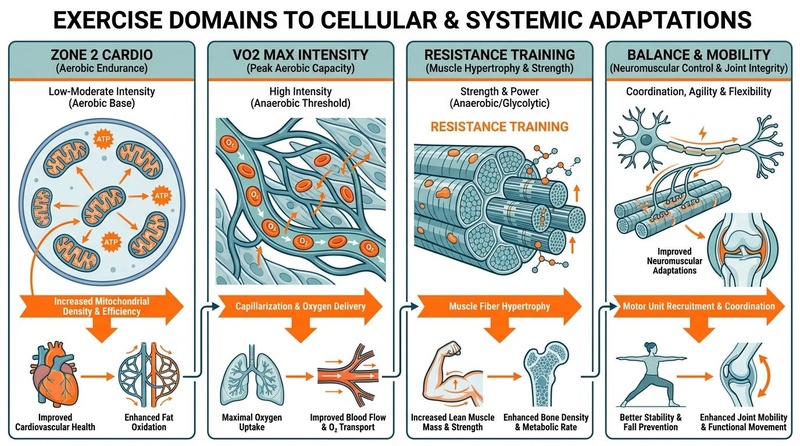
Most major health organizations recommend a combination of aerobic and strength-based activities. For longevity, specific intensity zones and training types confer distinct benefits:
¶ Weekly Targets (Evidence-Based Guidelines)
- Aerobic Activity: 150–300 minutes/week of moderate-intensity (Zone 2) or 75–150 minutes/week of vigorous-intensity (VO2 max/HIIT) exercise. Greater amounts may offer additional benefits up to a point.[5][6][7]
- Muscle Strengthening: 2 or more days/week, targeting all major muscle groups. This is crucial for combating sarcopenia and maintaining metabolic health.[8][9][10]
¶ Longevity Domains Explained
Zone 2 Training (Mitochondrial Health & Metabolic Flexibility)
Zone 2 training involves sustained aerobic activity at an intensity where you can comfortably hold a conversation but still feel challenged. This typically corresponds to 60-70% of your maximum heart rate (HRmax) or a perceived exertion of 4-6 out of 10.
- Physiological Benefits: Enhances mitochondrial density and function, improves metabolic flexibility (ability to burn fat efficiently), and builds a robust aerobic base.[11]
- Practical Application: Brisk walking, light jogging, cycling, swimming, or elliptical training.
VO2 Max Training / HIIT (Cardiovascular Reserve & Peak Performance)
VO2 max (maximal oxygen uptake) is a key indicator of cardiorespiratory fitness and a strong predictor of all-cause mortality.[12][13] High-Intensity Interval Training (HIIT) is an effective way to improve VO2 max, involving short bursts of near-maximal effort followed by recovery periods.
- Physiological Benefits: Increases cardiac stroke volume, enhances endothelial function, and improves maximal oxygen delivery and utilization.[14][15]
- Practical Application: Sprints, hill repeats, fast intervals on a bike or rower. Start with short intervals (e.g., 30 seconds on, 90 seconds off) and gradually increase duration or reduce rest.
Strength Training (Muscle Preservation & Bone Density)
Resistance training is critical for preserving muscle mass (combating sarcopenia), maintaining bone mineral density, and improving metabolic health. It involves working muscles against external resistance.
- Physiological Benefits: Promotes muscle protein synthesis, increases muscle strength and power, enhances insulin sensitivity, and strengthens bones.[9:1][16][17]
- Practical Application: Bodyweight exercises (squats, lunges, push-ups, planks), resistance bands, free weights, or machines. Focus on compound movements that work multiple muscle groups.
Balance & Mobility (Fall Prevention & Functional Independence)
Balance and mobility training are essential for maintaining functional independence, preventing falls, and improving quality of life, especially as we age.
Recovery, Adaptation, and Sleep Synergy
Exercise-induced physiological adaptations occur during recovery. Integrating structured exercise with sleep hygiene creates a powerful synergistic loop.
- Physiological Benefits: Exercise improves slow-wave sleep duration and decreases sleep latency.[23] Recovery markers, such as heart rate variability (HRV), track autonomic nervous system balance and adaptation to exercise training.[24][25]
- Practical Application: Schedule hard workouts early in the day to avoid sleep disruption. Use passive recovery strategies (stretching, breathwork) to stimulate parasympathetic tone.
¶ 7-Day Starter Plan (Simple & Progressive)
This plan provides a template. Adjust durations and intensities based on your current fitness level, always prioritizing proper form over speed or weight to prevent injuries.[26] Core stability exercises help protect the lower back and reduce the incidence of musculoskeletal strain.[27][28]
| Day | Focus Activity | Duration / Sets | Notes & Tips |
|---|---|---|---|
| Day 1 | Active Recovery / Zone 2 | 30-45 minutes | Brisk walk, light cycling, or easy swim. Maintain a conversational pace (you can talk, but it's not effortless). |
| Day 2 | Strength Training A | 30-45 minutes (2-3 sets of 8-12 reps) | Full Body: Squats (bodyweight or light weights), Push-ups (against wall or knees), Lunges, Plank. Focus on controlled movements. |
| Day 3 | Zone 2 + Mobility | 45-60 minutes Zone 2, 10-15 minutes mobility | Longer Zone 2 session. Add gentle stretches for hips, hamstrings, and shoulders. Consider dynamic movements like leg swings. |
| Day 4 | Active Recovery / Core Stability | 30-minute walk + 10-minute core | Focus on foundational core exercises: Bird-Dog, Dead Bug, Side Plank. Maintain a neutral spine. |
| Day 5 | Strength Training B | 30-45 minutes (2-3 sets of 8-12 reps) | Full Body: Repeat Day 2 exercises. If comfortable, slightly increase reps, sets, or resistance. |
| Day 6 | HIIT or Vigorous Zone 2 | 20-30 minutes | Option 1 (HIIT): 5-10 minutes warm-up, then 4-6 rounds of (30 seconds near-max effort, 90 seconds easy recovery). Option 2 (Vigorous Zone 2): Sustained pace that makes conversation difficult. |
| Day 7 | Rest & Reflection | Review the week, plan next. | Listen to your body. Light stretching or foam rolling is acceptable. Plan for the next week, adjusting based on how you felt. |
¶ What to Track (Minimal)
- Strength Sessions/Week: (count) – Aim for 2-3.
- Aerobic Minutes/Week: (count) – Aim for 150+ moderate, or 75+ vigorous.
- Daily Steps: (optional) – Aim for 7,500-10,000 as a general activity baseline.
- Subjective Wellbeing: How do you feel? Energy levels, mood, sleep quality.
Clinical Contraindications & Screening Thresholds
Structured physical activity is contraindicated in patients with unstable angina, acute myocardial infarction within the past 48 hours, uncontrolled cardiac arrhythmias causing symptoms or hemodynamic compromise, active endocarditis, or severe symptomatic aortic stenosis. Screening tools like the PAR-Q+ establish the physiological baseline for clinical exercise prescription.[1:1][2:1]
¶ Troubleshooting & Advanced Considerations
- Low Energy / Poor Recovery: Ensure adequate sleep, nutrition, and hydration. Consider reducing intensity or adding more rest days. For persistent issues, see Low energy troubleshooting.
- Genetic Variability: Individual responses to exercise training vary significantly. Some individuals are "high responders" while others may be "low responders" to specific training types (e.g., cardiorespiratory fitness improvements due to genetic predispositions).[29] Personalized adjustments are often necessary.[30]
- Deep Dive: For more detailed information on exercise physiology, benefits, and advanced protocols, refer to our main Exercise page or explore Training Blocks & Periodization.
¶ References
Jamnik, V. K., Warburton, D. E., & Makarski, J. (2011). Enhancing the effectiveness of clearance for physical activity participation: background and overall process. Applied Physiology, Nutrition, and Metabolism, 36(S1), S3-S13. https://pubmed.ncbi.nlm.nih.gov/21800946/ ↩︎ ↩︎
Schwartz, J., Oh, P., & Takito, M. Y. (2021). Translation, Cultural Adaptation, and Reproducibility of the Physical Activity Readiness Questionnaire for Everyone (PAR-Q+): The Brazilian Portuguese Version. Frontiers in Cardiovascular Medicine, 8, 715509. https://pubmed.ncbi.nlm.nih.gov/34381827/ ↩︎ ↩︎
Kong, X., Wang, X., & Li, Z. (2026). Walking and subjective sleep quality in adults: a Bayesian three-level meta-analysis with probabilistic clinical relevance assessment and dose-response modeling. Frontiers in Public Health, 14, 115024. https://pubmed.ncbi.nlm.nih.gov/42375593/ ↩︎
Wang, S., Chen, J., & Gao, C. (2026). Effects of aerobic exercise on cognition, sleep, and mood in healthy adults: a systematic review and meta-analysis of randomized controlled trials. Frontiers in Human Neuroscience, 20, 110243. https://pubmed.ncbi.nlm.nih.gov/42294103/ ↩︎
World Health Organization. WHO guidelines on physical activity and sedentary behaviour (2020). https://www.who.int/publications/i/item/9789240015128 ↩︎
Lang, J. J., Prince, S. A., & Merucci, K. (2024). Cardiorespiratory fitness is a strong and consistent predictor of morbidity and mortality among adults: an overview of meta-analyses representing over 20.9 million observations from 199 unique cohort studies. British Journal of Sports Medicine, 58(9), 503-512. https://pubmed.ncbi.nlm.nih.gov/38599681/ ↩︎
Weeldreyer, N. R., De Guzman, J. C., & Paterson, C. (2025). Cardiorespiratory fitness, body mass index and mortality: a systematic review and meta-analysis. British Journal of Sports Medicine, 59(4), 180-189. https://pubmed.ncbi.nlm.nih.gov/39537313/ ↩︎
Cruz-Jentoft, A. J., Bahat, G., Bauer, J., Boirie, Y., Bruyère, O., Cederholm, T., ... & Rolland, Y. (2019). Sarcopenia: revised European consensus on definition and diagnosis. Age and Ageing, 48(1), 16-31. https://pubmed.ncbi.nlm.nih.gov/30312372/ ↩︎
Li, G. Q., Tang, S. Y., & Luo, J. (2026). The intervention effects of resistance exercise on sarcopenia in older adults: a systematic review and meta-analysis. BMC Geriatrics, 26(1), 263. https://pubmed.ncbi.nlm.nih.gov/42304276/ ↩︎ ↩︎
Yan, R., Chen, Y., & Zhang, R. (2025). Optimal resistance training prescriptions to improve muscle strength, physical function, and muscle mass in older adults diagnosed with sarcopenia: a systematic review and meta-analysis. Aging Clinical and Experimental Research, 37(1), 312. https://pubmed.ncbi.nlm.nih.gov/41212331/ ↩︎
Storoschuk, K. L., Moran-MacDonald, A., & Gibala, M. J. (2025). Much Ado About Zone 2: A Narrative Review Assessing the Efficacy of Zone 2 Training for Improving Mitochondrial Capacity and Cardiorespiratory Fitness in the General Population. Sports Medicine, 55(7), 1435-1450. https://pubmed.ncbi.nlm.nih.gov/40560504/ ↩︎
Mandsager, K., Harb, S., Cremer, P., Phelan, D., Nissen, S. E., & Jaber, W. A. (2018). Association of Cardiorespiratory Fitness With Long-term Mortality Among Adults Undergoing Exercise Treadmill Testing. JAMA Network Open, 1(6), e183605. https://pubmed.ncbi.nlm.nih.gov/30646252/ ↩︎
Singh, B., Cadenas-Sanchez, C., & da Costa, B. G. G. (2025). Comparison of objectively measured and estimated cardiorespiratory fitness to predict all-cause and cardiovascular disease mortality in adults: A systematic review and meta-analysis of 42 studies representing 35 cohorts and 3.8 million observations. Journal of Sport and Health Science, 14(6), 560-571. https://pubmed.ncbi.nlm.nih.gov/39271056/ ↩︎
Liang, W., Liu, C., & Yan, X. (2024). The impact of sprint interval training versus moderate intensity continuous training on blood pressure and cardiorespiratory health in adults: a systematic review and meta-analysis. PeerJ, 12, e17056. https://pubmed.ncbi.nlm.nih.gov/38495758/ ↩︎
Strauss, J. A., Kirwan, R., & Ranasinghe, C. (2026). High-intensity interval training for reducing cardiometabolic syndrome in healthy but sedentary populations. Cochrane Database of Systematic Reviews, (3), CD014120. https://pubmed.ncbi.nlm.nih.gov/41810896/ ↩︎
Bettariga, F., Galvao, D. A., & Taaffe, D. R. (2025). Association of muscle strength and cardiorespiratory fitness with all-cause and cancer-specific mortality in patients diagnosed with cancer: a systematic review with meta-analysis. British Journal of Sports Medicine, 59(9), 503-512. https://pubmed.ncbi.nlm.nih.gov/39837589/ ↩︎
Tan, Z., Jiang, Y., & Candow, D. G. (2026). Optimizing prescription of resistance training for body composition, muscle strength, and physical performance in older adults with sarcopenia: a systematic review and meta-analysis. European Review of Aging and Physical Activity, 23(1), 45. https://pubmed.ncbi.nlm.nih.gov/41566419/ ↩︎
Sherrington, C., Fairhall, N. J., & Wallbank, G. K. (2019). Exercise for preventing falls in older people living in the community. Cochrane Database of Systematic Reviews, (1), CD012424. https://pubmed.ncbi.nlm.nih.gov/30703272/ ↩︎
Choudhary, P. K., Choudhary, S., & Saha, S. (2025). Effectiveness of Balance- and Strength-Based Exercise Interventions for Fall Prevention in Community-Dwelling Older Adults: A Systematic Review of Randomized Controlled Trials. Life, 15(12), 1420. https://pubmed.ncbi.nlm.nih.gov/41598197/ ↩︎
Yu, H., Zhong, J., & Li, M. (2025). Effects of exercise intervention on falls and balance function in older adults: a systematic review and meta-analysis. PeerJ, 13, e18102. https://pubmed.ncbi.nlm.nih.gov/41122235/ ↩︎
Ingram, L. A., Tomkinson, G. R., & d'Unienville, N. M. A. (2025). Optimising the Dose of Static Stretching to Improve Flexibility: A Systematic Review, Meta-analysis and Multivariate Meta-regression. Sports Medicine, 55(3), 610-625. https://pubmed.ncbi.nlm.nih.gov/39614059/ ↩︎
Nakamura, M., Takeuchi, K., & Fukaya, T. (2024). Acute effects of static stretching on passive stiffness in older adults: A systematic review and meta-analysis. Archives of Gerontology and Geriatrics, 117, 105190. https://pubmed.ncbi.nlm.nih.gov/37951029/ ↩︎
Guo, J., Tang, J., & Jiang, J. (2026). The impact of different types of exercise on sleep in sedentary populations: a systematic review and network meta-analysis. PeerJ, 14, e18301. https://pubmed.ncbi.nlm.nih.gov/42291438/ ↩︎
Zhang, W., Bi, S., & Luo, L. (2025). The impact of long-term exercise intervention on heart rate variability indices: a systematic meta-analysis. Frontiers in Cardiovascular Medicine, 12, 114510. https://pubmed.ncbi.nlm.nih.gov/40574815/ ↩︎
Chiang, J. K., Lin, Y. C., & Hung, T. Y. (2024). The Impact on Autonomic Nervous System Activity during and Following Exercise in Adults: A Meta-Regression Study and Trial Sequential Analysis. Medicina, 60(8), 1250. https://pubmed.ncbi.nlm.nih.gov/39202504/ ↩︎
Kłobuchowski, W., Skorulski, M., & Ornowski, K. (2026). Exercise-Based Strategies from Warm-Up to Training: A Systematic Review of Performance Enhancement and Injury Prevention. Sports, 14(5), 112. https://pubmed.ncbi.nlm.nih.gov/42188564/ ↩︎
Liu, Y., Yu, Y., & Lu, F. (2026). Comparative effectiveness of different core muscle training regimens for chronic non-specific low back pain: a systematic review and meta-analysis. Frontiers in Medicine, 13, 115201. https://pubmed.ncbi.nlm.nih.gov/42089060/ ↩︎
Guo, X. B., Lan, Q., & Ding, J. (2025). Effects of different types of core training on pain and functional status in patients with chronic nonspecific low back pain: a systematic review and meta-analysis. Frontiers in Physiology, 16, 112340. https://pubmed.ncbi.nlm.nih.gov/41178988/ ↩︎
Bouchard, C., Rankinen, T., & Chagnon, Y. C. (2000). Genomic scan for maximal oxygen uptake and its response to training in the HERITAGE Family Study. Journal of Applied Physiology, 88(2), 551-559. https://pubmed.ncbi.nlm.nih.gov/10658022/ ↩︎
Weatherwax, R. M., Harris, N. K., & Kilding, A. E. (2016). The incidence of training responsiveness to cardiorespiratory fitness and cardiometabolic measurements following individualized and standardized exercise prescription: study protocol for a randomized controlled trial. Trials, 17(1), 601. https://pubmed.ncbi.nlm.nih.gov/27993169/ ↩︎