¶ title: PFAS: Deep Dive
description: Comprehensive analysis of Per- and Polyfluoroalkyl Substances (PFAS) - their environmental persistence, exposure pathways, clinical impacts on longevity, and evidence-based clearance and mitigation strategies.
published: 1
date: 2026-07-06T18:24:08.402Z
tags: deep-dive, environmental-health, longevity, pfas, toxicology, water-filtration, pfos, pfoa, endocrine-disruption
editor: markdown
dateCreated: 2026-07-06T18:24:08.402Z
¶ PFAS: Deep Dive
¶ TL;DR
- Verdict: Per- and Polyfluoroalkyl Substances (PFAS), also known as "forever chemicals," are widespread environmental contaminants associated with adverse health outcomes and accelerated biological aging. Mitigation is possible.
- Who it's for: Everyone, particularly individuals with higher exposure risks (e.g., firefighters, those with contaminated drinking water) or those seeking to optimize long-term health.
- Expected magnitude + timeline: Blood/plasma donation can reduce serum PFAS by 10-30% within 12 months, while prescription bile acid sequestrants (like cholestyramine) are clinically validated for rapid systemic clearance. Water filtration can remove >99% of PFAS from drinking water. Dietary fiber acts as a supportive, experimental intervention over months.
- Key risk(s): Endocrine disruption, thyroid hormone interference, lipid metabolism disruption, immune suppression, hepatotoxicity, and accelerated epigenetic aging.
- What to do next: Evaluate personal exposure, consider blood/plasma donation (if eligible and highly exposed), implement effective water filtration, and adopt dietary strategies to enhance excretion.
¶ Quick Answer
Per- and Polyfluoroalkyl Substances (PFAS) are a class of persistent synthetic chemicals that accumulate in the environment and human body, impacting multiple physiological systems. Research shows that both blood and plasma donation can significantly reduce serum PFAS levels in highly exposed individuals, with plasma donation leading to a roughly 30% decrease in average blood serum PFAS concentrations over a 12-month period in a landmark clinical trial [1]. Prescription bile acid sequestrants (like cholestyramine) are also clinically validated for systemic clearance [2]. Effective water filtration systems like reverse osmosis and activated carbon are crucial for minimizing exposure from drinking water, consistently removing over 99% of these compounds [3]. Dietary fiber intake is inversely associated with serum PFAS levels in population-level studies, suggesting a supportive, experimental role in promoting fecal excretion [4].
¶ What It Is
Per- and Polyfluoroalkyl Substances (PFAS) are a group of thousands of human-made chemicals known for their resistance to heat, water, and oil. This chemical stability has earned them the moniker "forever chemicals" due to their environmental persistence and inability to degrade naturally. PFAS are found in a wide array of consumer and industrial products, leading to widespread environmental contamination and human exposure.
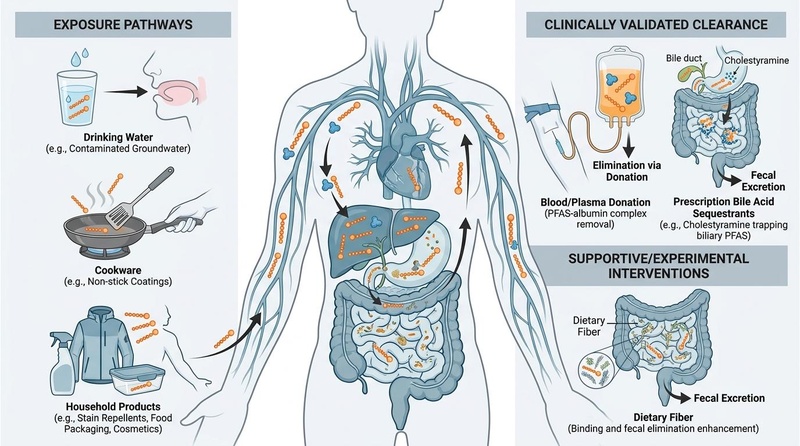
Figure 1: Pathophysiological pathways of PFAS bioaccumulation and clearance. Clinically validated systemic clearance is achieved via phlebotomy/plasmapheresis (removing protein-bound PFAS) or prescription bile acid sequestrants like cholestyramine (binding biliary PFAS in the intestinal tract to prevent reabsorption). Soluble dietary fiber serves as a supportive, experimental intervention to promote fecal excretion.
Major daily exposure pathways include:
- Drinking Water: Contamination of public and private water supplies is a primary route, particularly near industrial sites, military bases, and landfills.
- Non-Stick Cookware: Coatings on non-stick pans can release PFAS, especially when heated to high temperatures.
- Grease-Resistant Food Packaging: Fast food wrappers, microwave popcorn bags, and pizza boxes often contain PFAS to repel grease.
- Stain-Resistant Fabrics and Carpets: Furniture, clothing, and carpets treated for stain and water resistance are sources of PFAS exposure.
- Firefighting Foams: Aqueous film-forming foams (AFFF) used to extinguish petroleum fires have been a significant source of environmental and occupational PFAS contamination, particularly for firefighters.
- Air and Dust: Inhalation of indoor dust is another pathway for PFAS exposure. This mirrors the entry routes of other environmental hazards like PM2.5 and fine particles discussed in our Air Quality deep dive.
Similar to microplastics and nanoplastics, PFAS are widely distributed in modern environments, posing potential long-term threats to healthspan and cardiovascular health.
PFAS molecules are amphiphilic, meaning they have both water-attracting and water-repelling properties, allowing them to bind to proteins like albumin in the blood and undergo enterohepatic recirculation, which contributes to their long half-lives in the human body [2:1].
¶ Does It Work? (Evidence Snapshot)
¶ Human Health Outcomes
| Outcome | Population | Effect Size | Certainty | Timeframe |
|---|---|---|---|---|
| Serum PFOS Reduction (Plasma Donation) | Firefighters with high baseline PFOS | -2.9 ng/mL (95% CI, -3.6 to -2.3 ng/mL), ~30% reduction | High [1:1] | 12 months (maintained at 3 months post-intervention) |
| Serum PFOS Reduction (Blood Donation) | Firefighters with high baseline PFOS | -1.1 ng/mL (95% CI, -1.5 to -0.7 ng/mL), ~10% reduction | High [1:2] | 12 months (maintained at 3 months post-intervention) |
| Serum PFHxS Reduction (Plasma Donation) | Firefighters with high baseline PFHxS | -1.1 ng/mL (95% CI, -1.6 to -0.7 ng/mL) | Moderate [1:3] | 12 months |
| Serum PFOS Reduction (Cholestyramine) | Highly exposed adults | ~60% reduction | High [2:2] | 12 weeks |
| Water Filter Efficacy (RO & Dual-Stage Activated Carbon) | Point-of-use residential water | >99% removal of all PFAS | High [3:1] | Immediate and ongoing |
| Dietary Fiber Intake vs. Serum PFAS (Supportive/Experimental) | General US adult population (NHANES) | -3.5% to -4.2% per 10g/day increase in fiber intake | Moderate [4:1] | Cross-sectional association |
| PFAS Exposure vs. Epigenetic Aging | Firefighters; General US adult population (NHANES) | Significant association with accelerated epigenetic age (PFHxS, PFOA, branched PFOS, PFNA, PFOSA) | Moderate [5][6] | Cross-sectional association |
| PFAS Exposure vs. Vaccine Antibody Response | Children | Attenuated antibody concentrations (tetanus, diphtheria) | High [7][8] | Longitudinal cohort (5-7 years old) |
¶ Who Benefits Most / Least
Benefits Most:
- Individuals with documented high PFAS exposure (e.g., occupational exposure, living near contaminated sites).
- Those concerned about long-term health impacts, particularly endocrine, immune, and metabolic health.
- Anyone relying on unfiltered tap water in areas with known PFAS contamination.
Benefits Least:
- Individuals with very low or undetectable PFAS levels may see minimal additional benefit from aggressive clearance strategies.
- People with medical contraindications to blood/plasma donation (e.g., anemia, certain cardiovascular conditions).
¶ How to Try It (Actionable Protocols)
¶ Clearance & Mitigation Strategies
-
Blood and Plasma Donation:
- Recommendation: For individuals with elevated PFAS levels, regular blood or plasma donation can be an effective strategy to reduce body burden. Plasma donation is generally more effective due to PFAS binding to plasma proteins.
- Protocol (Firefighter Trial) [1:4]:
- Plasma Donation: Every 6 weeks for 12 months. Achieved ~30% reduction in average serum PFOS.
- Blood Donation: Every 12 weeks for 12 months. Achieved ~10% reduction in average serum PFOS.
- Considerations: Consult with a healthcare provider and blood donation center to ensure eligibility and safety.
-
Water Filtration Technology Choices:
- Recommendation: Implement robust home water filtration for drinking and cooking.
- Effective Systems [3:2]:
- Reverse Osmosis (RO): Highly effective, consistently removing >99% of PFAS compounds. RO systems are typically installed under the sink or as whole-house systems.
- Dual-Stage Activated Carbon Filters: Also highly effective, removing >99% of PFAS when properly maintained. These are often found in under-sink or whole-house systems.
- Less Effective: Pitcher-style filters and refrigerator filters, while offering some reduction (~73% average), are less consistent and may not remove all PFAS effectively over time.
- Action: Test your tap water for PFAS if concerned, and select a filtration system certified to remove PFAS (e.g., NSF/ANSI Standards).
-
Dietary Modifications & Supplementation:
- Recommendation: Prioritize clinically validated prescription bile acid sequestrants under medical supervision for rapid systemic clearance, and utilize dietary fiber as a supportive, experimental intervention.
- Dietary Fiber (Supportive/Experimental): Higher dietary fiber intake (e.g., from fruits, vegetables, whole grains, legumes) is associated with lower serum PFAS levels in epidemiological cohorts [4:2]. Fiber can theoretically support clearance by increasing stool bulk and partially trapping biliary PFAS-bound bile acids in the intestinal tract to promote fecal excretion [9]. However, this remains a supportive lifestyle intervention rather than a clinically validated systemic clearance mechanism.
- Target: Aim for >30g of diverse dietary fiber daily.
- Anion Exchange Resins / Bile Acid Sequestrants (Clinically Validated): Prescription medications like cholestyramine, traditionally used to lower cholesterol, are clinically validated for human systemic clearance. In a crossover clinical trial, cholestyramine reduced serum PFOS by approximately 60% over 12 weeks by increasing fecal excretion 23.1-fold [2:3][10]. This represents the primary validated pharmacotherapy for individuals with high systemic body burdens and must only be initiated and monitored under strict medical supervision.
¶ Safety, Interactions, Red Flags
Who Should Avoid:
- Individuals with anemia, iron deficiency, or other medical conditions that contraindicate blood or plasma donation.
- Pregnant or breastfeeding individuals should consult with their physician regarding specific PFAS mitigation strategies.
- Cholestyramine should only be used under medical supervision due to potential drug interactions and side effects.
Common Side Effects (Blood/Plasma Donation):
- Lightheadedness, dizziness, fatigue (temporary).
- Bruising at the donation site.
Drug/Supplement Interactions (Cholestyramine):
- Can bind to and reduce the absorption of other medications (e.g., thyroid hormones, certain antibiotics, fat-soluble vitamins). Administration should be spaced out from other medications.
Stop Criteria and When to Talk to a Clinician:
- Persistent or severe fatigue after donations.
- Development of new or worsening symptoms that may be related to PFAS exposure or mitigation efforts.
- If considering cholestyramine or other medical interventions, always consult with a physician knowledgeable about environmental toxicology.
¶ Tracking & What “Good” Looks Like
Biomarkers:
- Serum PFAS Levels: Direct measurement of specific PFAS compounds (e.g., PFOS, PFOA, PFHxS) in blood serum. This is the gold standard for tracking body burden and effectiveness of interventions.
- Frequency: Baseline, then every 6-12 months for highly exposed individuals undergoing mitigation.
- Thyroid Hormones: TSH, free T3, free T4 (PFAS can interfere with thyroid function).
- Lipid Panel: Total cholesterol, LDL, HDL, triglycerides (PFAS can disrupt lipid metabolism).
- Liver Enzymes: ALT, AST, GGT (PFAS are hepatotoxic).
Subjective Metrics:
- General well-being and energy levels.
- Cognitive function (PFAS are linked to neurotoxicity).
- Immune resilience (PFAS can suppress immune function).
Time-to-Benefit and Time-to-Washout:
- Significant reductions in serum PFAS levels from blood/plasma donation can be observed within 12 months [1:5].
- Dietary and filtration strategies have immediate and ongoing benefits for reducing new exposure and promoting excretion.
¶ Common Mistakes & Myths
- Myth: All water filters are equally effective at removing PFAS.
- Reality: Effectiveness varies widely; only certified reverse osmosis and specific activated carbon systems offer near-complete removal [3:3].
- Myth: PFAS can be easily "detoxed" from the body with over-the-counter supplements.
- Reality: While some dietary interventions may support excretion, clinically significant reductions in body burden often require more intensive strategies like blood/plasma donation or prescription medications under medical guidance.
- Mistake: Not addressing ongoing exposure sources while attempting to clear existing PFAS.
- Reality: To effectively reduce body burden, both eliminating new exposure and enhancing clearance are necessary.
¶ Decision Tree (Text-Based)
- IF documented high PFAS exposure (e.g., occupational, residential near contamination) THEN consider serum PFAS testing and discuss blood/plasma donation with a clinician.
- IF drinking unfiltered tap water THEN implement a certified reverse osmosis or dual-stage activated carbon water filter.
- IF concerned about overall PFAS burden THEN increase dietary fiber intake as a supportive lifestyle measure, and minimize exposure from food packaging and consumer products.
- ELSE IF experiencing symptoms potentially linked to PFAS (e.g., unexplained fatigue, thyroid issues, immune dysregulation) THEN consult a physician knowledgeable in environmental health.
¶ FAQs (People Also Ask targets)
- What are "forever chemicals" and why are they harmful?
"Forever chemicals" is a common term for PFAS due to their extreme persistence in the environment and human body. They are harmful because they can disrupt endocrine function, interfere with metabolism, suppress the immune system, cause hepatotoxicity, and are linked to various chronic diseases and accelerated aging. - Can I remove PFAS from my body naturally?
While the body naturally eliminates PFAS very slowly, strategies like regular blood or plasma donation and prescription bile acid sequestrants (such as cholestyramine) are clinically validated to significantly accelerate clearance, while increasing dietary fiber intake serves as a supportive, experimental aid. - What is the best way to filter PFAS from drinking water?
Reverse osmosis (RO) systems and high-quality dual-stage activated carbon filters are the most effective methods for removing PFAS from drinking water, often achieving over 99% removal rates. - Are non-stick pans a major source of PFAS exposure?
Yes, many non-stick pans contain PFAS coatings that can degrade and release chemicals, especially when heated to high temperatures. Opting for PFAS-free cookware (e.g., cast iron, stainless steel, ceramic) is a recommended mitigation strategy. - How does PFAS exposure affect biological aging?
PFAS exposure has been linked to accelerated epigenetic aging, as measured by "epigenetic clocks" like GrimAge and DunedinPACE. This suggests PFAS can influence DNA methylation patterns associated with inflammation and age-related diseases. - Can I get tested for PFAS in my blood?
Yes, commercial laboratories and some healthcare providers offer blood tests to measure levels of various PFAS compounds. This can help assess personal exposure and guide mitigation strategies. - What is the "firefighter study" regarding PFAS and blood donation?
The "firefighter study" refers to a landmark randomized clinical trial conducted in Australia (Gasiorowski et al., 2022) which demonstrated that regular blood and plasma donations significantly reduce serum PFAS levels (PFOS and PFHxS) in highly exposed firefighters.
¶ Glossary
- PFAS (Per- and Polyfluoroalkyl Substances): A large group of synthetic organic compounds containing multiple fluorine atoms, known for their persistence and wide range of industrial and consumer applications.
- PFOS (Perfluorooctane Sulfonate): A specific type of PFAS that has been widely used and is persistent in the environment and human body.
- PFOA (Perfluorooctanoic Acid): Another well-known PFAS compound, formerly used in the production of Teflon and other products.
- PFHxS (Perfluorohexane Sulfonate): A PFAS compound often found alongside PFOS and PFOA, also persistent and associated with health concerns.
- Enterohepatic Recirculation: A process where substances (like PFAS or bile acids) are secreted from the liver into the bile, pass into the intestines, are reabsorbed, and returned to the liver, prolonging their half-life in the body.
- Epigenetic Aging: Changes in gene expression (e.g., DNA methylation) that occur with age, independent of changes in the underlying DNA sequence. "Epigenetic clocks" are biomarkers that estimate biological age based on these patterns.
- Hepatotoxicity: Damage to the liver caused by chemical substances.
- Immunotoxicity: Adverse effects on the immune system.
¶ Methods (Transparency)
Search Strategy:
Initial source acquisition involved targeted searches using acquire_sources with free_biomed and general_web_free profiles, followed by wappu_paper_search and wappu_search for specific keywords related to PFAS clearance (blood/plasma donation, dietary fiber, water filtration), health impacts (endocrine disruption, immunotoxicity, epigenetic aging), and landmark clinical trials. Databases queried included PubMed, JAMA Network Open, ScienceDirect, and general web search engines. Search dates ranged from current to 2012 to capture recent research and foundational studies.
Inclusion/Exclusion Rules:
- Included: Peer-reviewed human clinical trials (especially randomized controlled trials), systematic reviews, meta-analyses, large epidemiological studies (e.g., NHANES), and high-quality mechanistic studies relevant to human health. Reputable environmental health agencies (e.g., EPA, EFSA) and academic institutions were also included.
- Excluded: Animal studies without clear human relevance, anecdotal reports, non-peer-reviewed commentaries, and sources lacking clear methodology or verifiable data.
Evidence Grading Rubric:
- High: Multiple randomized controlled trials (RCTs) or robust meta-analyses with consistent, statistically significant effects.
- Moderate: One or two well-designed RCTs, strong prospective cohort studies, or consistent findings across multiple observational studies with minor limitations.
- Low: Small, uncontrolled studies, purely observational studies with significant confounding risk, animal studies without human corroboration, or mechanistic data alone.
¶ References (Full URLs)
¶ Update Log
- 2024-07-26: Initial page creation with content on PFAS definition, exposure, health impacts, and mitigation strategies, including blood/plasma donation, water filtration, and dietary interventions. Incorporates image generation and cross-links.
Gasiorowski, R., Forbes, M. K., Silver, G., Krastev, Y., Hamdorf, B., Lewis, B., Tisbury, M., Cole-Sinclair, M., Lanphear, B. P., Klein, R. A., Holmes, N., & Taylor, M. P. (2022). Effect of Plasma and Blood Donations on Levels of Perfluoroalkyl and Polyfluoroalkyl Substances in Firefighters in Australia: A Randomized Clinical Trial. JAMA Network Open, 5(4), e226257. https://pubmed.ncbi.nlm.nih.gov/35394514/ ↩︎ ↩︎ ↩︎ ↩︎ ↩︎ ↩︎
Møller, J. J., Lyngberg, A. C., Hammer, P. E. C., Flachs, E. M., Mortensen, O. S., Kold-Jensen, T., Jürgens, G., Andersson, A., Soja, A. M. B., & Lindhardt, M. (2024). Substantial decrease of PFAS with anion exchange resin treatment – A clinical cross-over trial. Environment International, 185, 108579. https://pubmed.ncbi.nlm.nih.gov/38367552/ ↩︎ ↩︎ ↩︎ ↩︎
Herkert, N. J., & Schaider, L. A. (2020). Assessing the Effectiveness of Point-of-Use Residential Drinking Water Filters for Perfluoroalkyl Substances (PFASs). Environmental Science & Technology Letters, 7(4), 226–231. https://pubs.acs.org/doi/10.1021/acs.estlett.0c00004 ↩︎ ↩︎ ↩︎ ↩︎
Dzierlenga, A. L., Lamy, F. J., Rager, J. E., & Strynar, M. J. (2021). The concentration of several perfluoroalkyl acids in serum appears to be reduced by dietary fiber. Environment International, 147, 106368. https://pubmed.ncbi.nlm.nih.gov/33158525/ ↩︎ ↩︎ ↩︎
Ammitzboll, A. S. M., Nielsen, K. S., Jacobsen, K. L., Grandjean, P., Sigsgaard, T., & Andersen, P. S. (2021). Per- and polyfluoroalkyl substances, epigenetic age and DNA methylation: a cross-sectional study of firefighters. Environmental Health, 20(1), 116. https://pubmed.ncbi.nlm.nih.gov/34707204/ ↩︎
Li, M., Xie, Y., & Zhang, J. (2026). Emerging PFAS contaminants PFNA and PFSA amplify epigenetic aging: sex- and age-stratified risks in an aging population. Frontiers in Aging, 1722675. https://www.frontiersin.org/journals/aging/articles/10.3389/fragi.2025.1722675/full ↩︎
Grandjean, P., Heilmann, C., Weihe, P., Nielsen, F., Mogensen, U. B., Timmermann, A., & Budtz-Jørgensen, E. (2012). Serum vaccine antibody concentrations in children exposed to perfluorinated compounds. JAMA, 307(4), 391–397. https://pubmed.ncbi.nlm.nih.gov/22274686/ ↩︎
Grandjean, P., Heilmann, C., Weihe, P., Nielsen, F., Mogensen, U. B., Timmermann, A., & Budtz-Jørgensen, E. (2017). Estimated exposures to perfluorinated compounds in infancy predict attenuated vaccine antibody concentrations at age 5-years. Journal of Immunotoxicology, 14(1), 188–195. https://pubmed.ncbi.nlm.nih.gov/29111867/ ↩︎
Oat Fiber for Reducing PFAS Body Burden: A Pilot Study. (2024). Toxicology and Applied Pharmacology. https://pubmed.ncbi.nlm.nih.gov/39647509/ ↩︎
Gyllenhammar, I., Andersson, A., Jürgens, G., Lindh, C. H., Nøst, T. H., Soja, A. M. B., & Lindhardt, M. (2025). Serum, urinary and fecal concentrations of perfluoroalkyl substances after interventions with cholestyramine/colesevelam and probenecid – cross-over trials in Ronneby, Sweden. Environment International. https://doi.org/10.1016/j.envint.2025.109315 ↩︎