¶ title: PFAS: Deep Dive
description: Comprehensive analysis of Per- and Polyfluoroalkyl Substances (PFAS) - their environmental persistence, exposure pathways, clinical impacts on longevity, and evidence-based clearance and mitigation strategies.
published: 1
date: 2026-07-06T18:24:08.402Z
tags: deep-dive, environmental-health, longevity, pfas, toxicology, water-filtration, pfos, pfoa, endocrine-disruption
editor: markdown
dateCreated: 2026-07-06T18:24:08.402Z
¶ PFAS: Deep Dive
¶ TL;DR
- Verdict: Per- and Polyfluoroalkyl Substances (PFAS), also known as "forever chemicals," are widespread environmental contaminants associated with adverse health outcomes and accelerated biological aging. Mitigation is possible.
- Who it's for: Everyone, particularly individuals with higher exposure risks (e.g., firefighters, those with contaminated drinking water) or those seeking to optimize long-term health.
- Expected magnitude + timeline: Blood/plasma donation can reduce serum PFAS by 10-30% within 12 months, while prescription bile acid sequestrants (like cholestyramine) are clinically validated for rapid systemic clearance. Water filtration can remove >99% of PFAS from drinking water. Dietary fiber acts as a supportive, experimental intervention over months.
- Key risk(s): Endocrine disruption, thyroid hormone interference, lipid metabolism disruption, immune suppression, hepatotoxicity, and accelerated epigenetic aging.
- What to do next: Evaluate personal exposure, consider blood/plasma donation (if eligible and highly exposed), implement effective water filtration, and adopt dietary strategies to enhance excretion.
¶ Quick Answer
Per- and Polyfluoroalkyl Substances (PFAS) are a class of persistent synthetic chemicals that accumulate in the environment and human body, impacting multiple physiological systems. Research shows that both blood and plasma donation can significantly reduce serum PFAS levels in highly exposed individuals, with plasma donation leading to a roughly 30% decrease in average blood serum PFAS concentrations over a 12-month period in a landmark clinical trial [1]. Prescription bile acid sequestrants (like cholestyramine) are also clinically validated for systemic clearance [2]. Effective water filtration systems like reverse osmosis and activated carbon are crucial for minimizing exposure from drinking water, consistently removing over 99% of these compounds [3]. Dietary fiber intake is inversely associated with serum PFAS levels in population-level studies, suggesting a supportive, experimental role in promoting fecal excretion [4].
¶ What It Is
Per- and Polyfluoroalkyl Substances (PFAS) are a group of thousands of human-made chemicals known for their resistance to heat, water, and oil. This chemical stability has earned them the moniker "forever chemicals" due to their environmental persistence and inability to degrade naturally. PFAS are found in a wide array of consumer and industrial products, leading to widespread environmental contamination and human exposure.
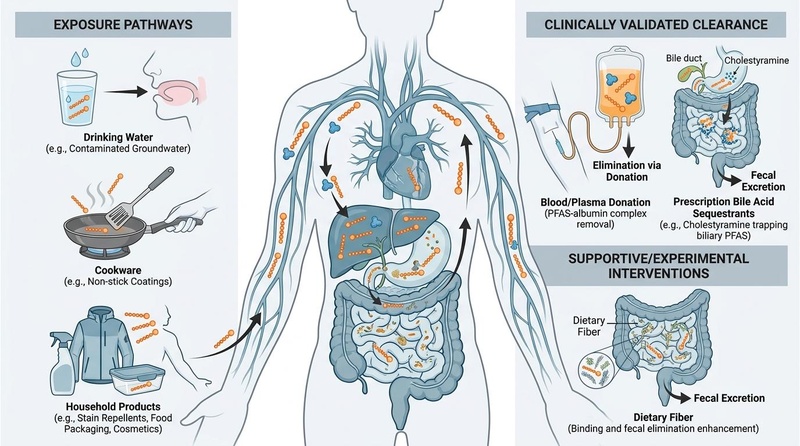
Figure 1: Pathophysiological pathways of PFAS bioaccumulation and clearance. Clinically validated systemic clearance is achieved via phlebotomy/plasmapheresis (removing protein-bound PFAS) or prescription bile acid sequestrants like cholestyramine (binding biliary PFAS in the intestinal tract to prevent reabsorption). Soluble dietary fiber serves as a supportive, experimental intervention to promote fecal excretion.
Major daily exposure pathways include:
- Drinking Water: Contamination of public and private water supplies is a primary route, particularly near industrial sites, military bases, and landfills.
- Non-Stick Cookware: Coatings on non-stick pans can release PFAS, especially when heated to high temperatures.
- Grease-Resistant Food Packaging: Fast food wrappers, microwave popcorn bags, and pizza boxes often contain PFAS to repel grease.
- Stain-Resistant Fabrics and Carpets: Furniture, clothing, and carpets treated for stain and water resistance are sources of PFAS exposure.
- Firefighting Foams: Aqueous film-forming foams (AFFF) used to extinguish petroleum fires have been a significant source of environmental and occupational PFAS contamination, particularly for firefighters.
- Air and Dust: Inhalation of indoor dust is another pathway for PFAS exposure. This mirrors the entry routes of other environmental hazards like PM2.5 and fine particles discussed in our Air Quality deep dive.
Similar to microplastics and nanoplastics, PFAS are widely distributed in modern environments, posing potential long-term threats to healthspan and cardiovascular health.