¶ Skin Barrier Repair, Hydration, and Texture
¶ TL;DR
- Optimal Skin Function: A healthy skin barrier is crucial for hydration, protection, and smooth texture.
- Key Interventions: Physiological lipid creams (3:1:1 ratio), humectants (glycerin, hyaluronic acid, urea), and occlusives (petrolatum) are foundationally effective.
- Advanced Treatments: Niacinamide and low-concentration urea can further enhance barrier function and texture.
- Oral Supplements: Phytoceramides and oral hyaluronic acid show promise for systemic hydration and barrier support.
- Avoid Over-Exfoliation: Harsh cleansers and excessive exfoliation can severely damage the skin barrier.
¶ Quick Answer
Skin barrier repair, hydration, and texture improvement are achieved by understanding the skin's natural protective mechanisms and supporting them with evidence-based interventions. This involves restoring the delicate balance of lipids in the stratum corneum, drawing and retaining moisture, and promoting healthy cellular turnover, leading to a resilient, supple, and smooth complexion.
¶ Type-Identification Table
This table helps distinguish between common skin concerns related to barrier function, hydration, and texture, guiding appropriate intervention strategies.
| Condition | Primary Characteristics | Underlying Biology |
|---|---|---|
| Acute Barrier Impairment | stinging, redness, flaking, tight after washing | Disruption of intercellular lipid matrix (ceramides, cholesterol, fatty acids) and corneocyte integrity. Elevated Trans-Epidermal Water Loss (TEWL). |
| Deep Dehydration (Xerosis) | crepey lines, dullness, tight but oily skin | Depletion of Natural Moisturizing Factors (NMF) like urea and amino acids. Impaired aquaporin function. Reduced water content in all epidermal layers. |
| Rough Texture/Hyperkeratinization | rough patches, congested pores, flaking without erythema | Impaired desquamation (shedding of dead skin cells) due to pH imbalance or enzyme dysfunction. Accumulation of corneocytes, leading to a thickened stratum corneum. |
¶ Evidence Snapshot Table (Human Outcomes)
This table summarizes key interventions, their clinical efficacy in human studies, and the strength of evidence supporting their use for skin barrier repair, hydration, and texture improvement.
| Intervention | Clinical Efficacy | Strength of Evidence | Citation |
|---|---|---|---|
| Topical Physiological Lipids (3:1:1 Ratio) | Accelerates barrier repair, reduces TEWL, improves atopic dermatitis symptoms. | High (RCTs) | [1], [2], [3] |
| Topical Glycerin | Significantly improves stratum corneum hydration, restores barrier function, reduces xerosis. | High (RCTs) | [4], [5], [6] |
| Topical Urea | Enhances hydration, reduces scaling, improves texture (low conc. 3-5%). Keratolytic (>10%). | High (RCTs) | [7], [8], [9] |
| Topical Niacinamide (2-5%) | Increases ceramide synthesis, reduces TEWL, improves barrier function, decreases sebum. | High (RCTs) | [10], [11] |
| Topical Petrolatum | Gold standard occlusive; dramatically reduces TEWL (up to 99%), promotes barrier repair. | High (RCTs) | [12], [13], [6:1] |
| Topical Hyaluronic Acid | Significantly increases skin hydration, improves surface texture, plumps skin. | Moderate (RCTs, observational) | [14], [15], [16] |
| Topical Nanocosmeceutical Carriers (SLN/NLC) | Achieves 2–5-fold enhanced skin deposition, sustained active release (24–72 h), and significant TEWL reduction. | Moderate (Pre-clinical and emerging clinical trials) | [17] |
| Oral Phytoceramides | Improves skin hydration and elasticity, reduces TEWL and dryness. | Moderate (RCTs) | [18], [19], [20] |
| Oral Hyaluronic Acid | Increases corneal water content, reduces TEWL, improves tactile roughness and dryness. | Moderate (RCTs) | [21], [22] |
| Raw Botanical Oils (e.g., Olive Oil) | May disrupt lipid lamellae and delay barrier recovery due to high oleic acid content. | Low / Insufficient human data | [3:1] |
¶ Causes Tied to Biology & Anatomy
The skin barrier is primarily formed by the stratum corneum (SC), the outermost layer of the epidermis. Its integrity relies on a "brick and mortar" structure:
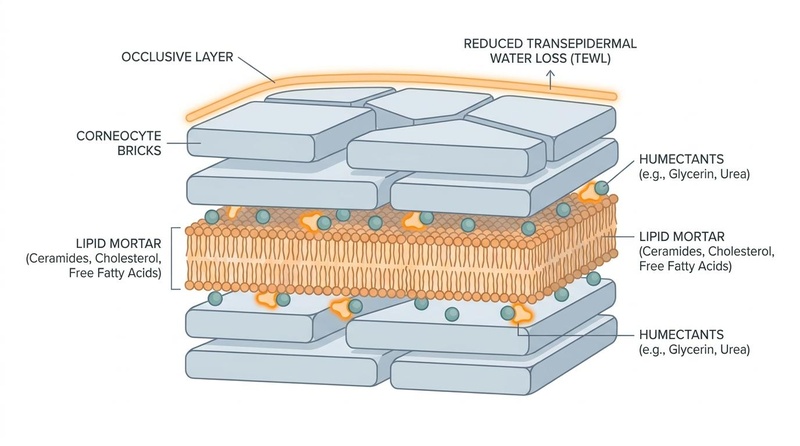
Figure 1: The Stratum Corneum Hydration and Barrier Repair Matrix: A visual representation of the 'brick-and-mortar' skin barrier, highlighting lipid lamellae restoration, humectant water binding, and occlusive-mediated TEWL reduction.
- Corneocytes (bricks): These are flattened, anucleated cells filled with keratin and surrounded by a tough protein envelope.
- Intercellular Lipid Matrix (mortar): A complex mixture of ceramides (50%), cholesterol (25%), and free fatty acids (15%) arranged in lamellar sheets, forming a hydrophobic seal that prevents water loss and protects against external aggressors [23], [3:2].
Key Biological Components and Their Role in Barrier Function:
- Natural Moisturizing Factors (NMF): Derived from the enzymatic degradation of filaggrin within corneocytes, NMFs are a cocktail of water-soluble compounds (amino acids, pyrrolidone carboxylic acid, urocanic acid, urea, lactate, salts) that attract and bind water, maintaining SC hydration [24], [25].
- Filaggrin Degradation: Filaggrin, a structural protein, undergoes precise enzymatic breakdown to form NMFs. Defective filaggrin production or accelerated degradation (e.g., due to genetic mutations or alkaline pH) leads to reduced NMF levels, impaired hydration, and increased TEWL, contributing to conditions like atopic dermatitis [24:1], [26].
- pH-Dependent Enzymes: The skin's slightly acidic surface pH (around 5.0) is crucial for the optimal activity of enzymes involved in lipid synthesis, corneocyte desquamation, and antimicrobial defense. Key enzymes like beta-glucocerebrosidase and acidic sphingomyelinase are vital for converting glucosylceramides into ceramides and sphingomyelin into ceramide, respectively, both essential processes for a healthy lipid matrix [17:1]. An elevated pH can inactivate these ceramide-synthesizing enzymes while activating serine proteases (kallikreins), leading to premature desquamation and barrier breakdown [27], [28].
- Tight Junctions: Located in the stratum granulosum, tight junctions form a selective barrier that regulates paracellular transport and complements the lipid matrix in maintaining epidermal integrity. These junctions are primarily composed of proteins such as claudins and occludins, which create a seal between keratinocytes, preventing uncontrolled passage of water and solutes and enhancing the overall barrier function [17:2], [29], [30].
¶ Starter Protocol
This foundational protocol focuses on gentle care and essential barrier-supporting ingredients.
- Gentle, pH-Balanced Cleanser (pH 5.5): Use a cleanser that respects the skin's natural acidic mantle. Avoid harsh sulfates and alkaline soaps that can strip lipids and elevate pH.
- Humectant Layer: Apply a serum or toner containing humectants like glycerin [4:1], [5:1] or hyaluronic acid [14:1], [15:1] to draw moisture into the skin.
- Physiological Lipid-Ratio Moisturizer (3:1:1): Use a moisturizer formulated with ceramides, cholesterol, and free fatty acids in a 3:1:1 molar ratio. This composition mimics the skin's natural lipid matrix, promoting efficient barrier repair [1:1], [2:1], [3:3].
¶ Stronger Add-On Path
For more persistent concerns or to accelerate results, consider incorporating these proven active ingredients.
- Niacinamide (2-5%): Apply a serum or cream with 2-5% niacinamide. This ingredient boosts the skin's natural production of ceramides, free fatty acids, and cholesterol, enhancing barrier function and reducing transepidermal water loss. It also has anti-inflammatory properties and can reduce sebum production, improving texture and pore appearance [10:1], [11:1].
- Low-Concentration Urea (3-5%): Incorporate a lotion or cream with 3-5% urea. At these concentrations, urea acts as a powerful humectant and mild keratolytic, increasing water content in the stratum corneum, facilitating healthy desquamation, and smoothing skin texture without irritation [7:1], [8:1], [9:1].
- Polyhydroxy Acids (PHAs): For gentle exfoliation and texture refinement, PHAs like gluconolactone or lactobionic acid are a milder alternative to AHAs, suitable for compromised barriers.
- Red Light Therapy: Integrating at-home red light (660nm) and near-infrared (850nm) photobiomodulation can improve skin barrier integrity, reduce inflammation, and accelerate the natural repair of the stratum corneum by stimulating mitochondrial ATP in dermal cells.
¶ Advanced Nanocarrier Delivery Systems (Nanocosmeceuticals)
Conventional topical formulations often suffer from poor skin penetration, restricted retention of active ingredients in target skin layers, and instability of active compounds [17:3]. Emerging nanocosmeceutical systems circumvent these limitations using engineered lipidic and polymeric structures:
- Nanocarrier Architectures:
- Liposomes and Niosomes: Lipid bilayer vesicles that fuse with stratum corneum lipids to enhance the solubility and absorption of both hydrophilic and lipophilic actives [17:4].
- Solid Lipid Nanoparticles (SLN) and Nanostructured Lipid Carriers (NLC): Solid-matrix lipid particles that provide controlled release and create an ultra-thin occlusive film on the skin surface, rapidly reducing TEWL [17:5].
- Nanoemulsions and Polymeric Nanoparticles: Sub-micron dispersions that achieve high kinetic stability, protect sensitive actives (e.g., Retinol, Vitamin C) from oxidation, and facilitate targeted intercellular or follicular penetration [17:6].
- Clinical Performance: Modern lipid-based nanocarriers demonstrate 2- to 5-fold enhanced skin deposition and sustain the release of therapeutic actives over a 24- to 72-hour window, significantly reducing inflammatory markers and restoring barrier homeostasis compared to traditional emulsions [17:7].
¶ Clinical/Procedure Path
For advanced concerns or when at-home care is insufficient, professional procedures can provide targeted results. Ensure the skin barrier is stable before pursuing these options.
- Skin Boosters (Injectable Hyaluronic Acid): Micro-injections of non-cross-linked hyaluronic acid into the dermis improve deep hydration, elasticity, and overall skin quality [14:2].
- Superficial Chemical Peels (e.g., Lactic Acid, Mandelic Acid): Mild peels can promote controlled exfoliation, improving texture and radiance. Selection and strength should be carefully chosen based on skin type and barrier integrity.
- Low-Density Non-Ablative Lasers: Lasers such as fractional non-ablative 1550nm Erbium-doped fiber lasers can stimulate collagen remodeling and improve texture with minimal downtime.
- Needleless Mesotherapy: When the barrier is stable, this technique uses devices to enhance transdermal delivery of active ingredients (e.g., hyaluronic acid, vitamins) for hydration and nutrient delivery.
¶ What Fails
Certain practices and product choices can actively harm the skin barrier, leading to worsened hydration and texture.
- Over-Exfoliation: Excessive use of physical scrubs, harsh chemical exfoliants (high-concentration AHAs/BHAs), or strong retinoids can strip away the stratum corneum, disrupt the lipid matrix, and compromise barrier function, leading to increased TEWL, redness, and sensitivity.
- Relying Solely on Heavy Occlusives Without Humectants: While occlusives like petrolatum are essential for preventing water loss [12:1], [6:2], using them without sufficient humectants can create a superficial seal without adequately hydrating the deeper layers of the stratum corneum, leading to a feeling of tightness underneath.
- Alkaline Soaps and Harsh Cleansers: Products with a high pH (typically >6.0-7.0) can disrupt the skin's acidic mantle, interfering with lipid-synthesizing enzymes and promoting the activity of proteases that degrade barrier components [27:1], [28:1].
- High-Strength Active Overuse: Introducing multiple high-strength active ingredients (e.g., multiple retinoids, strong acids) simultaneously or too frequently can overwhelm the skin's repair mechanisms, leading to irritation, inflammation, and barrier damage.
¶ Tracking Plan
Monitoring progress is essential for optimizing your skin barrier repair and hydration strategy.
¶ Objective Metrics
- Trans-Epidermal Water Loss (TEWL): Measured with a tewlometer, this indicates the integrity of the skin barrier. A decrease in TEWL signifies improved barrier function.
- Corneometry/Capacitance: Measures the electrical capacitance of the stratum corneum, directly correlating with its water content. Increased values indicate better hydration.
- Skin Surface pH: Measured with a pH meter, a return to the optimal acidic range (4.5-5.5) indicates restored enzymatic activity and barrier health.
¶ Subjective Assessments
- Tactile Evaluation: Regularly assess skin for smoothness, softness, and suppleness.
- Visual Inspection: Monitor for reductions in redness, flaking, scaling, and overall improvement in skin tone and radiance.
- Comfort Assessment: Note any decrease in sensations of tightness, itching, or stinging.
¶ Time-to-Benefit and Washout
- Initial Improvements: Often seen within 2-4 weeks for hydration and mild barrier repair.
- Significant Barrier Restoration: Can take 4-8 weeks of consistent, appropriate care.
- Texture Refinement: May require 6-12 weeks, especially for hyperkeratinization.
- Washout Period: If discontinuing an intervention, observe the skin for 2-6 weeks to determine if benefits were sustained or if the concern returns, indicating continued need.
¶ Safety & Red Flags
While most interventions for skin barrier repair are generally safe, it's crucial to be aware of potential issues and when to seek professional advice.
- Contact Dermatitis: New products can sometimes trigger allergic or irritant contact dermatitis, presenting as redness, itching, burning, or blistering. Discontinue use immediately if this occurs.
- Severe Barrier Dysfunction (Eczema, Psoriasis, Atopic Dermatitis): Individuals with pre-existing chronic inflammatory skin conditions should consult a dermatologist before initiating new extensive skincare regimens, as their barrier is severely compromised and requires specialized medical management.
- Persistent Redness or Irritation: If skin remains red, inflamed, or irritated despite a gentle routine, it may indicate an underlying condition or an intolerance to an ingredient, requiring professional evaluation.
- Worsening Symptoms: If dryness, flaking, or sensitivity worsens, or if new symptoms like pain, oozing, or signs of infection develop, seek medical attention.
¶ FAQs
Can enlarged pores be completely eliminated?
While enlarged pores cannot be completely eliminated, their appearance can be significantly minimized. Strategies focus on reducing sebum production (e.g., niacinamide), improving skin elasticity, and promoting healthy cellular turnover to prevent follicular congestion and visibly reduce pore size [11:2].
How long does it take to see results from barrier repair interventions?
Initial improvements in hydration and skin comfort can often be observed within 2-4 weeks of consistent use of appropriate barrier-supporting products. More significant and lasting improvements in barrier function and texture may take 4-12 weeks, as the skin needs time for cellular regeneration and lipid synthesis [10:2], [15:2].
Are physical scrubs effective for dull skin and uneven texture?
Physical scrubs can offer immediate superficial smoothness, but they carry a high risk of over-exfoliation and micro-tears, which can damage the skin barrier. For dull skin and uneven texture, chemical exfoliants like low-concentration urea or PHAs offer more controlled and gentle resurfacing with less risk to barrier integrity [7:2].
Can diet impact skin barrier health and hydration?
Yes, diet plays a significant role. Adequate intake of essential fatty acids (omega-3 and omega-6), vitamins (especially A, C, and E), and hydration is crucial for skin barrier integrity and overall skin health. A balanced diet supports the production of healthy lipids and collagen, contributing to a strong barrier and proper hydration. Oral phytoceramides and hyaluronic acid supplements can also provide systemic benefits [18:1], [21:1].
¶ References
Zettersten, E. M., et al. Optimal ratios of topical stratum corneum lipids improve barrier recovery in chronologically aged skin. Journal of the American Academy of Dermatology, 1997. https://pubmed.ncbi.nlm.nih.gov/9308554/ ↩︎ ↩︎
Chamlin, S. L., et al. Ceramide-dominant barrier repair lipids alleviate childhood atopic dermatitis: changes in barrier function and clinical severity. Pediatric Dermatology, 2002. https://pmc.ncbi.nlm.nih.gov/articles/PMC3070468/ ↩︎ ↩︎
Purnamawati, S., Indrastuti, N., & Danarti, R. The Role of Moisturizers in Addressing Various Kinds of Dermatitis: A Review. Clinical Medicine & Research, 2017. https://pmc.ncbi.nlm.nih.gov/articles/PMC5849435 ↩︎ ↩︎ ↩︎ ↩︎
Breternitz, M., et al. Placebo-controlled, double-blind, randomized prospective study of a glycerol-based emollient on eczematous skin in atopic dermatitis. Skin Pharmacology and Physiology, 2008. https://pubmed.ncbi.nlm.nih.gov/18025807/ ↩︎ ↩︎
Fluhr, J. W., et al. Glycerol accelerates recovery of barrier function in vivo. Acta Dermato-Venereologica, 1999. https://pubmed.ncbi.nlm.nih.gov/10598752/ ↩︎ ↩︎
Sethi, A., Kaur, T., & Dabas, A. Moisturizers: The Slippery Road. Indian Journal of Dermatology, 2016. https://pmc.ncbi.nlm.nih.gov/articles/PMC4885180 ↩︎ ↩︎ ↩︎
Celleno, L. Topical urea in skincare: A review. Dermatologic Therapy, 2018. https://onlinelibrary.wiley.com/doi/10.1111/dth.12690 ↩︎ ↩︎ ↩︎
Dall'Oglio, F., et al. Clinical evidences of urea at medium concentration. International Journal of Clinical Practice, 2020. https://onlinelibrary.wiley.com/doi/10.1111/ijcp.13815 ↩︎ ↩︎
Pan, X., et al. Evaluation of a 10% Urea Lotion for Xerosis: Clinical and Patient-Reported Outcomes from a Prospective Study. Journal of Cosmetic Dermatology, 2024. https://pmc.ncbi.nlm.nih.gov/articles/PMC12975674/ ↩︎ ↩︎
Tanno, O., Ota, Y., Kitamura, N., Katsube, T., & Inoue, S. Nicotinamide increases biosynthesis of ceramides as well as other stratum corneum lipids to improve the epidermal permeability barrier. British Journal of Dermatology, 2000. https://www.researchgate.net/publication/12351434_Niacinamide_increases_biosynthesis_of_ceramides_as_well_as_other_stratum_corneum_lipids_to_improve_the_epidermal_permeability_barrier ↩︎ ↩︎ ↩︎
Draelos, Z. D. The effect of 2% niacinamide on facial sebum production. Journal of Cosmetic and Laser Therapy, 2006. https://pubmed.ncbi.nlm.nih.gov/16766489/ ↩︎ ↩︎ ↩︎
Ghadially, R., et al. Effects of petrolatum on stratum corneum structure and function. Journal of the American Academy of Dermatology, 1992. https://www.sciencedirect.com/science/article/abs/pii/019096229270060S ↩︎ ↩︎
Czarnowicki, T., et al. Petrolatum: Barrier repair and antimicrobial responses underlying this "inert" moisturizer. Journal of Allergy and Clinical Immunology, 2016. https://www.jacionline.org/article/S0091-6749(15)01194-X/fulltext ↩︎
Bukhari, N. A., & Al-Dabbagh, H. K. Hyaluronic acid, a promising skin rejuvenating cosmeceutical: A review of cosmetic properties and clinical effects. International Journal of Biological Macromolecules, 2018. https://pubmed.ncbi.nlm.nih.gov/29372904 ↩︎ ↩︎ ↩︎
Robinson, C., et al. Multicenter evaluation of a topical hyaluronic acid serum. Journal of Cosmetic Dermatology, 2022. https://pubmed.ncbi.nlm.nih.gov/35833366/ ↩︎ ↩︎ ↩︎
Liposomal HA Study. Liposomal Hyaluronic Acid Enhances Skin Permeation and Hydration. PMC Journal, 2024. https://pmc.ncbi.nlm.nih.gov/articles/PMC12580642/ ↩︎
Shadab, A., & Ansari, A. F. Nanocosmeceutical innovations for chronic inflammatory skin disorders: bridging therapeutic efficacy, barrier restoration, and cosmetic outcomes. Journal of Biomaterials Science, Polymer Edition, 2026. https://pubmed.ncbi.nlm.nih.gov/42179087/ ↩︎ ↩︎ ↩︎ ↩︎ ↩︎ ↩︎ ↩︎ ↩︎
Bizot, M. N., et al. Improving Skin Hydration and Age-related symptoms by Oral Phytoceramides (Ceramosides). Cosmetics, 2017. https://www.orling.cz/uploads/files/ceramidy-glucosylceramides-skin-hydratation.pdf ↩︎ ↩︎
Hasegawa, T., et al. Oral intake of milk ceramides improves skin hydration, elasticity, and wrinkles: A randomized, double-blind, placebo-controlled trial. Journal of Functional Foods, 2024. https://www.sciencedirect.com/science/article/pii/S1756464624000100 ↩︎
Konjac, A., et al. Potential benefits of oral administration of Amorphophallus konjac glycosylceramides on skin health – a randomized clinical study. Pharmacognosy Research, 2020. https://pmc.ncbi.nlm.nih.gov/articles/PMC7076855 ↩︎
Dolečková, I., et al. Oral sodium hyaluronate improves skin hydration, barrier function and signs of aging: a randomized, double-blind, placebo-controlled trial in 150 healthy adults. Scientific Reports, 2025. https://www.nature.com/articles/s41598-025-32758-5 ↩︎ ↩︎
Oe, M., et al. Oral hyaluronan relieves wrinkles and improves dry skin: a 12-week double-blinded, placebo-controlled study. Clinical, Cosmetic and Investigational Dermatology, 2017. https://pmc.ncbi.nlm.nih.gov/articles/PMC8308347/ ↩︎
Madison, K. C. Barrier function of the skin: “la différence” resides in the epidermis. Journal of Investigative Dermatology, 2003. https://pubmed.ncbi.nlm.nih.gov/12839420 ↩︎
Sandilands, A., et al. Filaggrin in the frontline: role in skin barrier function and disease. Journal of Cell Science, 2009. https://pmc.ncbi.nlm.nih.gov/articles/PMC2721001 ↩︎ ↩︎
Rawlings, A. V., & Harding, C. R. Stratum corneum moisturization at the molecular level: an update. International Journal of Cosmetic Science, 2012. https://pubmed.ncbi.nlm.nih.gov/22462551 ↩︎
Kim, H. S., et al. Revisiting the Roles of Filaggrin in Atopic Dermatitis. International Journal of Molecular Sciences, 2020. https://pmc.ncbi.nlm.nih.gov/articles/PMC9140947 ↩︎
Cork, M. J., et al. Epidermal barrier dysfunction, the interstitial fluid, and atopic dermatitis. Journal of Allergy and Clinical Immunology, 2009. https://pubmed.ncbi.nlm.nih.gov/19344837 ↩︎ ↩︎
Lambers, H., et al. Natural skin surface pH is on average below 5, which is beneficial for its resident flora. International Journal of Cosmetic Science, 2006. https://pubmed.ncbi.nlm.nih.gov/18489300 ↩︎ ↩︎
Elias, P. M., & Menon, G. K. Structure and function of the epidermis related to barrier properties. Clinical Dermatology, 2012. https://pubmed.ncbi.nlm.nih.gov/22421111 ↩︎
Proksch, E., et al. Bathing in a magnesium-rich Dead Sea salt solution improves skin barrier function, enhances skin hydration, and reduces inflammation in atopic dry skin. International Journal of Dermatology, 2008. https://pubmed.ncbi.nlm.nih.gov/15689218 ↩︎