¶ Red Light Therapy for Skin and Hair
Red light therapy, also known as photobiomodulation (PBM), harnesses specific wavelengths of red and near-infrared (NIR) light to stimulate cellular functions in the skin and hair follicles. This non-invasive modality supports various aesthetic goals, including wrinkles and skin elasticity rejuvenation, preventing and minimizing scars, and reversing hair loss. The therapeutic effects stem from light absorption by mitochondrial chromophores, primarily cytochrome c oxidase, leading to increased ATP production, modulation of reactive oxygen species, and activation of signaling pathways that promote cell proliferation, collagen synthesis, and anti-inflammatory responses [1][2].
¶ TL;DR
- Wavelengths Matter: Red light (630-670nm) is effective for superficial skin issues, while Near-Infrared (810-850nm) penetrates deeper for hair follicles and deeper skin layers [1:1][3].
- Dosing is Key: Optimal therapeutic effects are dose-dependent, with typical energy densities ranging from 1-10 J/cm² for superficial applications and higher for deeper targets. Both too little and too much light can reduce efficacy [4][2:1].
- Consistency is Crucial: Regular, consistent treatments are more effective than infrequent, high-intensity sessions.
- Skin Rejuvenation: PBM can reduce periocular wrinkles by up to 30%, improve skin texture, and promote collagen synthesis [5][6].
- Hair Loss: Effective for androgenetic alopecia, stimulating hair growth, increasing hair density and diameter, and inhibiting local DHT production [7][8][9][10][11].
- Scars: Shows promise in improving the appearance and healing of various scars, including post-surgical and hypertrophic scars [2:2].
- Eye Safety: Always use appropriate eye protection during treatment, especially with higher-powered devices.
- Device Selection: LED-based devices are suitable for broad-area treatment and home use; laser-based systems offer precise targeting for specific clinical applications [3:1].
¶ Quick Answer
Red light therapy (photobiomodulation) utilizes specific red (630-670nm) and near-infrared (810-850nm) wavelengths to stimulate cellular repair and regeneration. For skin rejuvenation, it promotes collagen production and reduces fine lines, such as periocular wrinkles, with studies showing reductions of up to 30% [5:1][3:2]. For hair loss, particularly androgenetic alopecia, PBM stimulates hair follicles, increases hair density and diameter, and can inhibit dihydrotestosterone (DHT) production [7:1][8:1]. Effective treatment involves consistent sessions (e.g., 3-5 times per week) with appropriate dosing (e.g., 1-10 J/cm² for skin, higher for hair) and adherence to eye safety protocols. Device selection should consider the target area and desired depth of penetration, with LEDs for broader coverage and lasers for more targeted applications [4:1][1:2][2:3].
¶ Candidate Fit
Red light therapy is suitable for individuals seeking non-invasive aesthetic improvements for:
- Skin Aging: Fine lines, wrinkles, skin laxity, and overall texture improvement (see Wrinkles and Skin Elasticity and Skin Barrier Repair, Hydration, and Texture).
- Hair Thinning/Loss: Androgenetic alopecia (male and female pattern hair loss) (see Reversing Hair Loss).
- Scar Management: Improving the appearance of new and existing scars (see Preventing and Minimizing Scars).
- General Skin Health: Enhancing skin tone, reducing inflammation, and promoting wound healing (see Collagen, Hyaluronic Acid, and GHK-Cu for Skin).
¶ Evidence Snapshot
| Outcome | Evidence Grade | Key Findings | Citation |
|---|---|---|---|
| Periocular Wrinkle Volume | Moderate | Randomized controlled trial showed a 30% reduction in periocular wrinkle volume with PBM [5:2]. | [5:3] |
| Hair Density & Diameter | Moderate | Double-blind randomized controlled studies indicate significant improvements in hair density and diameter in androgenetic alopecia with dual-wavelength low-level light therapy [7:2][9:1]. Murine studies show metabolic shifts in hair follicles with red light [11:1]. | [7:3][9:2][11:2] |
| Collagen Synthesis | Moderate | Red and NIR light promote fibroblast proliferation and enhance collagen synthesis, contributing to skin rejuvenation [3:3][6:1]. Wunsch et al. documented a highly significant increase in intradermal collagen density [12]. | [3:4][6:2][12:1] |
| DHT Production Inhibition | Emerging | In vitro studies suggest dual wavelength LEDs can induce reactive oxygen species and nitric oxide to inhibit 5-alpha reductase activity, thus lowering DHT production [8:2][13]. | [8:3][13:1] |
| Scar Improvement | Emerging | PBM contributes to improved wound healing and may enhance the aesthetic outcome of scars by modulating inflammatory responses and collagen remodeling [2:4]. | [2:5] |
¶ How It Works: The Science of Photobiomodulation
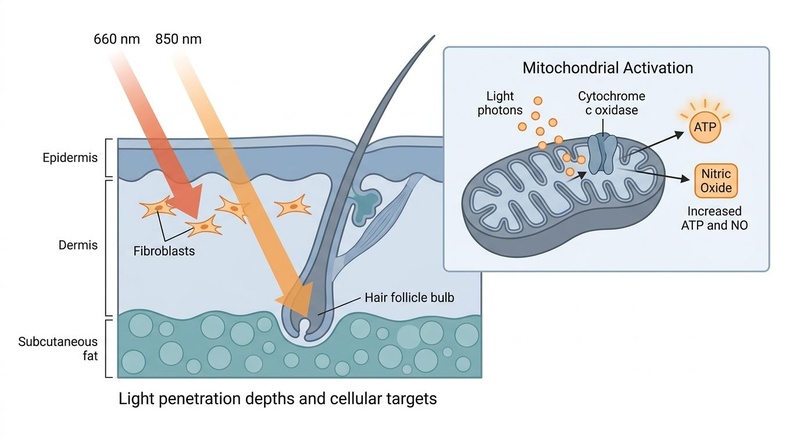
Red light therapy operates on the principle of photobiomodulation, where specific light photons are absorbed by photoreceptors within cells, particularly cytochrome c oxidase (CCO) in the mitochondria [1:3]. This absorption initiates a cascade of intracellular events:
- Mitochondrial Activation: Light absorption by CCO leads to increased mitochondrial activity, enhancing the electron transport chain and boosting adenosine triphosphate (ATP) production. ATP is the primary energy currency of the cell, fueling repair and regeneration processes [1:4][11:3].
- Nitric Oxide Release: PBM can trigger the release of nitric oxide (NO) from CCO, improving local blood flow and promoting vasodilation, which in turn enhances nutrient and oxygen delivery to tissues [8:4].
- Modulation of Reactive Oxygen Species (ROS): While high levels of ROS are damaging, low, transient levels induced by PBM can act as signaling molecules, activating transcription factors that upregulate protective and reparative genes, including those involved in antioxidant defenses [8:5].
- Anti-inflammatory Effects: PBM helps reduce inflammation by modulating inflammatory mediators and promoting the resolution of inflammation, which is beneficial for skin conditions, wound healing, and hair follicle health [2:6].
- Enhanced Collagen and Elastin Production: In the skin, red and NIR light stimulate fibroblasts, leading to increased synthesis of collagen and elastin, crucial proteins for skin firmness, elasticity, and wrinkle reduction [3:5][6:3].
- Hair Follicle Stimulation: In hair follicles, PBM extends the anagen (growth) phase, reduces the telogen (resting) phase, and promotes the proliferation of dermal papilla cells, leading to increased hair density and diameter [9:3][11:4][13:2].
¶ Wavelengths, Dose, Distance, and Consistency
Optimizing red light therapy requires attention to specific parameters:
-
Wavelengths:
- Red Light (630-670nm): Ideal for superficial skin issues, penetrating approximately 2-3mm into the tissue. Common wavelengths include 630nm, 660nm, and 670nm. Effective for collagen production, fine lines, and superficial wound healing [1:5][3:6].
- Near-Infrared (NIR) Light (810-850nm): Penetrates deeper, up to 5-10mm, reaching the subcutaneous tissue and hair follicles. Common wavelengths include 810nm, 830nm, and 850nm. Beneficial for deeper skin rejuvenation, scar reduction, and hair growth stimulation [1:6][3:7].
- Dual Wavelength Combinations: Devices often combine red and NIR wavelengths to achieve both superficial and deep tissue effects, providing comprehensive treatment [7:4][8:6].
-
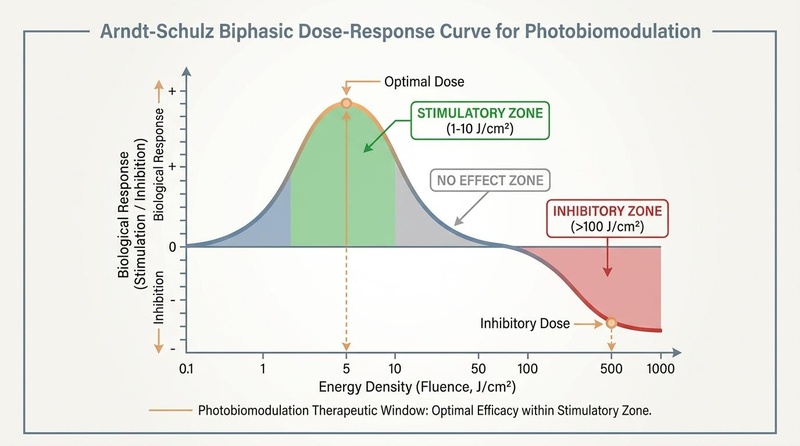
Dose (Energy Density): Measured in Joules per square centimeter (J/cm²), this is a critical parameter. There is a biphasic dose-response, meaning too little or too much energy can be less effective.
-
Skin Rejuvenation: Typically ranges from 1-10 J/cm² per session [5:4][2:7].
-
Hair Growth: Often requires higher doses, sometimes up to 30-50 J/cm² per session, depending on the device and target area [7:5][9:4].
-
Power Density (Irradiance): Measured in milliwatts per square centimeter (mW/cm²), this refers to the power delivered to the skin surface. Higher power density allows for shorter treatment times to achieve the desired energy density.
-
Distance: The distance from the light source to the skin directly impacts the power density and effective dose. Closer distances result in higher power density and shorter treatment times. Follow device-specific recommendations, but generally, 3-6 inches is a common range for direct exposure.
-
Consistency: Regular and consistent application is paramount for achieving and maintaining results.
- Frequency: Most protocols suggest 3-5 sessions per week.
- Duration: Each session typically lasts 10-20 minutes, depending on the device’s power output and the target dose.
- Realistic Timelines: Noticeable improvements for skin rejuvenation often take 8-12 weeks, while significant hair growth can take 6-12 months of consistent use [7:6][9:5].
¶ Sex and Age-Specific Responses
Biomedical studies indicate that individual responses to photobiomodulation are significantly shaped by age-associated cellular baselines and sex-specific tissue characteristics:
¶ Age-Associated Variations
- Younger Skin (Ages 18–35): Fibroblasts in younger skin are highly metabolically active and maintain dense extracellular networks. In this population, PBM primarily acts as a preventative modality, protecting cells against oxidative stress, supporting mitochondrial resilience, and accelerating recovery from acute injuries or acne lesions [1:7].
- Aging Skin (Ages 60+): With advanced age, fibroblasts undergo partial senescence and exhibit a slower metabolic rate, leading to a thinner dermis and lower native collagen density. Older skin requires consistent, long-term stimulation. While the absolute regenerative potential is lower than in younger cohorts, older adults often see the most clinically visible benefits from PBM due to the upregulation of dormant dermal collagen-producing genes [12:2].
- Hair Follicles: In older adults, age-related hair thinning (senescent alopecia) involves capillary network depletion. NIR light (850nm) targets the deep subcutaneous boundary of hair bulbs, encouraging capillary expansion and extending follicle survival independent of androgenic sensitivity [11:5][13:3].
¶ Sex-Specific Differences
- Dermal Thickness: Male skin is histologically thicker (by approximately 20–25%) than female skin and contains a denser collagen matrix. Due to this thickness, male skin may require slightly higher irradiance or closer proximity to the light source to deliver an equivalent effective dose to deep dermal fibroblasts.[1:8][2:8]
- Adipose Distribution: Female skin features a different subcutaneous fat structure, which allows NIR wavelengths to penetrate deeply but can distribute thermal energy differently. In hair restoration protocols, women with FPHL show excellent compliance and high satisfaction with lower-irradiance devices, whereas men with advanced AGA frequently require higher power thresholds combined with topical antiandrogens.[7:7][9:6]
¶ Starter Protocol
For general skin and hair health, a basic protocol can be implemented:
- Device: High-quality LED panel or handheld device offering both red (e.g., 660nm) and NIR (e.g., 850nm) wavelengths.
- Frequency: 3-5 times per week.
- Duration: 10-15 minutes per target area.
- Distance: 6-12 inches from the skin.
- Eye Safety: Always wear protective eyewear during treatment.
- Clean Skin: Ensure skin is clean and free of heavy makeup or sunscreen before treatment.
¶ Stronger Add-On Path
To enhance results, consider integrating PBM with other modalities:
- Topical Serums: Apply serums containing hyaluronic acid, vitamin C, or peptides after red light therapy to maximize absorption and synergistic effects on skin rejuvenation. See Collagen, Hyaluronic Acid, and GHK-Cu for Skin and Skin Barrier Repair, Hydration, and Texture for optimized topical formulations.
- Microneedling: Combining PBM with microneedling can enhance collagen induction and product penetration for both skin and hair applications.
- Hair Growth Topicals: Use PBM in conjunction with reversing hair loss protocols, minoxidil, or other physician-prescribed hair growth treatments for additive benefits [9:7].
¶ Clinical/Procedure Path
For more advanced needs or in-clinic treatments:
- High-Power Medical Devices: Dermatologists and aesthetic clinics use higher-powered PBM devices (e.g., medical-grade LED panels or low-level lasers) to deliver precise, higher doses for conditions like severe hair loss, significant scarring, or advanced skin rejuvenation.
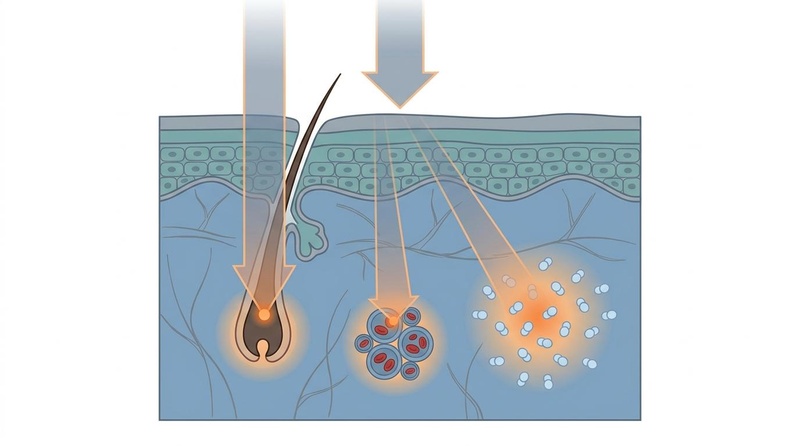
- Combination Therapies: PBM is often integrated into broader clinical protocols alongside chemical peels, ablative lasers, or injectables to optimize healing, reduce downtime, and enhance overall outcomes [2:9].
- Targeted Treatment for Scars: For specific scars (e.g., hypertrophic or keloid), PBM can be part of a multi-modal approach including silicone sheets, steroid injections, or fractional lasers [2:10].
¶ Common Failure Modes
- Inconsistent Use: Irregular application is the most common reason for lack of results.
- Incorrect Dosing: Using too low a dose for insufficient stimulation or too high a dose leading to inhibitory effects (biphasic response).
- Inadequate Wavelengths: Using only red light for deep hair follicle issues, or only NIR for superficial skin texture.
- Poor Device Quality: Low-powered or ineffective devices that do not deliver sufficient energy.
- Unrealistic Expectations: Expecting immediate or dramatic results within a short timeframe.
- Lack of Eye Protection: Neglecting eye safety can lead to discomfort or potential damage, particularly with powerful devices.
¶ Tracking Plan
- Baseline Photos: Take clear, well-lit photos of the target area (face, scalp, scars) at the start of treatment.
- Monthly Progress Photos: Re-take photos monthly under similar lighting and angles to track subtle changes.
- Subjective Assessment: Keep a journal to note improvements in skin texture, hair thickness, or scar appearance.
- Hair Count/Density (for hair loss): For clinical trials, objective measurements like hair count per square centimeter or hair diameter provide quantitative data [7:8].
¶ Safety and Red Flags
- Ocular Safety: While red and NIR light are non-ionizing, direct ocular exposure to high-intensity coherent or incoherent sources can induce thermal or photochemical retinal injury. Opaque or waveband-specific protective goggles are required during high-irradiance facial treatments [2:11].
- Thermal/Sensation Monitoring: High-fluence LED panels or laser arrays can produce localized thermal emission. Discontinue irradiation if skin surface temperature exceeds comfortable therapeutic limits.
- Skin Photosensitivity: Prior use of photosensitizing agents (e.g., topical retinoids, systemic amiodarone, or tetracyclines) represents a relative contraindication, potentially amplifying the risk of acute erythema or post-inflammatory hyperpigmentation.
- Contraindicated Tissues: Active cutaneous malignancies, undiagnosed pigmented lesions, or direct irradiation over the thyroid gland or gravid uterus should be avoided due to the mitotic and systemic metabolic signaling effects of photobiomodulation.
- Clinical Indicators for Cessation: The emergence of atypical inflammatory responses, hyperpigmentation, or persistent localized erythema indicates a need to reassess dosimetry and treatment parameters.
¶ FAQs
¶ Q: How long does it take to see results with red light therapy?
A: For skin rejuvenation, visible improvements often begin around 8-12 weeks. For hair growth, it typically takes 6-12 months of consistent use to see significant changes in density and thickness [7:9][9:8].
¶ Q: Can red light therapy cause eye damage?
A: While generally safe, direct exposure to high-intensity red or NIR light can potentially harm the eyes. Always wear protective eyewear specifically designed for red light therapy during sessions [2:12].
¶ Q: What is the ideal distance for red light therapy?
A: The ideal distance depends on the device's power output. For most home devices, 3-6 inches from the skin is common. Always refer to your device's instructions for specific recommendations to ensure proper dosing.
- Q: Can I use red light therapy every day?
A: Most protocols suggest 3-5 sessions per week, allowing for rest days. Daily use may be acceptable for some low-power devices, but consistency is more important than daily application. Refer to device specifications or clinical guidelines for detailed parameters.
¶ Q: Is there a difference between red light and near-infrared light?
A: Yes. Red light (e.g., 630-670nm) penetrates superficially, primarily targeting the epidermis and dermis for surface skin issues. Near-infrared (NIR) light (e.g., 810-850nm) penetrates deeper, reaching subcutaneous tissues and hair follicles for more profound cellular effects [1:9][3:8].
¶ References
Ziveh T, Arjmand B, Razzaghi Z, Hossein-Khannazer N. Biological and Therapeutic Responses of Human Skin to Different Wavelengths of Light: A Comprehensive Review. Journal of Lasers in Medical Sciences. 2025. https://pubmed.ncbi.nlm.nih.gov/41789284/ ↩︎ ↩︎ ↩︎ ↩︎ ↩︎ ↩︎ ↩︎ ↩︎ ↩︎ ↩︎
Mineroff J, Maghfour J, Ozog DM, et al. Photobiomodulation CME Part II: Clinical Applications in Dermatology. Journal of the American Academy of Dermatology. 2024. https://pubmed.ncbi.nlm.nih.gov/38307144/ ↩︎ ↩︎ ↩︎ ↩︎ ↩︎ ↩︎ ↩︎ ↩︎ ↩︎ ↩︎ ↩︎ ↩︎ ↩︎
Guo Z, Yuan K. The Application of Light Emitting Led (LED) in Cosmetic Dermatology. Photodermatology, Photoimmunology & Photomedicine. 2025. https://pubmed.ncbi.nlm.nih.gov/40751922/ ↩︎ ↩︎ ↩︎ ↩︎ ↩︎ ↩︎ ↩︎ ↩︎ ↩︎
Maghfour J, Mineroff J, Ozog DM, et al. Evidence-based consensus on the clinical application of photobiomodulation. Journal of the American Academy of Dermatology. 2025. https://pubmed.ncbi.nlm.nih.gov/40253006/ ↩︎ ↩︎
Mota LR, Duarte IDS, Galache TR, et al. Photobiomodulation Reduces Periocular Wrinkle Volume by 30%: A Randomized Controlled Trial. Photobiomodulation, Photomedicine, and Laser Surgery. 2023. https://pubmed.ncbi.nlm.nih.gov/36780572/ ↩︎ ↩︎ ↩︎ ↩︎ ↩︎
Barolet D, Roberge CJ, Auger FA. Regulation of skin collagen metabolism in vitro using a pulsed 660 nm LED light source: clinical correlation with a single-blinded study. The Journal of Investigative Dermatology. 2009. https://pubmed.ncbi.nlm.nih.gov/19587693/ ↩︎ ↩︎ ↩︎ ↩︎
Thomas M, Stockslager M, Oakley J, Womble TM, Sinclair R. Clinical Safety and Efficacy of Dual Wavelength Low-Level Light Therapy in Androgenetic Alopecia: A Double-Blind Randomized Controlled Study. Dermatologic Surgery. 2025. https://pubmed.ncbi.nlm.nih.gov/39679573/ ↩︎ ↩︎ ↩︎ ↩︎ ↩︎ ↩︎ ↩︎ ↩︎ ↩︎ ↩︎
Kocher J, Jandick N, Spragion D, et al. Dual Wavelength LEDs Induce Reactive Oxygen Species and Nitric Oxide That Inhibit the Production of Dihydrotestosterone by 5-α Reductase. Journal of Biophotonics. 2025. https://pubmed.ncbi.nlm.nih.gov/39667415/ ↩︎ ↩︎ ↩︎ ↩︎ ↩︎ ↩︎ ↩︎
Tantiyavarong J, Charoensuksira S, Meephansan J, et al. Red and Green LED Light Therapy: A Comparative Study in Androgenetic Alopecia. Photodermatology, Photoimmunology & Photomedicine. 2024. https://pubmed.ncbi.nlm.nih.gov/39368074/ ↩︎ ↩︎ ↩︎ ↩︎ ↩︎ ↩︎ ↩︎ ↩︎ ↩︎
Cho EH, An J, Chi Y, et al. Wearable textile-based phototherapy platform with customized NIR OLEDs toward non-invasive hair loss treatment. Nature Communications. 2026. https://pubmed.ncbi.nlm.nih.gov/41519867/ ↩︎
Xu S, Wang A, Lin Y, et al. FLIM Reveals Red Light-Induced Changes in Murine Hair Follicles. Biosensors. 2026. https://pubmed.ncbi.nlm.nih.gov/42187428/ ↩︎ ↩︎ ↩︎ ↩︎ ↩︎ ↩︎
Wunsch A, Matuschka K. A controlled trial to determine the efficacy of red and near-infrared light treatment in patient satisfaction, reduction of fine lines, wrinkles, skin roughness, and intradermal collagen density increase. Photomedicine and Laser Surgery. 2014. https://pubmed.ncbi.nlm.nih.gov/24286286/ ↩︎ ↩︎ ↩︎
Ren Y, Miao X, Jiang H. Photobiomodulation mitigates DHT-induced apoptosis in dermal papilla cells via mitochondrial rescue and Wnt/TGF-β/BMP signaling modulation. Journal of Photochemistry and Photobiology. B, Biology. 2025. https://pubmed.ncbi.nlm.nih.gov/40618686/ ↩︎ ↩︎ ↩︎ ↩︎