¶ P-21
| Sequence | Ac-DGGLAG-NH2 |
| Formula | C30H54N6O5 |
| Molar Mass | 578.3 g/mol |
| Category | Neurotrophic Peptide Mimetic |
| Half-life | >3 hours (plasma in mice) |
| Admin | Subcutaneous, Intranasal (Preclinical/Anecdotal) |
| FDA Status | Research Chemical (Unapproved) |
| CAS | Not Officially Assigned |
P-21 (also known as P021) is a synthetic peptide mimetic derived from Ciliary Neurotrophic Factor (CNTF) designed to promote neurogenesis and cognitive function. It aims to overcome the limitations of full-length CNTF, such as poor blood-brain barrier penetration and adverse side effects, by stimulating neural growth and synaptic plasticity with an improved safety profile. It is primarily under preclinical investigation for its potential in Alzheimer's disease and cognitive enhancement.
¶ At a glance
Aliases
- Also known as: P021, Peptide 021.
- Amino acid sequence: Ac-Asp-Gly-Gly-Leu-AdamantylGlycine-NH2 (Ac-DGGLAG-NH2).
- Sequence length: Tetrapeptide (four amino acids, plus adamantane modification).
- Category: Neurotrophic factor mimetic, neurogenic peptide.
Key points (high-level summary)
- P-21 robustly stimulates neurogenesis and synaptic plasticity by modulating LIF signaling and upregulating BDNF expression, showing promise in preclinical models of cognitive decline[1][2].
- In animal models of Alzheimer's disease and healthy aging, P-21 has demonstrated significant cognitive rescue and neuroprotective effects, including reduction of Tau pathology[1:1][3].
- It avoids the anorectic and immunogenic side effects observed with full-length CNTF, possessing a favorable safety profile in rodent studies[2:1].
- P-21 is an unapproved research chemical with no completed human clinical trials, meaning all efficacy and safety data are preclinical or anecdotal.
What people use it for
- Main goals: Cognitive enhancement (memory, processing speed), neuroprotection, recovery from Traumatic Brain Injury (TBI), and potential prevention/treatment of age-related cognitive decline.
- Evidence quality (overall): Low (Strong preclinical data in rodent models; no human clinical trials).
¶ Legal & regulatory status
⚠️ CRITICAL INFORMATION
Regulatory classification
- FDA status: P-21 is an unapproved research chemical. It has not been evaluated by the FDA for safety or efficacy in humans.
- Approved indications (if any): None. P-21 is strictly for research purposes.
- Prescription requirement: Not available for human use; legally sold for laboratory research only.
- DEA schedule: Not scheduled.
Geographic legal status
- United States: Legally sold as a research chemical, but illegal for human consumption or unapproved compounding.
- European Union: Similar restrictions; generally considered a research chemical.
- Other regions: Varies, but typically unapproved for human use.
Sports and competition
- WADA status: Not explicitly listed but may fall under general bans on peptide hormones or growth factors depending on interpretation.
- Athletic organization bans: Athletes should consult relevant anti-doping authorities.
Source quality considerations
- Pharmaceutical vs research chemical grade: P-21 is primarily available as research-grade from chemical suppliers, which may vary widely in purity and consistency.
- Third-party testing importance: Highly recommended to verify purity and identity, including the presence of the adamantane moiety.
- Common purity/contamination issues: Impurities, incorrect peptide sequences, or degraded products are risks in unregulated markets.
- Counterfeit concerns: High risk due to unregulated status and demand for cognitive enhancers.
¶ What is P-21?
P-21 is a synthetic tetrapeptide (four amino acids) derived from the active site (residues 148–151) of human Ciliary Neurotrophic Factor (CNTF). It was developed to specifically target CNTF's neurotrophic properties while improving its pharmacological profile.
- Definition: Ac-Asp-Gly-Gly-Leu-AdamantylGlycine-NH2 (Ac-DGGLAG-NH2). It is a highly stable, blood-brain barrier penetrant peptide.
- Relationship to endogenous peptides: It is a mimetic of CNTF, an endogenous cytokine that supports neuron survival and differentiation. P-21 mimics CNTF's neurogenic effects without its systemic side effects[2:2].
- Modifications from native sequence: The key modification is the addition of an adamantane group to the C-terminal glycine, which significantly enhances its lipophilicity, stability, and ability to cross the blood-brain barrier (BBB) and resist enzymatic degradation[2:3].
- Natural sources (if any): P-21 is purely synthetic; it does not occur naturally.
- Development history: Developed by Dr. Khalid Iqbal's laboratory following epitope mapping of CNTF, aiming to create a stable, BBB-permeable neurotrophic compound for Alzheimer's research[4].
- Key pharmacological property: It acts as a neurogenic and neurotrophic agent, primarily by modulating LIF signaling and upregulating BDNF[1:2].
¶ What are P-21's main benefits?
Note: The following benefits are based on high-quality rodent studies (Tier 2 evidence). Human efficacy has not been confirmed in clinical trials.
¶ Neurogenesis and Synaptic Plasticity
P-21 consistently promotes the proliferation and differentiation of neural progenitor cells in the dentate gyrus of the hippocampus, a critical region for memory. This leads to increased neurogenesis and enhanced synaptic connections.
- Outcome: Increased neurogenesis, enhanced synaptic plasticity.
- Direction of effect: ↑↑↑ (p)
- Magnitude: Large; restored neurogenesis to young adult levels in aged rats[5].
- Population studied: Aged rats, triple-transgenic Alzheimer's mice.
- Evidence quality: Moderate (Consistent preclinical data, but no human trials).
- Summary sentence: P-21 significantly boosts the formation of new neurons and strengthens synaptic connections, restoring brain plasticity in preclinical models of aging and neurodegeneration.
¶ Alzheimer's Disease and Neuroprotection
In models of Alzheimer's disease, P-21 has shown promising results in mitigating core pathologies and improving cognitive function.
- Outcome: Reduced Tau hyperphosphorylation, decreased amyloid-beta levels (soluble and plaque), improved spatial and episodic memory.
- Direction of effect: ↓↓↓ (p) for Tau and Aβ pathology; ↑↑↑ (p) for cognitive function.
- Magnitude: Large; reversed cognitive deficits and reduced pathological markers[1:3][3:1].
- Population studied: 3xTg-AD (triple-transgenic Alzheimer's) mice.
- Evidence quality: Moderate (Extensive and consistent preclinical data, but no human trials).
- Summary sentence: P-21 effectively reduces key Alzheimer's pathologies like Tau tangles and amyloid-beta plaques while reversing cognitive decline in animal models.
¶ Cognitive Enhancement in Normal Aging
Even in the absence of overt pathology, P-21 has demonstrated potential for improving cognitive function in healthy aging models.
- Outcome: Improved discrimination learning, enhanced spatial memory.
- Direction of effect: ↑↑ (p)
- Magnitude: Moderate; restored cognitive performance to younger levels[5:1].
- Population studied: Aged Fisher rats.
- Evidence quality: Low (Consistent preclinical data, but no human trials).
- Summary sentence: P-21 may enhance learning and memory in healthy aging by promoting hippocampal neurogenesis and synaptic function.
Evidence summary table (human outcomes)
| Outcome / Goal | Effect* | Consistency** | Evidence quality | Trials*** | Notes (population, duration, dose) |
|---|---|---|---|---|---|
| Neurogenesis / Synaptic Plasticity | N/A | Very low | 0 | Insufficient human data; strong preclinical evidence[1:4][2:4] | |
| Alzheimer's Disease Pathology | N/A | Very low | 0 | Insufficient human data; strong preclinical evidence[1:5][3:2] | |
| Cognitive Enhancement | N/A | Very low | 0 | Insufficient human data; strong preclinical evidence[5:2] |
- *Effect: Number of arrows (1-3) indicates magnitude. Direction: ↑ (increase), ↓ (decrease), = (no effect), ? (unclear). Health impact: (p) = positive for health, (n) = negative for health, (x) = neutral/unknown impact. Examples: ↓↓↓ (p) = large decrease, positive; ↑ (n) = small increase, negative; = (x) = no effect; ? = unclear.
- **Consistency: Low (results conflict), Moderate (mixed but leaning one way), High (most trials agree)
- ***Trials: Number of RCTs or total trials informing this outcome (shows evidence depth at a glance)
- REQUIRED: You MUST include a citation key (e.g.
[^1]) in the "Notes" column for every single row. If you claim a result, you must link the specific Meta-Analysis or Key RCT that proves it.
¶ How does P-21 work?
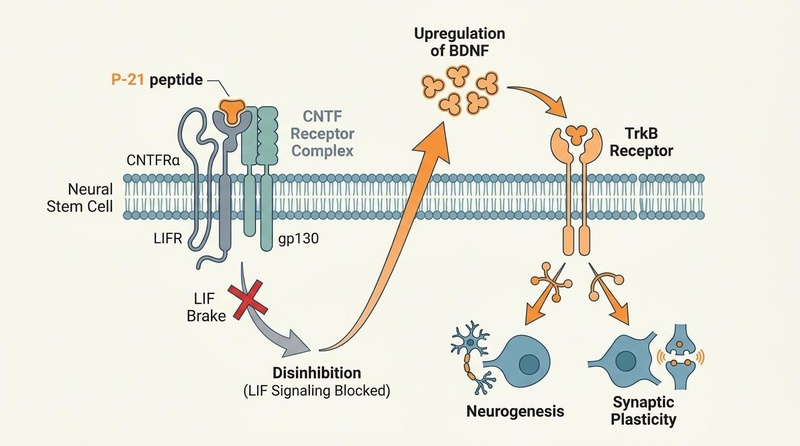
P-21 acts as a neurogenic and neurotrophic compound primarily through the modulation of the CNTF receptor complex, leading to a "disinhibition" of neurogenesis rather than direct agonism.
- Primary targets: The CNTF receptor complex (specifically modulating LIF signaling) and indirectly upregulating BDNF-TrkB signaling.
- Core mechanisms:
- LIF Signaling Modulation: P-21 competitively inhibits Leukemia Inhibitory Factor (LIF) signaling. LIF normally acts as a brake on neural progenitor cell proliferation. By blocking this inhibitory signal, P-21 effectively "releases the brake," thereby promoting neurogenesis[6].
- BDNF Upregulation: The inhibition of LIF signaling leads to a compensatory increase in the expression of Brain-Derived Neurotrophic Factor (BDNF). BDNF then binds to its TrkB receptors.
- Intracellular Signaling Cascades: Activation of the BDNF/TrkB pathway initiates the PI3K-Akt signaling cascade. This leads to the phosphorylation and inhibition of Glycogen Synthase Kinase-3β (GSK-3β). Inhibition of GSK-3β is critical as active GSK-3β promotes Tau hyperphosphorylation (a hallmark of Alzheimer's disease) and cellular apoptosis. This pathway also enhances the expression of synaptic proteins, promoting synaptic plasticity[1:6][3:3].
- Evidence source:
- Human data (if any): No direct human mechanistic trials for P-21.
- Animal / in vitro data: Extensive data from rodent models and cell cultures strongly support these mechanisms[1:7][3:4][2:5][5:3].
- Pharmacokinetics:
- Half-life: The adamantane modification provides significant protection against peptidase degradation, extending its plasma half-life to over 3 hours in mice[2:6].
- Bioavailability by route: Due to its lipophilic adamantane group, P-21 exhibits good BBB penetration. Subcutaneous administration is effective, and intranasal delivery is also used, though with potentially lower bioavailability.
- Peak plasma concentration: Not well-documented in humans; preclinical data suggests rapid absorption.
- Metabolism/degradation: Protected from rapid degradation by exopeptidases due to the adamantane and N-terminal acetylation.
- Major PK issues: While improved, complete resistance to degradation is not achieved, and frequent dosing is still indicated by preclinical data and user protocols.
¶ Effects on different systems
Note: All effects discussed below are based on preclinical (animal) research. Human data is currently absent.
¶ Brain & mental health (cognition, mood, neuroprotection)
P-21 has shown significant effects on the central nervous system, particularly concerning neurogenesis, synaptic plasticity, and cognitive function. In animal models, it has been demonstrated to prevent and reverse cognitive deficits associated with Alzheimer's disease and normal aging, including improvements in memory and learning tasks[1:8][3:5][5:4]. Its neuroprotective effects are linked to the inhibition of Tau hyperphosphorylation and reduction of amyloid-beta pathology.
¶ Other domains (retinal health and macular protection)
Preclinical research in rodent models suggests P-21 may offer protection against age-related macular degeneration (AMD) features, reducing microgliosis (retinal inflammation) and preventing retinal pigment epithelium disruption. This indicates a potential neuroprotective role for P-21 extending to the visual system, though clinical validation in humans is entirely lacking.
¶ Administration, reconstitution, and storage
Warning: This information is derived from preclinical studies and anecdotal user reports. Consult relevant regulations and ethical guidelines for research use.
¶ Administration Routes
- Subcutaneous (SubQ) Injection: The most common and studied route in preclinical settings, offering reliable systemic delivery. Injections are typically performed into subcutaneous fat (e.g., abdomen).
- Intranasal (IN) Administration: Used anecdotally and in some research, leveraging the adamantane moiety's ability to enhance mucosal absorption and BBB penetration. This route aims for direct CNS delivery while avoiding injections.
¶ Reconstitution Guidelines (for lyophilized powder)
- Diluent: Bacteriostatic Water for Injection (BWFI) is typically used for reconstitution to inhibit bacterial growth and allow for multiple withdrawals.
- Procedure: Slowly inject the diluent down the side of the vial. Do NOT shake. Gently swirl the vial until the powder is fully dissolved. Avoid vigorous agitation.
Example reconstitution calculations:
| Vial strength | Diluent volume | Final concentration | Example: 100 mcg dose | Example: 500 mcg dose |
|---|---|---|---|---|
| 2 mg | 2 mL | 1 mg/mL (1000 mcg/mL) | 0.1 mL (10 units) | 0.5 mL (50 units) |
| 5 mg | 2 mL | 2.5 mg/mL (2500 mcg/mL) | 0.04 mL (4 units) | 0.2 mL (20 units) |
| 10 mg | 2 mL | 5 mg/mL (5000 mcg/mL) | 0.02 mL (2 units) | 0.1 mL (10 units) |
Note: 100 units on an insulin syringe = 1 mL
Storage requirements
- Lyophilized (powder): Store at -20°C (freezer) for long-term storage, or 2–8°C (refrigerator) for shorter periods. Protect from light. Shelf life typically 1–2 years.
- Reconstituted (solution): Store at 2–8°C (refrigerator). Use within 14-21 days. Discard if solution becomes cloudy, contains particles, or changes color.
- During travel: Transport lyophilized vials in a cool, dark container. Reconstituted solution should be kept refrigerated with ice packs.
- Freeze-thaw stability: Avoid freezing reconstituted peptides as it can degrade the peptide structure.
- Light sensitivity: Store in amber vials or protect from direct light exposure.
Handling and safety
- Sterile technique: Always use sterile syringes, needles, and diluent. Swab vial tops and injection sites with alcohol to prevent contamination.
- Sharps disposal: Dispose of all used needles and syringes in a designated sharps container.
- Avoiding contamination: Do not touch the needle or plunger. Ensure the diluent is clean.
- Signs of degradation: Cloudiness, particles, or discoloration in the reconstituted solution indicate degradation, and it should be discarded.
¶ Dosage and protocols
Warning: The following protocols are based on preclinical research and anecdotal user reports. They are not medically established and are for informational purposes only. P-21 is an unapproved research chemical.
Standard dosing in studies (preclinical evidence-based extrapolations)
- Typical dose range: In rodent studies, doses equivalent to 0.1–1 mg/kg in humans have been used. Direct human pharmacokinetic extrapolation is unreliable without clinical trials.
- Common dosing schedules: Preclinical studies often administer P-21 daily or every other day, with treatment durations ranging from weeks to several months[1:9][3:6][5:5].
- Study durations: Typically 4-24 weeks in animal models.
Community/anecdotal protocols (NOT evidence-based)
- Common off-label dosing patterns:
- SubQ Injection: 100–500 mcg once daily for cognitive enhancement or neuroprotection.
- Intranasal: 500 mcg – 2 mg daily, often split into 1-2 doses.
- Rationale claimed: Users often cite improved focus, memory, mood, or neuroprotective benefits based on subjective experience.
- Evidence level: Anecdotal only; no human clinical trial data supports these protocols. The efficacy and safety in humans at these doses are unknown.
- Risks of deviating from studied protocols: Unknown safety profile, potential for increased side effects, lack of confirmed efficacy, and legal ramifications of using a research chemical for personal consumption.
Cycling and timing protocols
- Cycling recommendations: Anecdotal reports suggest cycles of 4-6 weeks "on" followed by 2-4 weeks "off" to prevent potential tolerance or assess baseline cognitive function. However, the mechanistic basis for cycling P-21 is not established.
- Saturation/loading phase: Not typically reported for P-21, as its effects are believed to be cumulative over weeks.
- Maintenance phase: If used cyclically, the "off" period serves as a maintenance phase.
- Timing considerations: Due to reported "napogenic" effects, many users prefer evening dosing (SubQ) to avoid daytime drowsiness.
- Frequency: Once daily for both SubQ and intranasal routes is common.
Dose escalation
- Starting dose: Anecdotal, users often start with lower doses (e.g., 100-200 mcg SubQ or 500 mcg IN) to assess individual response.
- Titration schedule: Gradual increases in dose are reported by users, based on subjective effects and tolerance.
- Maximum dose: No established maximum human dose. Preclinical safety data at very high doses in rodents are not directly translatable.
- Signs to reduce dose: Excessive fatigue, brain fog, headaches, or any unexpected adverse reactions.
Special populations
- Dose considerations or lack of data in:
- Kidney or liver impairment: Unknown; extreme caution advised due to lack of metabolic data in impaired populations.
- Older adults: Preclinical studies show benefits in aged animals, but human data is lacking.
- Women (especially pregnancy/breastfeeding): Absolutely contraindicated due to unknown developmental effects.
- Children and adolescents: Absolutely contraindicated; no safety data.
- Those with specific conditions: Individuals with existing neurological conditions or on medications should strictly avoid P-21 without medical supervision.
¶ Safety and side effects
Warning: Safety data for P-21 is almost exclusively from preclinical (rodent) studies. Human safety is largely uncharacterized, and side effects reported are primarily anecdotal.
Common side effects (preclinical/anecdotal)
- Injection site reactions: Mild redness, itching, or swelling can occur with subcutaneous injections, as with any injection.
- Fatigue/Drowsiness: The most frequently reported anecdotal side effect, often described as a "napogenic" effect shortly after administration. Many users time their doses accordingly.
- Brain Fog/Headache: Some users report temporary brain fog or headaches, particularly with intranasal administration.
Less common / serious concerns (preclinical data/theoretical)
- No Weight Loss/Cachexia: A significant advantage over full-length CNTF, which caused severe wasting in clinical trials. P-21 did not induce weight loss in long-term rodent studies[2:7].
- No Immunogenicity: P-21 did not trigger the formation of neutralizing antibodies in rodent studies, addressing a major limitation of recombinant protein therapies[2:8].
- Acute Toxicity: Preclinical studies suggest a high safety margin, with no acute toxicity observed at doses up to 550 times the therapeutic dose in mice (Phanes Biotech data).
- Long-term Safety: Although long-term rodent studies showed no increase in tumors or mortality[2:9], the long-term human safety profile remains unknown.
- Source purity and contamination: Unregulated sources carry inherent risks of impurities, incorrect substances, or degradation products that could cause unknown side effects.
Peptide-specific safety issues
- Antibody formation: While preclinical data is positive, human immune responses to synthetic peptides can vary.
- Desensitization/tachyphylaxis: Possible with prolonged use, leading to reduced efficacy.
- Infection risk: Non-sterile injection techniques always carry a risk of local or systemic infection.
Who should be especially cautious or avoid it
- People with specific medical conditions: Individuals with cancer (especially those with growth-promoting potential), diabetes, cardiovascular disease, or any neurological disorder should avoid P-21 due to lack of human safety data.
- Those on certain medications: Potential for unknown drug interactions (see Interactions section).
- Pregnant/breastfeeding: Absolutely contraindicated.
- Children and adolescents: Absolutely contraindicated.
- Athletes subject to drug testing: May be banned or fall under general prohibitions.
Safety row provenance requirements (required for DB-backed safety rows)
- Every safety row must include
reference_id,reference_url, andreviewed_at. reference_urlshould be a DOI, PubMed, clinical guideline, or direct primary source URL.- If a safety row cannot meet provenance requirements, do not include it in the DB widget.
¶ Drug and supplement interactions
Warning: No formal human drug interaction studies have been conducted for P-21. The information below is theoretical or based on general peptide pharmacology.
Pharmacokinetic interactions (how drugs are processed)
- Major enzymes or transporters affected: Unknown. Given it's a peptide, direct CYP450 enzyme inhibition or induction is less likely but not ruled out.
- Drugs likely impacted: None specifically identified.
Pharmacodynamic interactions (additive / opposing effects)
- Additive effects with drugs that:
- Promote Neurogenesis/Synaptic Plasticity: Theoretical interactions with other nootropics, BDNF enhancers, or compounds affecting GSK-3β.
- Affect Alzheimer's Pathology: Potential additive effects with cholinesterase inhibitors or NMDA receptor antagonists, but this is speculative.
- Opposing effects with: Compounds that inhibit neurogenesis or promote neuroinflammation.
- Other hormones or peptides: Avoid combining P-21 with other neurotrophic factors or untested peptide combinations due to unknown cumulative effects and safety.
Monitoring recommendations
- Biomarkers to track: Given the lack of human data, no specific biomarkers are recommended for routine monitoring. Preclinical studies track markers like BDNF, Tau phosphorylation, and amyloid-beta levels.
- Frequency of monitoring: N/A for human use.
- When to involve healthcare provider: Immediately report any unexpected side effects, neurological changes, or severe reactions to a healthcare professional, though P-21 is not approved for human use.
¶ Combining P-21 with other peptides and supplements ("stacks")
Warning: Combining P-21 with other substances is an experimental practice with no clinical evidence. All such combinations carry unknown risks.
Common combinations (anecdotal)
- Synergistic peptide stacks: Users sometimes report combining P-21 with other cognitive peptides like Semax or Selank for enhanced nootropic effects, or with Cerebrolysin for broader neuroprotection. The scientific basis for synergy is purely theoretical.
- Complementary supplements: Occasionally stacked with supplements like Alpha-GPC, Lion's Mane mushroom, or fish oil to support cognitive function or enhance perceived effects.
- Rationale: Mechanistic complementarity (e.g., targeting different pathways for neurogenesis) or overlapping effects for stronger subjective outcomes. However, these rationales lack empirical support in humans.
Evidence level
- Formal combination trials: None exist.
- Post-hoc analyses or case series: None.
- Mechanistic/theoretical reasoning only: Most common basis for "stacks," highly speculative in humans.
- Potential risks of combining: Increased likelihood of side effects, unforeseen interactions, masking of adverse reactions, and difficulty in attributing effects to individual components. The safety of such combinations is completely unknown.
Safety considerations
- Additive side effects: Combining substances with similar side effect profiles (e.g., fatigue with multiple nootropics) could exacerbate adverse reactions.
- Monitoring complexity: Tracking effects and side effects becomes significantly more challenging with multiple compounds.
- Unknown interactions: The most significant risk; P-21 itself is unstudied in humans, let alone in combination with other drugs or supplements.
- Legal/regulatory implications of combining research chemicals: Increases legal and health risks.
¶ Cost considerations
Note: Costs are approximate and fluctuate widely due to P-21's status as a research chemical sold by various suppliers.
Typical costs
- Research chemical grade: P-21 typically costs $40-$100 per 5mg vial, depending on the supplier, purity, and promotions. Monthly costs for a typical 4-6 week cycle could range from $80 to $400 or more, based on daily doses from anecdotal protocols.
- Cost varies by: Supplier, perceived purity, batch size, and whether it's sold as a lyophilized powder or a pre-mixed solution.
Cost-benefit considerations
- For FDA-approved indications: N/A, as P-21 has none.
- For off-label use: The entire cost is out-of-pocket. Given the complete lack of human clinical evidence, the significant financial investment must be weighed against highly uncertain benefits and uncharacterized risks. This represents a significant financial gamble.
- Long-term financial commitment: Continued use for chronic conditions (e.g., age-related cognitive decline) would entail substantial ongoing costs without clinical validation.
- Hidden costs: Syringes, bacteriostatic water, alcohol swabs, proper storage equipment (refrigeration), and potential for third-party purity testing add to the overall expense.
Value assessment
- Strength of evidence: Currently very weak for human use (Tier 3/anecdotal). Strong preclinical evidence exists, but it does not translate directly to human efficacy or safety.
- Magnitude of effect: Anecdotal reports suggest noticeable cognitive improvements for some users, but these are subjective and not quantifiable through controlled trials.
- Alternative options: Numerous well-studied and FDA-approved interventions exist for cognitive health and neuroprotection, as do a range of supplements with more human evidence, often at a lower cost.
- Opportunity cost: Funds spent on unapproved research chemicals like P-21 could be allocated to interventions with stronger evidence bases for desired health outcomes.
¶ Practical questions (FAQ)
¶ Is P-21 FDA approved?
No, P-21 is not approved by the FDA for any medical use in humans. It is classified as an unapproved research chemical.
¶ What are the main benefits of P-21?
Based on preclinical (animal) research, the main benefits include promoting neurogenesis, enhancing synaptic plasticity, and providing neuroprotection, particularly against Alzheimer's-like pathologies and age-related cognitive decline[1:10][3:7][5:6].
¶ What are the common side effects of P-21?
The most commonly reported side effect in anecdotal user experiences is fatigue or drowsiness shortly after administration. Other reported effects include temporary brain fog or headaches, especially with intranasal use. Preclinical studies show a good safety profile in rodents, with no weight loss or immunogenicity[2:10].
¶ How is P-21 administered?
P-21 is typically administered via subcutaneous injection (under the skin) or intranasally (via nasal spray) in research settings and by anecdotal users.
¶ How does P-21 work to improve brain health?
P-21 works by competitively inhibiting Leukemia Inhibitory Factor (LIF) signaling, which disinhibits neurogenesis. It also upregulates Brain-Derived Neurotrophic Factor (BDNF) and activates downstream signaling pathways (TrkB/PI3K/Akt/GSK-3β) that promote neuron growth, synaptic plasticity, and reduce pathological Tau phosphorylation[1:11][6:1].
¶ Is P-21 a form of Cerebrolysin?
P-21 is often described as a "synthetic Cerebrolysin derivative" because it was developed by isolating and optimizing a neurogenic peptide sequence found within the complex mixture of porcine brain peptides that constitute Cerebrolysin[4:1]. However, P-21 is a single synthetic molecule, while Cerebrolysin is a broad extract.
¶ What is the recommended dosage for P-21?
There is no medically recommended dosage for P-21 in humans, as it is an unapproved research chemical. Anecdotal user protocols typically range from 100-500 mcg daily for subcutaneous injection and 500 mcg-2 mg daily for intranasal administration.
¶ How we evaluated evidence
This profile was compiled by synthesizing preclinical pharmacology data and peer-reviewed studies on the synthetic peptide P-21, as well as documented community experiences. Efficacy and safety claims are prioritized according to a standard pyramid of evidence, distinguishing established scientific findings in rodent models from unverified human anecdotal reports.
¶ References
Baazaoui, N., & Iqbal, K. (2017). Prevention of Amyloid-β and Tau Pathologies, Associated Neurodegeneration, and Cognitive Deficit by Early Treatment with a Neurotrophic Compound. Journal of Alzheimer's Disease, 59(1), 81–93. https://pubmed.ncbi.nlm.nih.gov/28387677/ ↩︎ ↩︎ ↩︎ ↩︎ ↩︎ ↩︎ ↩︎ ↩︎ ↩︎ ↩︎ ↩︎ ↩︎
Li, B., Wanka, L., Blanchard, J., et al. (2010). Neurotrophic peptides incorporating adamantane improve learning and memory, promote neurogenesis and synaptic plasticity in mice. FEBS Letters, 584(16), 3656–3660. https://pubmed.ncbi.nlm.nih.gov/20600002/ ↩︎ ↩︎ ↩︎ ↩︎ ↩︎ ↩︎ ↩︎ ↩︎ ↩︎ ↩︎ ↩︎
Baazaoui, N., Iqbal, K., & Gong, C. X. (2022). Alzheimer's Disease: Challenges and a Therapeutic Opportunity to Treat It with a Neurotrophic Compound. Biomolecules, 12(10), 1409. https://pubmed.ncbi.nlm.nih.gov/36291618/ ↩︎ ↩︎ ↩︎ ↩︎ ↩︎ ↩︎ ↩︎ ↩︎
Iqbal, K., Alonso, A. D. C., & Gong, C. X. (2014). Method of treating neurofibrillary tangles and/or amyloids beta (Abeta) associated pathologies. US Patent 8796214B2. https://patents.google.com/patent/US8796214B2/en ↩︎ ↩︎
Wei, W., Liu, Y., Dai CL, et al. (2021). Neurotrophic Treatment Initiated During Early Postnatal Development Prevents the Alzheimer-Like Behavior and Synaptic Dysfunction. Journal of Alzheimer's Disease, 81(1), 267–280. https://pubmed.ncbi.nlm.nih.gov/34057082/ ↩︎ ↩︎ ↩︎ ↩︎ ↩︎ ↩︎ ↩︎
Chojnacki, A., & Weiss, S. (2003). Glycoprotein 130 signaling regulates Notch1 expression and activation in the self-renewal of mammalian forebrain neural stem cells. The Journal of Neuroscience, 23(7), 2919-2929. https://pubmed.ncbi.nlm.nih.gov/12629177/ ↩︎ ↩︎