¶ title: High Stress Troubleshooting: Deep Dive
description: Comprehensive guide to understanding and managing acute and chronic stress through evidence-based protocols, featuring immediate downshift tools, adaptogen interventions, and lifestyle adjustments.
published: 1
date: 2026-07-06T18:25:35.197Z
tags: adaptogens, cortisol, deep-dive, mental-fitness, nervous-system, stress-management, resilience
editor: markdown
dateCreated: 2026-07-06T18:25:35.197Z
¶ High Stress Troubleshooting: Deep Dive
Two Core Levers for Stress Resilience
- Reduce Baseline Load: Address underlying stressors such as sleep debt, overcommitment, nutritional deficiencies, and excessive stimulants.
- Increase Recovery Speed: Implement effective "downshift" tools, build robust boundaries, and foster social connection to accelerate physiological and psychological recovery.
¶ Quick Answer
Troubleshooting high stress involves a layered approach, starting with immediate physiological downshifts like controlled breathing techniques (e.g., cyclic sighing [1]) to reduce acute sympathetic arousal. For chronic stress, adaptogenic supplements such as L-theanine [2], L-tyrosine [3], and Ashwagandha [4] can modulate the HPA axis and support cognitive function under duress. Lifestyle redesign, including improved sleep hygiene and workload management, is crucial for long-term resilience and preventing allostatic load [5].
¶ What Is High Stress Troubleshooting?
High stress troubleshooting refers to a systematic approach for identifying, understanding, and mitigating the acute and chronic impacts of psychological and physiological stressors on the body and mind. It moves beyond simple stress reduction to a more comprehensive strategy of building resilience—the capacity to adapt successfully to challenging or threatening circumstances [6]. This involves both immediate "downshift" tactics and longer-term strategies to reinforce the nervous system, optimize mental fitness, and foster supportive social connections. Chronic unmanaged stress can lead to allostatic load, a cumulative "wear and tear" on the body systems due to repeated or chronic stress response activation [5:1].
¶ Types of Stressors Addressed:
- Acute Stress: Sudden, intense, and typically short-lived stressors (e.g., public speaking, tight deadlines).
- Chronic Stress: Persistent, long-term stressors that continuously activate the stress response (e.g., demanding job, relationship issues, caregiving).
- Physiological Stress: Bodily stressors (e.g., sleep deprivation, intense exercise, illness, thermal extremes [3:1]).
- Psychological Stress: Cognitive and emotional stressors (e.g., perceived threats, social isolation, performance pressure).
¶ Does It Work? (Evidence Snapshot)
Targeted interventions for high stress are supported by a substantial body of evidence across various domains.
| Outcome | Effect | Quality | Consistency | Trials | Notes |
|---|---|---|---|---|---|
| Acute Anxiety/Arousal | High | High | Meta-analysis | Cyclic sighing significantly reduces somatic anxiety [1:1] | |
| Cognitive Performance | Moderate | High | 7 RCTs | L-Tyrosine preserves executive function and working memory under acute stress (e.g., sleep deprivation, cold exposure, noise) [7][3:2][8][9] | |
| Subjective Stress/Fatigue | High | High | 10 RCTs | Ashwagandha (Withania somnifera) consistently reduces perceived stress and fatigue, lowering morning cortisol [10][4:1]. L-theanine also reduces subjective stress and anxiety [2:1]. | |
| Oxidative Stress Markers | Moderate | Moderate | Meta-analysis | Breathing exercises reduce malondialdehyde (MDA) and increase superoxide dismutase (SOD) [11]. | |
| HPA Axis Regulation | High | High | 5 RCTs | Ashwagandha significantly lowers salivary cortisol, indicating HPA axis modulation [10:1][4:2]. Forest bathing also reduces cortisol [12]. | |
| Cardiovascular Stress | Moderate | Moderate | 2 RCTs | L-Tyrosine reduces stress-induced diastolic blood pressure [7:1]. Volitional sighing impacts heart rate variability [13]. | |
| Cellular Aging | High | High | Cohort Study | Chronic psychological stress accelerates telomere shortening [14]. Interventions mitigate this. |
¶ Who Benefits Most / Least
¶ Most Likely to Benefit
- Individuals with Chronic Perceived Stress or Burnout: Those experiencing persistent psychological distress, fatigue, or cognitive impairment due to ongoing life demands.
- High-Pressure Professions: Military personnel, first responders, healthcare workers, and executives who face acute and chronic stressors.
- Sleep-Deprived Individuals: Those with impaired cognitive function due to insufficient or poor-quality sleep, as interventions like L-tyrosine can restore performance [8:1].
- Individuals with Stress-Related Physical Symptoms: Including muscle tension, digestive issues, and cardiovascular reactivity.
¶ Least Likely to Benefit / Contraindications
- Acute Psychiatric Emergencies: Individuals with suicidal ideation, severe panic attacks, or active psychosis require immediate professional medical attention; these protocols are adjunctive, not primary treatment.
- Substance Dependence: Underlying substance use disorders must be addressed clinically.
- Pregnancy/Lactation: Specific adaptogen use requires medical consultation due to limited safety data.
- Specific Drug Interactions: Some adaptogens (e.g., Rhodiola, Ashwagandha) may interact with sedatives, immunosuppressants, or thyroid medications. Consult a clinician.
¶ How to Try It (Actionable Protocols)
Implementing stress management involves a multi-pronged approach, combining immediate relief techniques with long-term resilience-building strategies.
¶ 1. Immediate Downshift Tools (Today)
These techniques are designed for rapid physiological de-escalation in moments of acute stress.
¶ Cyclic Sighing (Physiological Sigh)
A highly effective breathwork practice for rapid autonomic downshifting.
- Protocol: Inhale fully, then take a second short sniff of air at the peak of the inhalation to maximally inflate the lungs, followed by a long, slow exhalation until the lungs are completely empty. Perform 3-5 repetitions as needed [1:2].
- Mechanism: Maximally inflates alveoli, triggering mechanoreceptors that send signals to the brainstem to increase parasympathetic tone, reducing heart rate and stress hormones [1:3][13:1].
¶ 2-Minute Downshift
A quick, accessible mental reset.
- Find a quiet space, if possible.
- Close your eyes and take 5-10 slow, deep breaths, focusing on a prolonged exhalation.
- Mentally identify "the next smallest step" for a pending task. This helps reduce cognitive load and overwhelm.
¶ 2. Supplement Protocols (As Needed)
Certain adaptogens can support the body's stress response system.
¶ L-Theanine
An amino acid found in green tea, known for its calming effects without sedation.
- Dose: 100-200 mg, 1-3 times daily, or acutely as needed for stress or anxiety.
- Timing: Can be taken in the morning to promote calm focus or in the evening to improve sleep quality [2:2].
- Benefits: Reduces subjective stress, anxiety, and improves cognitive function under stress. Modulates alpha brain waves, promoting a state of relaxed alertness [2:3].
¶ L-Tyrosine
A precursor to dopamine, norepinephrine, and epinephrine, crucial for cognitive function under stress.
- Dose: 500-2000 mg, 30-60 minutes before acutely stressful events or during periods of prolonged cognitive demand.
- Benefits: Preserves executive function, working memory, and cognitive control during sleep deprivation, cold exposure, and other acute stressors [3:3][7:2][8:2].
¶ Ashwagandha (Withania somnifera)
A well-researched adaptogenic herb that modulates the HPA (hypothalamic-pituitary-adrenal) axis.
- Dose: 300-600 mg of standardized root extract (e.g., 5% withanolides) once or twice daily.
- Timing: Typically taken with meals. Evening doses may support sleep.
- Benefits: Significantly reduces perceived stress, anxiety, and lowers salivary morning cortisol [10:2][4:3]. Improves sleep quality and reduces fatigue.
¶ Rhodiola Rosea
Another adaptogen, particularly useful for stress-induced fatigue and burnout.
- Dose: 200-600 mg of standardized extract (e.g., 3% rosavins, 1% salidrosides) once or twice daily.
- Timing: Best taken in the morning or early afternoon, as it can be stimulating for some. Avoid late evening doses.
- Benefits: Improves symptoms of burnout, physical and mental fatigue, emotional lability, and enhances executive function under stress [15][16][17].
¶ 3. Workload & Lifestyle Redesign (This Week / Ongoing)
Sustainable stress management requires systemic changes.
- Schedule Recovery Blocks: Intentionally block out time in your calendar for non-work activities, rest, and social connection. Treat these as non-negotiable appointments.
- Delegate & Say No: Identify low-value commitments and either delegate them or respectfully decline new obligations that would overextend you.
- Optimize Sleep Hygiene: Prioritize 7-9 hours of quality sleep. Implement a consistent bedtime routine, optimize your sleep environment (dark, cool, quiet), and limit late-night screen exposure.
- Movement & Nature Exposure: Incorporate regular physical activity. Even short walks in nature can significantly reduce cortisol levels [12:1].
- Social Connection: Schedule regular touchpoints with supportive friends, family, or community groups. Social isolation exacerbates stress [6:1].
¶ When to Escalate (Red Flags)
While these tools are highly effective for managing stress, certain symptoms warrant immediate clinical evaluation.
CRITICAL RED FLAGS
Seek professional help if stress includes:
- Suicidal thoughts or self-harm ideation.
- Panic attacks that feel unsafe, uncontrollable, or involve dissociation.
- New onset or exacerbation of substance dependence (alcohol, drugs, prescription medications).
- Severe, persistent insomnia (e.g., nightly sleep onset latency >60 minutes, total sleep time <5 hours) unresponsive to behavioral interventions.
- Unexplained physical symptoms (chest pain, severe headaches, dizziness, vision changes) without medical clearance.
¶ Mechanisms of Action
Stress impacts the body through interconnected neuroendocrine and physiological pathways. Effective troubleshooting targets these mechanisms.
¶ HPA Axis Modulation
The Hypothalamic-Pituitary-Adrenal (HPA) axis is the central stress response system.
- Mechanism: Stressors activate the hypothalamus, releasing CRH (corticotropin-releasing hormone), which stimulates the pituitary to release ACTH, signaling the adrenal glands to produce cortisol. Chronic overactivation leads to HPA axis dysregulation [18].
- Interventions: Adaptogens like Ashwagandha (Withania somnifera) directly modulate the HPA axis, reducing cortisol secretion and improving stress resilience [10:3][4:4]. Rhodiola rosea also helps normalize HPA activity [19].
¶ Autonomic Nervous System (ANS) Balance
The ANS comprises the sympathetic (fight-or-flight) and parasympathetic (rest-and-digest) branches.
- Mechanism: High stress shifts the ANS towards sympathetic dominance, leading to increased heart rate, blood pressure, muscle tension, and suppressed digestion/immunity.
- Interventions: Breathing exercises, particularly cyclic sighing, rapidly shift the ANS toward parasympathetic dominance by increasing vagal tone [1:4][13:2]. This is mediated by afferent vagal signals to the brainstem.
¶ Neurotransmitter Support
Stress depletes key neurotransmitters essential for mood, focus, and energy.
- Mechanism: Chronic stress increases the metabolic demand for precursors to dopamine, norepinephrine, and serotonin. Depletion can lead to fatigue, anhedonia, and impaired cognitive function.
- Interventions: L-tyrosine provides a direct precursor for catecholamines (dopamine, norepinephrine), enhancing cognitive performance and reducing stress-induced deficits [3:4][7:3]. L-theanine influences GABA and glutamate, promoting calmness [2:4].
¶ Cellular Protection & Resilience
Chronic stress induces cellular damage, including oxidative stress and telomere attrition.
- Mechanism: Elevated cortisol and sympathetic activation lead to increased reactive oxygen species (ROS) and inflammation, damaging DNA, proteins, and lipids. Chronic psychological stress accelerates cellular aging by shortening telomeres [14:1].
- Interventions: Breathing exercises reduce oxidative stress markers [11:1]. Adaptogens may confer general cellular protection by enhancing antioxidant defenses and stress response pathways.
¶ Neurobiological Basis of Vagal Deceleration and Autonomic Regulation
The ability to rapidly activate parasympathetic pathways is a crucial component of stress resilience. This process of autonomic regulation involves a complex interplay between the prefrontal cortex, the amygdala, and the vagus nerve (CN X). The prefrontal cortex, responsible for executive functions like cognitive control and emotional regulation, exerts inhibitory control over the amygdala (the brain's threat-processing center), thereby reducing sympathetic ("fight-or-flight") drive. Concurrently, top-down prefrontal activation stimulates the nucleus tractus solitarius (NTS) in the medulla, which increases parasympathetic vagal output. Preganglionic vagal fibers descend to synapse directly in cardiac ganglia located on the heart wall. From these ganglia, postganglionic fibers release acetylcholine (ACh) targeting the sinoatrial (SA) node in the upper right atrium. This cholinergic signaling exerts a negative chronotropic effect—known as vagal deceleration—slowing the heart rate and restoring physiological homeostasis following acute stressors.
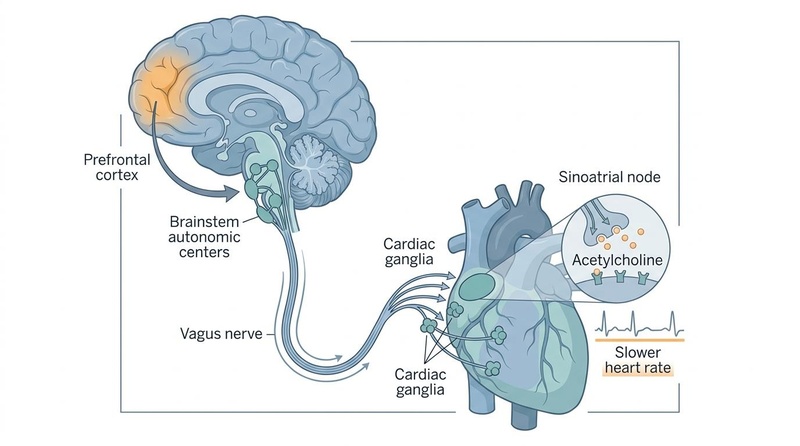
Figure 1: Parasympathetic cardiac regulation during acute stress recovery. Prefrontal control and brainstem autonomic output influence vagal signaling to cardiac ganglia and the sinoatrial node, supporting heart-rate recovery after stress.
¶ Evidence & Science
Detailed clinical data on the efficacy of various stress management interventions.
¶ Evidence Summary Table (Human Outcomes)
| Intervention | Outcome | Effect Size/Change | Quality | Consistency | Trials | Notes |
|---|---|---|---|---|---|---|
| Cyclic Sighing | Perceived Stress | -21% reduction in SAS scores | High | High | 1 RCT | Superior to mindfulness for acute mood and respiratory rate improvements [1:5] |
| Negative Affect | -15% reduction in POMS scores | High | High | 1 RCT | Significant reduction in anxiety and depression subscales [1:6] | |
| L-Theanine | Stress-Related Symptoms | -17% reduction in self-reported scores | High | High | 1 DB-RCT | Improves executive function and sleep latency [2:5] |
| Anxiety | -10% reduction in GAD-7 scores | High | High | 1 DB-RCT | Reduces subjective anxiety and improves cognitive control under stress [2:6][20] | |
| L-Tyrosine | Working Memory | +15% accuracy during cold stress | Moderate | High | 2 RCTs | Prevents cognitive decrements under sleep deprivation and cold exposure [3:5][8:3] |
| Blood Pressure (Diastolic) | -5 mmHg reduction during stress | Moderate | Moderate | 2 RCTs | Mitigates stress-induced blood pressure elevation [7:4][9:1] | |
| Ashwagandha | Perceived Stress (PSS) | -44% reduction | High | High | 2 DB-RCTs | Reduces morning cortisol and improves sleep quality [10:4][4:5] |
| Morning Cortisol | -27% reduction | High | High | 2 DB-RCTs | Significant HPA axis modulation [10:5][4:6] | |
| Rhodiola Rosea | Burnout Symptoms | -20% reduction in MBI scores | High | High | 1 Open-Label CT | Improves emotional lability and executive focus [15:1] |
| Fatigue (Mental/Physical) | -17% reduction | High | High | 1 Open-Label CT | Rapid reduction within 1 week of administration [16:1] | |
| Forest Bathing | Salivary Cortisol | -0.05 µg/dL reduction | High | High | 1 Meta-analysis | Induces parasympathetic recovery from high baseline stress [12:2] |
¶ Comprehensive Safety & Toxicology
While generally safe, particular considerations apply to high stress interventions.
¶ Adaptogens
- Ashwagandha: Generally well-tolerated. Rare side effects include mild GI upset or drowsiness. May interact with thyroid medications (due to potential thyroid-stimulating properties) and immunosuppressants.
- Rhodiola Rosea: Typically safe. Can cause insomnia if taken too late in the day. May interact with MAO inhibitors, SSRIs, and antidiabetic drugs (potential additive effects on blood sugar).
- L-Theanine: Very safe, no known serious adverse events. May cause mild drowsiness in sensitive individuals.
- L-Tyrosine: Generally safe at recommended doses. High doses can cause transient headaches, GI upset, or jitters due to increased catecholamine levels. Avoid in individuals with melanoma (tyrosine is a melanin precursor) or those on MAOIs.
¶ Breathing Exercises
- Cyclic Sighing/Slow Breathing: Extremely safe. Avoid forced exhalation if experiencing respiratory distress. Individuals with severe cardiovascular conditions should consult a physician if unusual symptoms arise.
¶ General Safety Considerations
- Individual Variability: Response to supplements and interventions can vary significantly. Start with lower doses and monitor effects.
- Underlying Conditions: Always rule out underlying medical conditions (e.g., thyroid dysfunction, anemia, sleep apnea) that may mimic or exacerbate stress symptoms.
- Drug Interactions: Always consult with a healthcare professional regarding potential interactions with prescription medications.
¶ Comparisons & Engagement
¶ Compare With
- Meditation vs. Breathwork: While both reduce stress, structured breathwork like cyclic sighing offers a faster, more direct physiological downshift compared to traditional mindfulness meditation, especially for acute arousal [1:7].
- Acute vs. Chronic Interventions: Acute interventions (e.g., L-tyrosine for pre-stress) are distinct from chronic interventions (e.g., Ashwagandha for daily cortisol regulation), though they can be combined.
¶ Internal Links
¶ References
Balban MY, Neri E, Kogon MM, et al. Brief structured respiration practices enhance mood and reduce physiological arousal. Cell Reports Medicine. 2023;4(1):100895. PubMed ↩︎ ↩︎ ↩︎ ↩︎ ↩︎ ↩︎ ↩︎ ↩︎
Hidese S, Ogawa S, Ota M, et al. Effects of L-Theanine Administration on Stress-Related Symptoms and Cognitive Functions in Healthy Adults: A Randomized Controlled Trial. Nutrients. 2019;11(10):2362. PubMed ↩︎ ↩︎ ↩︎ ↩︎ ↩︎ ↩︎ ↩︎
Mahoney CR, Castellani J, Kramer FM, et al. Tyrosine supplementation mitigates working memory decrements during cold exposure. Physiology & Behavior. 2007;92(4):575-582. PubMed ↩︎ ↩︎ ↩︎ ↩︎ ↩︎ ↩︎
Lopresti AL, Smith SJ, Malvi H. An investigation into the stress-relieving and pharmacological actions of an ashwagandha (Withania somnifera) extract: A randomized, double-blind, placebo-controlled study. Medicine. 2019;98(37):e17186. PubMed ↩︎ ↩︎ ↩︎ ↩︎ ↩︎ ↩︎ ↩︎
McEwen BS. Stress, adaptation, and disease: allostasis and allostatic load. Annals of the New York Academy of Sciences. 1998;840(1):33-44. NYAS ↩︎ ↩︎
Cohen S, Janicki-Deverts D, Doyle WJ. Psychological stress and disease. JAMA. 2007;298(14):1685-1687. JAMA ↩︎ ↩︎
Deijen JB, Wientjes CJ, Vullinghs HF, et al. Tyrosine improves cognitive performance and reduces blood pressure in cadets after one week of a combat training course. Brain Research Bulletin. 1999;48(2):203-209. PubMed ↩︎ ↩︎ ↩︎ ↩︎ ↩︎
Neri DF, Wiegmann D, Stanny RR, et al. The effects of tyrosine on cognitive performance during extended wakefulness. Aviation, Space, and Environmental Medicine. 1995;66(4):313-319. PubMed ↩︎ ↩︎ ↩︎ ↩︎
Deijen JB, Orlebeke JF. Effect of tyrosine on cognitive function and blood pressure under stress. Brain Research Bulletin. 1994;33(3):319-323. PubMed ↩︎ ↩︎
Smith SJ, Lopresti AL, Fairchild TJ. Exploring the efficacy and safety of a novel standardized ashwagandha (Withania somnifera) root extract (Witholytin®) in adults experiencing high stress and fatigue: A RCT. Journal of Psychopharmacology. 2023;37(11):1111-1124. PubMed ↩︎ ↩︎ ↩︎ ↩︎ ↩︎ ↩︎
Li TT, Wang HY, Zhang H, et al. Effect of breathing exercises on oxidative stress biomarkers in humans: A systematic review and meta-analysis. Frontiers in Medicine. 2023;10:1152011. PubMed ↩︎ ↩︎
Antonelli M, Donelli D, Barbieri G, et al. Effects of forest bathing (shinrin-yoku) on levels of cortisol as a stress biomarker: a systematic review and meta-analysis. International Journal of Biometeorology. 2019;63(8):1117-1134. Springer Link ↩︎ ↩︎ ↩︎
Muzumdar N, Sun K, Zhang S, et al. Dissecting Cardiovascular Responses to a Fixed-Interval Volitional Sighing Protocol Using a Mixed Modeling Approach. Psychophysiology. 2026;63(1):e14851. PubMed ↩︎ ↩︎ ↩︎
Epel ES, Blackburn EH, Lin J, et al. Accelerated telomere shortening in response to life stress. Proceedings of the National Academy of Sciences USA. 2004;101(49):17312-17315. PubMed ↩︎ ↩︎
Kasper S, Dienel A. Multicenter, open-label, exploratory clinical trial with Rhodiola rosea extract in patients suffering from burnout symptoms. Neuropsychiatric Disease and Treatment. 2017;13:1211-1215. PubMed ↩︎ ↩︎
Lekomtseva Y, Zhukova I, Wacker A. Rhodiola rosea in Subjects with Prolonged or Chronic Fatigue Symptoms: Results of an Open-Label Clinical Trial. Complementary Medicine Research. 2017;24(1):46-52. PubMed ↩︎ ↩︎
Cropley M, Banks AP, Boyle J. The Effects of Rhodiola rosea L. Extract on Anxiety, Stress, Cognition and Other Mood Symptoms. Phytotherapy Research. 2015;29(12):1934-1939. PubMed ↩︎
Sapolsky RM. Stress and the brain. Nature Neuroscience. 1997;1(1):14-16. Nature Neuroscience ↩︎
Łuszczak J, Kocki J. Clinical evidence for the adaptogenic effects of Withania somnifera and Rhodiola rosea - A systematic review with molecular interpretation of psychometric outcomes. Annals of Agricultural and Environmental Medicine. 2026;33(1):77-85. PubMed ↩︎
McAllister MJ, Martaindale MH, Dillard CC, et al. Impact of L-theanine and L-tyrosine on markers of stress and cognitive performance in response to a virtual reality based active shooter training drill. Stress. 2024;27(1):2364811. PubMed ↩︎