¶ Folate
| Type | Water-soluble Vitamin |
| Active Cmpd | L-methylfolate (5-MTHF) |
| Source | Leafy greens, legumes, liver |
| Dose Range | 400–1,000 mcg (standard); up to 15 mg (adjunctive) |
| Half-life | ~3 hours |
| Main Benefit | Homocysteine reduction, prenatal health |
| Absorption | High (Active Transport) |
Folate (Vitamin B9) is an essential water-soluble micronutrient required for DNA synthesis, amino acid metabolism, and cellular methylation. It is internationally recognized for its role in preventing neural tube defects during fetal development and managing cardiovascular risk through the regulation of plasma homocysteine.[1][2]
¶ At a glance
Aliases
- Also known as: Vitamin B9, Folic Acid (synthetic), L-methylfolate (active)
- Chemical / botanical name: Pteroylmonoglutamic acid (folic acid)
- Category: Essential water-soluble vitamin
Key points (high-level summary)
- Prenatal Health: In pregnant women, folate supplementation significantly reduces the risk of neural tube defects (NTDs) and potentially congenital heart disease in offspring.[3][2:1]
- Cardiovascular Support: In individuals with elevated homocysteine, folate supplementation effectively lowers plasma homocysteine levels and reduces the risk of primary stroke.[4][5]
- Bioavailability & Genetics: Standard folic acid requires conversion by the MTHFR enzyme, which is less efficient in individuals with common genetic polymorphisms, making L-methylfolate a more direct option.[6][7]
- B12 Interaction: High doses of synthetic folic acid can mask the hematological signs of Vitamin B12 deficiency (anemia) while allowing irreversible neurological damage to progress.[8]
What people use it for
- Main goals: Prevention of birth defects, homocysteine lowering, cardiovascular risk reduction, mood support (depression adjunct), cognitive health.
- Evidence quality (overall): High for prenatal and homocysteine reduction; Moderate for stroke prevention and depression adjunct.
¶ What is Folate?
Folate is a generic term for a group of related compounds (pteroylglutamates) that function as cofactors in one-carbon transfer reactions.
- Definition: An essential B-vitamin that the human body cannot synthesize de novo, requiring intake from diet or supplements.
- Natural sources: Dark leafy green vegetables (spinach, kale), legumes (lentils, beans), asparagus, eggs, and organ meats (liver).
- Traditional / historical use: Identified in the 1930s (as "Wills Factor") for its ability to treat megaloblastic anemia in pregnant women.
- Current regulatory status: Globally used in mandatory food fortification programs (e.g., grain fortification) to reduce the population-wide incidence of folate deficiency.[1:1]
- Key pharmacological property: A primary methyl donor in the one-carbon metabolism cycle, essential for purine and thymidylate synthesis (DNA/RNA).
¶ What are Folate’s main benefits?
Folate's benefits are primarily derived from its foundational role in cellular repair and amino acid regulation.
- Neural Tube Defect Prevention: Overwhelming clinical evidence demonstrates that supplemental folic acid taken periconceptionally reduces NTD risk by up to 70%.[2:2]
- Homocysteine Reduction: High-dose folate (0.8–1.0 mg) consistently lowers homocysteine—a vascular toxin—by 20-25%, which is strongly associated with reduced stroke risk.[4:1][5:1][9]
- Mood Support (Depression Adjunct): Clinical trials indicate that high-dose L-methylfolate (7.5–15 mg) significantly improves response rates in patients with treatment-resistant major depressive disorder (MDD).[10][11]
- Cardiovascular Mortality: Long-term intake and optimal serum biomarkers are associated with reduced risk of death from cardiovascular disease and all causes.[12]
- Oncology: Folate appears to have a dual role in cancer; while adequate levels may prevent early oncogenesis (e.g., colorectal cancer), excessive levels in some contexts might support the growth of existing pre-cancerous lesions.[13][14]
¶ Evidence summary table (human outcomes)
| Outcome / Goal | Effect* | Consistency | Evidence quality | Trials | Notes (population, duration, dose) |
|---|---|---|---|---|---|
| Neural Tube Defects | High | High | Meta-Analysis | 0.4–0.8 mg daily periconceptionally [2:3] | |
| Homocysteine | High | High | Meta-Analysis | Consistent 20-25% reduction [5:2][9:1] | |
| Stroke Risk | High | Moderate | 21 RCTs | Significant reduction in primary stroke [4:2] | |
| Depression Response | Moderate | Moderate | RCTs | Adjunct to SSRI/SNRI (7.5–15 mg) [11:1] | |
| Lipid Profile | Moderate | Moderate | Meta-Analysis | Modest reductions in TC and LDL [15] | |
| Diabetes (HbA1c) | Moderate | Moderate | 29 RCTs | Modest improvement in glycemic control [16] | |
| Migraine Severity | Moderate | Low | Meta-Analysis | May reduce attack frequency and severity [17] | |
| Male Fertility | Low | Very Low | Scoping Review | May improve DNA integrity (mostly preclinical) [18] |
- *Effect:
Large Improvement (Large decrease, positive),Medium Improvement (Moderate increase, positive),Small Improvement (Small decrease, positive).
¶ How does Folate work?
Folate serves as the critical carrier of one-carbon units in a complex metabolic network known as the one-carbon metabolism pathway.
- Primary targets: Methionine synthase, Thymidylate synthase, and Methylenetetrahydrofolate reductase (MTHFR).
- Core mechanisms:
- DNA Synthesis: 5,10-methylene THF is required to convert dUMP to dTMP for DNA replication. Folate deficiency leads to "uracil misincorporation" and DNA strand breaks.
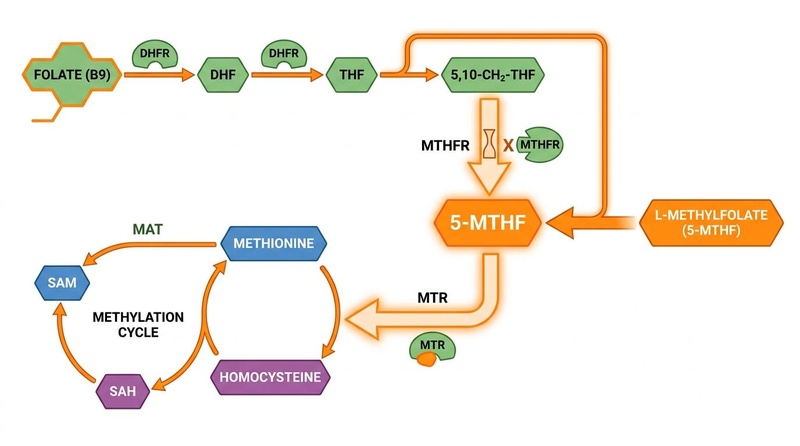
- Methylation (Homocysteine to Methionine): 5-MTHF (the active form) provides the methyl group required for the remethylation of homocysteine into methionine (facilitated by Vitamin B12). Methionine then generates SAMe, the universal methyl donor for DNA and proteins.
- Neurotransmitter Production: By supporting the folate cycle, it ensures adequate levels of Tetrahydrobiopterin (BH4), which is a necessary cofactor for the synthesis of serotonin, dopamine, and norepinephrine.[11:2]
- Forms & Bioavailability:
- Dietary Folate: Polyglutamate form; requires hydrolysis in the gut. Bioavailability is roughly 50%.
- Folic Acid: Monoglutamate form; highly stable and bioavailable (~85-100% when taken with food/fortified). Requires MTHFR for conversion to active 5-MTHF.
- L-Methylfolate (5-MTHF): The biologically active form that bypasses the MTHFR bottleneck and does not produce unmetabolized folic acid (UMFA) in the blood.[6:1]
¶ Effects on different systems
¶ Cardiovascular & Metabolic Health
Beyond stroke prevention, folate supplementation has been studied for its impact on cardiorenal outcomes. In patients with chronic kidney disease (CKD), folate-based interventions significantly reduce the risk of cardiovascular events and may slow the progression of kidney damage.[19] In metabolic disease, meta-analyses of RCTs show that folate supplementation can modestly lower fasting blood glucose, insulin resistance (HOMA-IR), and HbA1c levels.[16:1] It also exerts a small beneficial effect on plasma lipid profiles, specifically reducing total cholesterol.[15:1]
¶ Brain & Mental Health
Folate is deeply integrated into neuropsychiatric health. Low folate levels are correlated with an increased risk of suicidality, and supplementation may act as a protective factor.[20] High-dose L-methylfolate (Deplin®) is an FDA-regulated medical food for depression adjunct therapy, showing efficacy even in patients who failed multiple SSRI trials.[10:1][11:3] Emerging evidence also suggests that folate may reduce the frequency and severity of migraine attacks, particularly in those with high baseline homocysteine.[17:1] In neurodegeneration, the MTHFR C677T polymorphism is a recognized risk factor for Alzheimer's disease in Asian populations, suggesting a role for optimal folate status in cognitive preservation.[7:1]
¶ Oncology
Folate status exhibits an "umbrella" relationship with various cancers. High folate intake and optimal biomarkers are associated with a reduced risk of colorectal cancer [13:1], breast cancer [14:1], and cervical cancer.[21] Conversely, individuals with Human Papillomavirus (HPV) frequently exhibit lower serum folate and B12 levels, indicating that folate may play a role in the progression of virus-mediated malignancies.[22] Furthermore, folate receptor alpha (FRα) is a major therapeutic target; drugs like mirvetuximab soravtansine target this receptor in platinum-resistant ovarian cancer.[23]
¶ Reproductive Health
Folate is the cornerstone of prenatal care. Beyond NTD prevention, maternal exposure to folate antagonists (such as certain antiepileptics or methotrexate) increases the susceptibility to congenital heart disease in offspring.[3:1] Furthermore, maternal Vitamin B12 status is now recognized as an essential partner to folate in ensuring healthy neural tube development.[24] In male fertility, mechanistic evidence suggests folate regulates spermatogenesis, preserves sperm membrane integrity, and inhibits oxidative DNA damage, although clinical trial evidence is currently limited.[18:1]
¶ Dosage and how to take it
¶ Standard dosing in studies
- General Maintenance: 400 mcg daily (the standard RDA).
- Pregnancy / NTD Prevention: 400 mcg to 800 mcg daily, ideally starting 1–3 months before conception.[2:4]
- Homocysteine Lowering: 800 mcg to 1,000 mcg (1 mg) daily.[5:3]
- Depression Adjunct: 7.5 mg to 15 mg of L-methylfolate (often prescribed as a medical food).[11:4]
¶ Forms and bioavailability
- Folic Acid: Most common; used in grain fortification.[1:2] Highly effective for NTD prevention but can lead to circulating unmetabolized folic acid (UMFA) at doses >400 mcg.
- L-Methylfolate (5-MTHF): Preferred for individuals with MTHFR variants or those wanting to bypass the conversion bottleneck. It is safer in the context of Vitamin B12 deficiency as it does not mask the anemia.[6:2]
¶ Special populations
- Metformin (Biguanide) Users: Long-term metformin use is associated with a significantly increased risk of Vitamin B12 and folate deficiency.[25]
- Adolescent Girls: Global data indicate a high prevalence of folate deficiency in adolescent girls, a critical window for future reproductive health.[26]
- Older Adults: B-vitamin intervention can support cognitive function in older adults, even in regions with mandatory folic acid fortification.[27]
- Phenylketonuria (PKU): Patients with PKU, especially those non-adherent to their diet, are at high risk for folate and Vitamin B12 deficiencies.[8:1]
¶ Safety and side effects
Folate is generally well-tolerated, but high doses of synthetic forms carry specific risks.
Common side effects
- Tolerability: Extremely high (up to 15 mg) doses in clinical trials report very few side effects, occasionally including mild GI upset or sleep disturbances.
Less common / serious concerns
- B12 Masking: High intake of folic acid corrects the megaloblastic anemia caused by Vitamin B12 deficiency but does not halt the neurological damage. This can lead to irreversible nerve damage if Vitamin B12 status is not checked.[8:2]
- Methotrexate Toxicity: Individuals with the RFC1 G80A polymorphism may experience elevated toxicity from methotrexate (a folate antagonist) when folate pathways are disrupted.[28]
- Congenital Heart Risk: Maternal exposure to folate antagonists significantly increases the risk of heart defects in the fetus.[3:2]
¶ Drug and supplement interactions
- Metformin: Impairs B12/folate absorption; monitoring is required for long-term users.[25:1]
- Antifolates (Methotrexate): Folate supplementation can interfere with the efficacy of methotrexate for cancer treatment but is often prescribed alongside it for rheumatoid arthritis to reduce side effects.
- Antiepileptics: Phenytoin and valproate can lower folate levels, and high-dose folate may conversely lower the serum levels of these drugs.
¶ Combining Folate with other supplements (“stacks”)
- B-Complex: Always best to take folate with Vitamin B12 (and B6) to prevent B12 masking and optimize the one-carbon cycle.[24:1]
- Prenatal Stack: Combined with Iron and Vitamin B12, as global prevalences of these deficiencies are high in pregnant women.[29]
¶ Practical FAQ
Does folate help with weight loss?
There is no strong evidence that folate directly causes weight loss, though it may modestly improve metabolic biomarkers like insulin sensitivity in people with metabolic disorders.[16:2]
Is L-methylfolate better than Folic Acid?
For many, folic acid is sufficient. However, L-methylfolate is superior for individuals with MTHFR mutations and it does not carry the risk of masking B12 deficiency.[6:3]
Can I take folate if I am healthy?
Yes, maintaining optimal levels is associated with lower mortality and cardiovascular health, though the most significant benefits are seen in deficiency states or high-risk periods like pregnancy.[12:1]
¶ How we evaluated the evidence
- We prioritized Tier 1 systematic reviews and meta-analyses (Li 2025, Zhang 2024, Akbari 2018).
- We utilized recent (2024–2026) high-authority scoping reviews for emerging domains (male fertility, suicidality).
- Evidence Grading:
- High: Multiple meta-analyses of RCTs (NTD prevention, Homocysteine).
- Moderate: Robust RCT data with some heterogeneity (Stroke, Depression).
- Low: Observational or primarily preclinical data (Male fertility, cancer prevention).
¶ References
Parker J, Kisho A, Hou S. (2026). Impact of Mandatory Grain Fortification With Folic Acid on Population Folate Concentrations and the Risk of Folate Deficiency and Insufficiency: A Systematic Review and Meta-Analysis. The Journal of nutrition. https://pubmed.ncbi.nlm.nih.gov/41461274/ ↩︎ ↩︎ ↩︎
US Preventive Services Task Force. (2023). Folic Acid Supplementation to Prevent Neural Tube Defects: US Preventive Services Task Force Reaffirmation Recommendation Statement. JAMA. https://jamanetwork.com/journals/jama/fullarticle/2807739 ↩︎ ↩︎ ↩︎ ↩︎ ↩︎
Luitel P, Yadav R, Mandal P. (2024). Maternal exposure to folate antagonists and susceptibility to congenital heart disease in offspring: A systematic review and meta-analysis. British journal of clinical pharmacology. https://pubmed.ncbi.nlm.nih.gov/38369772/ ↩︎ ↩︎ ↩︎
Zhang N, et al. (2024). Folic acid supplementation for stroke prevention: A systematic review and meta-analysis of 21 randomized clinical trials worldwide. Clinical Nutrition. https://doi.org/10.1016/j.clnu.2024.05.034 ↩︎ ↩︎ ↩︎
Homocysteine Lowering Trialists' Collaboration. (1998). Lowering blood homocysteine with folic acid based supplements: meta-analysis of randomised trials. BMJ. https://www.bmj.com/content/316/7135/894 ↩︎ ↩︎ ↩︎ ↩︎
Xie M, Qing X, Huang H. (2025). The effectiveness and safety of the active form of folate on biochemical parameters in women of childbearing age: A systematic review and meta-analysis. Medicine. https://pubmed.ncbi.nlm.nih.gov/41398893/ ↩︎ ↩︎ ↩︎ ↩︎
Rai V. (2016). Folate Pathway Gene Methylenetetrahydrofolate Reductase C677T Polymorphism and Alzheimer Disease Risk in Asian Population. Indian journal of clinical biochemistry. https://pubmed.ncbi.nlm.nih.gov/27382194/ ↩︎ ↩︎
Bokayeva K, Jamka M, Walkowiak D. (2025). Vitamin B12 and Folate in Adherent and Non-Adherent Individuals with Phenylketonuria: A Cross-Sectional Study, Systematic Review, and Meta-Analysis. Metabolites. https://pubmed.ncbi.nlm.nih.gov/40710538/ ↩︎ ↩︎ ↩︎
Ghattas Hasbun P, et al. (2025). Efficacy of folic acid supplementation in the prevention of cardiovascular disease - a systematic review and meta-analysis of randomized controlled trials. BMC Nutrition. https://pubmed.ncbi.nlm.nih.gov/41194300/ ↩︎ ↩︎
Lam NSK, Long XX, Li X. (2022). The potential use of folate and its derivatives in treating psychiatric disorders: A systematic review. Biomedicine & pharmacotherapy. https://pubmed.ncbi.nlm.nih.gov/34953391/ ↩︎ ↩︎
Papakostas GI, et al. (2012). l-Methylfolate as Adjunctive Therapy for SSRI-Resistant Major Depression: Results of Two Randomized, Double-Blind, Parallel-Sequential Trials. American Journal of Psychiatry. https://psychiatryonline.org/doi/10.1176/appi.ajp.2012.11071114 ↩︎ ↩︎ ↩︎ ↩︎ ↩︎
Fallah M, Karim Dehnavi M, Lotfi K. (2025). Folate Biomarkers, Folate Intake, and Risk of Death From All Causes, Cardiovascular Disease, and Cancer: A Systematic Review and Dose-Response Meta-Analysis of Prospective Cohort Studies. Nutrition reviews. https://pubmed.ncbi.nlm.nih.gov/38950416/ ↩︎ ↩︎
Li T, Yin L, Li Y. (2025). Folate exposures and risk of colorectal cancer: an umbrella review of meta-analyses of observational studies and randomised controlled trials. BMJ open. https://pubmed.ncbi.nlm.nih.gov/41314820/ ↩︎ ↩︎
Eleotério MR, Ferreira LS, Azevedo FM. (2026). Folate Intake and Breast Cancer Risk: A Systematic Review and Meta-Analysis. Molecular nutrition & food research. https://pubmed.ncbi.nlm.nih.gov/41437765/ ↩︎ ↩︎
Fogacci F, Pizzi C, Bergamaschi L. (2024). Folic acid and plasma lipids: Interactions and effect of folate supplementation. Current problems in cardiology. https://pubmed.ncbi.nlm.nih.gov/38521293/ ↩︎ ↩︎
Akbari M, Tabrizi R, Lankarani KB. (2018). The Effects of Folate Supplementation on Diabetes Biomarkers Among Patients with Metabolic Diseases: A Systematic Review and Meta-Analysis of Randomized Controlled Trials. Hormone and metabolic research. https://pubmed.ncbi.nlm.nih.gov/29342488/ ↩︎ ↩︎ ↩︎
Ahmed Omer II, Kubbara EA, Hajali TA. (2026). Association Between Homocysteine, Vitamin B12, Folate and Migraine: An Updated Systematic Review and Meta-Analysis. Brain sciences. https://pubmed.ncbi.nlm.nih.gov/41750218/ ↩︎ ↩︎
Ramgir-Naidu S, Abubakar YA, Soni M. (2026). Nutritional modulation of male fertility: a molecular-focused scoping review. Journal of health, population, and nutrition. https://pubmed.ncbi.nlm.nih.gov/42310716/ ↩︎ ↩︎
Chan WL, Jiao Y, Chim KCY. (2026). Effect of Folate-Based Supplementation in Kidney Disease: A Systematic Review and Meta-analysis of Kidney, Cardiovascular, and Mortality Outcomes. Nutrition reviews. https://pubmed.ncbi.nlm.nih.gov/41885832/ ↩︎
Noel C, Lombardi N, Price M. (2026). The relationship between vitamin B9 (folate) supplementation and suicidality: a scoping review. The mental health clinician. https://pubmed.ncbi.nlm.nih.gov/42239831/ ↩︎
Hua Y, Li Y, Qin H. (2026). Association Between Folate Status and Risk of Cervical Cancer: A Systematic Review, Dose-Response Meta-analysis, and Mendelian Randomization Study. Nutrition reviews. https://pubmed.ncbi.nlm.nih.gov/41812139/ ↩︎
Kermani F, Alahverdi F, Rashidi F. (2026). Investigation of Blood Folate and Vitamin B12 Levels in Women With Human Papillomavirus: A Systematic Review. Journal of lower genital tract disease. https://pubmed.ncbi.nlm.nih.gov/42132147/ ↩︎
Smith JA, Medina P, Miao M. (2025). A review of mirvetuximab soravtansine-gynx in folate receptor alpha-expressing platinum-resistant ovarian cancer. American journal of health-system pharmacy. https://pubmed.ncbi.nlm.nih.gov/40126684/ ↩︎
Nie L, Liu X, Li X. (2025). Beyond Folate: The Emerging Role of Maternal Vitamin B12 in Neural Tube Development. Nutrients. https://pubmed.ncbi.nlm.nih.gov/40573151/ ↩︎ ↩︎
Panou T, Asimakopoulos B. (2026). What ultimately underlies vitamin B12 and folate deficiency in subjects treated with biguanides? Hormones (Athens, Greece). https://pubmed.ncbi.nlm.nih.gov/41087811/ ↩︎ ↩︎
Aweke MN, Alhur AA, Baykemagn ND. (2026). Global folate deficiency among adolescent girls: A systematic review and meta-analysis. PloS one. https://pubmed.ncbi.nlm.nih.gov/42008508/ ↩︎
Zhang L, Chen X, Chen Y. (2024). A Comparative Study Evaluating the Effectiveness of Folate-Based B Vitamin Intervention on Cognitive Function of Older Adults under Mandatory Folic Acid Fortification Policy: A Systematic Review and Meta-Analysis of Randomized Controlled Trials. Nutrients. https://pubmed.ncbi.nlm.nih.gov/39064642/ ↩︎
Yue Y, Yao L, Wang F. (2026). Reduced folate carrier 1 G80A polymorphism is correlated with elevated methotrexate-induced toxicity in pediatric acute lymphoblastic leukemia patients: a systemic meta-analysis. World journal of surgical oncology. https://pubmed.ncbi.nlm.nih.gov/41673870/ ↩︎
Nguyen NTH, Chen YC, Nhu NT. (2025). Global prevalences of erythropoiesis-associated micronutrient deficiencies (iron, folate, and vitamin B(12)) among pregnant women: a systematic review and meta-analysis. Annals of medicine. https://pubmed.ncbi.nlm.nih.gov/41414845/ ↩︎