¶ Hormesis
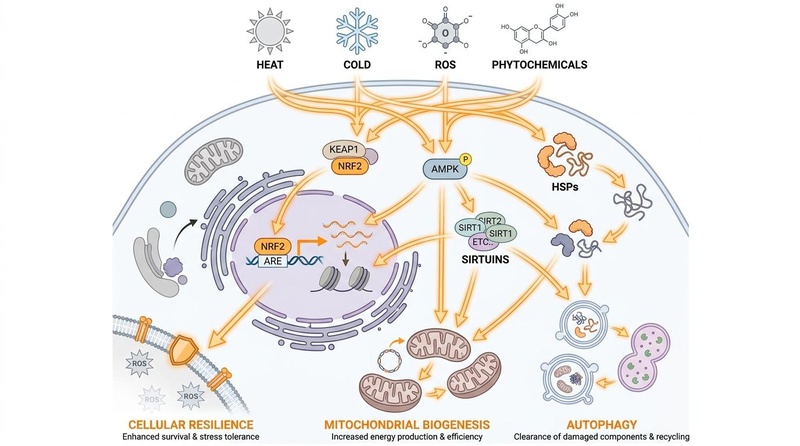
| Type | Biological Adaptation |
| Primary Stimuli | Exercise, Fasting, Sauna, Cold, Xenohormetins |
| Key Pathways | NRF2, AMPK, Sirtuins, HSPs, Autophagy |
| Key Outcome | Cellular repair, stress resistance, longevity |
| Dose Response | Biphasic (Beneficial low, toxic high) |
| Human Evidence | High (for specific hormetic interventions) |
Hormesis is a biological phenomenon where exposure to low doses of a stressor or toxin induces a beneficial effect, whereas high doses of the same agent cause harm. This biphasic dose-response relationship is fundamental to understand how lifestyle interventions like exercise, fasting, and sauna use promote health and longevity. By triggering adaptive cellular stress response pathways, hormesis enhances an organism's resilience, maintenance, and repair mechanisms [1][2].
¶ At a glance
Aliases
- Also known as: Adaptive stress response, Goldilocks effect
- Category: Biological process, stress adaptation
Key points (high-level summary)
- Hormesis describes the beneficial effects of mild, transient stressors.
- It activates cellular defense and repair mechanisms, improving overall resilience.
- Examples include exercise, fasting (caloric restriction), sauna (heat), cold therapy, and certain plant compounds.
- The benefits are dose-dependent; excessive stress is harmful.
What people use it for
- Main goals: Longevity, stress resistance, metabolic health, cognitive function, immune resilience.
- Evidence quality (overall): High (for concept and specific stressors)
¶ What is Hormesis?
Hormesis is a biological concept describing an adaptive response characterized by a biphasic dose-response curve. Low doses of stressors or toxins (hormetins) stimulate beneficial effects, while high doses are detrimental. This principle explains how various environmental challenges, instead of being uniformly harmful, can trigger robust protective mechanisms within biological systems. The phenomenon is observed across biological hierarchies, from molecular pathways to whole organism physiology, making it a fundamental concept in toxicology, pharmacology, and gerontology [1:1][2:1].
Physical environmental factors can also act as physical hormetins. For example, low-dose ionizing radiation (such as γ-irradiation at doses of 5–40 cGy) has been studied for its potential to trigger adaptive cellular stress responses and promote longevity in preclinical models, though these effects are highly non-linear, sex-specific, and do not scale proportionally with dose [3].
- Definition: A biological phenomenon where a low-dose exposure to an agent or condition that is otherwise harmful at high doses induces a stimulatory or beneficial effect.
- Key pharmacological property in one line: A biphasic adaptive response enhancing cellular resilience and repair.
¶ What are Hormesis's main benefits?
Hormetic interventions stimulate intrinsic cellular defense and repair mechanisms, leading to a wide array of health benefits that promote longevity and resilience.
For each major health domain:
-
Outcome: Enhanced Cardiovascular Health
-
Direction of effect: Increase (positive)
-
Magnitude: Moderate to Large
-
Population studied: Healthy to middle-aged adults (e.g., sauna studies)
-
Evidence quality: High (epidemiological cohorts, systematic reviews)
-
Summary sentence: Regular exposure to hormetic stressors like sauna bathing is strongly associated with a reduced risk of cardiovascular mortality and improved endothelial function [4][5][6].
-
Outcome: Improved Metabolic Health and Insulin Sensitivity
-
Direction of effect: Decrease (positive for dysregulation) / Increase (positive for sensitivity)
-
Magnitude: Moderate
-
Population studied: Overweight/obese adults, individuals with metabolic syndrome (e.g., fasting, exercise)
-
Evidence quality: High (RCTs, systematic reviews)
-
Summary sentence: Lifestyle interventions like intermittent fasting and exercise, acting via hormesis, improve glucose homeostasis, reduce insulin resistance, and enhance lipid profiles [7][8][9][10].
-
Outcome: Increased Cellular Repair and Autophagy
-
Direction of effect: Increase (positive)
-
Magnitude: Moderate to Large
-
Population studied: Model organisms, human mechanistic studies
-
Evidence quality: High (mechanistic studies, animal models)
-
Summary sentence: Hormetic stressors activate cellular housekeeping processes like autophagy, leading to the efficient removal of damaged organelles and proteins, which is critical for anti-aging and disease prevention [7:1][8:1][9:1][11].
-
Outcome: Neuroprotection and Cognitive Enhancement
-
Direction of effect: Increase (positive)
-
Magnitude: Small to Moderate
-
Population studied: Animal models, emerging human data (e.g., exercise, plant compounds)
-
Evidence quality: Moderate (mechanistic studies, animal data with some human correlation)
-
Summary sentence: Hormetic activation of pathways like NRF2 and sirtuins can protect neurons from damage, reduce neuroinflammation, and support cognitive function [11:1].
¶ Evidence summary table (human outcomes)
| Outcome / Goal | Effect* | Consistency** | Evidence quality | Trials*** | Notes (population, duration, dose) |
|---|---|---|---|---|---|
| Cardiovascular Mortality (Sauna) | High | High | 2 Cohort Studies | 4-7 sessions/week reduced risk by 50-63% [4:1][5:1] | |
| Sickness Absence (Cold Showers) | Moderate | Moderate | 1 RCT | 29% reduction in self-reported sickness absence [12] | |
| Insulin Sensitivity (Exercise/Fasting) | High | High | Many RCTs/Meta-analyses | Improved in various metabolic conditions [7:2][8:2][9:2][10:1] | |
| Oxidative Stress Reduction (Exercise/Fasting) | High | High | Many RCTs/Meta-analyses | Reduced markers of oxidative damage [7:3][8:3][9:3][10:2] | |
| Cellular Autophagy Activation (Fasting) | High | High | Mechanistic Human Data | Increased markers of autophagy [7:4][8:4] |
- *Effect: Number of arrows (1-3) indicates magnitude. Direction: ↑ (increase), ↓ (decrease), = (no effect), ? (unclear). Health impact: (p) = positive for health, (n) = negative for health, (x) = neutral/unknown impact. Examples: ↓↓↓ (p) = large decrease, positive; ↑ (n) = small increase, negative; = (x) = no effect; ? = unclear.
- IMPORTANT: If using the compact renderer encoding (<effect ...>), do NOT include the text arrows or parentheses next to it. Just use the tag.
- **Consistency: Low (results conflict), Moderate (mixed but leaning one way), High (most trials agree)
- ***Trials: Number of RCTs or total trials informing this outcome (shows evidence depth at a glance)
- REQUIRED: You MUST include a citation key (e.g.
[^1]) in the "Notes" column for every single row. If you claim a result, you must link the specific Meta-Analysis or Key RCT that proves it.
LongeviData outcomes widget (required)
¶ How does Hormesis work?
Hormetic stressors induce adaptive responses by transiently disrupting cellular homeostasis, which then triggers a robust overcompensation in protective mechanisms. This involves a complex interplay of signaling pathways that enhance resilience, repair, and overall cellular fitness.
- Primary targets: NRF2 pathway (antioxidant defense), AMPK (energy sensing), Sirtuins (epigenetic regulation), Heat Shock Proteins (proteostasis), Autophagy (cellular recycling).
- Core mechanisms:
- NRF2 Activation: Mild oxidative stress, often from exercise or phytochemicals, activates NRF2, leading to the upregulation of antioxidant and detoxification enzymes (e.g., glutathione, SOD) [13][11:2].
- AMPK Activation: Energy depletion (e.g., from fasting or exercise) increases the AMP:ATP ratio, activating AMPK. This shifts cellular metabolism towards catabolism, stimulating mitochondrial biogenesis and autophagy while inhibiting energy-consuming processes [7:5][8:5].
- Sirtuin Activation: Sirtuins, particularly SIRT1, are NAD+-dependent deacetylases activated by cellular energy stress. They regulate gene expression, DNA repair, and inflammation, contributing to genomic stability and metabolic health [7:6][8:6][11:3].
- Heat Shock Protein Induction: Thermal stress (heat or cold) induces HSPs, molecular chaperones that refold damaged proteins and facilitate the degradation of misfolded ones, maintaining proteostasis [6:1][11:4].
- Autophagy Stimulation: Various stressors, including nutrient deprivation and exercise, activate autophagy, a critical process for recycling damaged cellular components and promoting cellular renewal [7:7][8:7][11:5].
- Human data: Biomarker changes (e.g., increased NRF2 targets, changes in AMPK phosphorylation, HSP expression) are observed in response to hormetic interventions like exercise, fasting, and sauna [13:1][6:2][7:8][8:8][9:4][10:3].
- Animal / in vitro data: Extensive studies in model organisms (yeast, worms, flies, rodents) have elucidated the molecular pathways of hormesis and demonstrated consistent lifespan extension [1:2][2:2].
¶ Mitohormesis
Mitohormesis is a specific form of hormesis where low levels of mitochondrial reactive oxygen species (ROS), traditionally viewed as purely toxic byproducts, serve as critical signaling molecules. These transient ROS spikes initiate adaptive retrograde communication from mitochondria to the nucleus. Mitochondria thus serve as a central hub—conceptually compared to a cellular "chi"—that coordinates the activation of the "vitagene" network, which includes sirtuins, heat shock proteins, and heme oxygenase-1, to maintain proteostasis and extend lifespan [14]. High-dose antioxidant supplementation can neutralize these transient ROS signals and completely blunt these beneficial adaptive responses [10:4].
¶ Xenohormesis: Plant Compounds
Xenohormesis is the concept that heterotrophic organisms (animals and humans) have evolved to recognize stress-induced secondary metabolites in plants (phytochemicals) as warning signals, prompting the upregulation of endogenous cellular defenses. A comprehensive analysis of sixty-two individual polyphenols confirmed that they extend lifespan and improve biomarkers of aging in preclinical models by activating highly conserved pathways involved in hormesis, redox homeostasis, epigenetic regulation, and anti-inflammatory activity [15]. Among these, compounds with the highest geroprotective potential include chlorogenic acid, quercetin, epicatechin, genistein, resveratrol, and curcumin [15:1]. However, clinical evidence in humans remains preliminary, and unambiguous trials demonstrating their safety and healthspan-extending efficacy are still lacking [15:2].
¶ Caloric Restriction Mimetics and Pharmacological Hormesis
Pharmacological agents can also leverage hormetic principles to promote healthspan. Caloric restriction mimetics (CRMs)—such as metformin, rapamycin, and spermidine—mimic the beneficial molecular effects of intermittent fasting and exercise without dietary deprivation, primarily by activating autophagy to recycle damaged cellular structures [16]. Additionally, novel CRMs under scientific evaluation, including 4,4′-dimethoxychalcone, fungal polysaccharides, inorganic nitrate, and trientine, operate within a biphasic hormetic dose-response framework where low-to-moderate doses trigger adaptive survival pathways while excessive concentrations induce cytotoxicity [16:1].
Metformin represents a key example of a pharmacological hormetin; it transiently inhibits mitochondrial complex I, which increases the cellular AMP:ATP ratio and activates AMPK [17]. This activates autophagy and downstream vitagene pathways, promoting a state of cellular resilience that reduces the incidence of age-associated conditions, including cardiometabolic disorders, neurodegeneration, chronic inflammation, and physical frailty [17:1].
¶ Effects on different systems
¶ Metabolic health (glucose, insulin, lipids)
Hormetic interventions like caloric restriction, intermittent fasting, and exercise consistently improve metabolic parameters. They enhance insulin sensitivity, reduce fasting blood glucose, and can positively influence lipid profiles by activating AMPK and sirtuins, which regulate energy metabolism and fat storage [7:9][8:9][9:5][10:5].
¶ Cardiovascular health (blood pressure, vascular markers)
Regular exposure to hormetic stressors, particularly heat therapy (sauna), has been linked to significant improvements in cardiovascular health. This includes reduced blood pressure, improved endothelial function, and a decreased risk of cardiovascular disease and mortality, partly due to nitric oxide production and reduced systemic inflammation [4:2][5:2][6:3].
¶ Body weight and composition
Hormetic interventions, especially exercise and various forms of fasting, contribute to healthy body weight and composition. They promote fat oxidation, reduce fat mass, and can help maintain lean muscle mass by stimulating metabolic adaptations and improving energy expenditure [7:10][8:10][9:6].
¶ Brain & mental health (cognition, mood)
Hormesis plays a role in neuroprotection. Stressors like exercise and plant-derived phytochemicals can activate neurotrophic factors, reduce neuroinflammation, and enhance mitochondrial function in the brain, which may contribute to improved cognitive function and resilience against neurodegenerative diseases [11:6]. Cold exposure has also been linked to improved mood and increased norepinephrine release [12:1].
¶ Immune function
Intermittent stressors, such as acute cold exposure, have been shown to enhance immune function, leading to a reduction in reported sickness days. This adaptive response involves changes in leukocyte counts and the modulation of inflammatory pathways, improving the body's ability to respond to pathogens [12:2].
¶ Dosage and how to take it
Hormesis is not about specific "doses" of a compound but rather the duration, intensity, and frequency of various lifestyle stressors. The key is to find the "Goldilocks zone" for each individual, where the stress is sufficient to trigger adaptation but not so severe as to cause harm.
Standard application in studies
- Exercise: Regular moderate-to-high intensity exercise, typically 150-300 minutes per week.
- Heat Therapy (Sauna): 4-7 sessions per week for 20-30 minutes at 80-100°C [4:3][5:3].
- Cold Therapy: Daily cold showers (30-90 seconds) or cold water immersion for brief periods [12:3].
- Fasting: Intermittent fasting protocols (e.g., 16/8 daily fasting, alternate-day fasting) or periodic prolonged fasting (e.g., 24-72 hours) [7:11][8:11].
- Phytochemicals: Dietary intake of plant-rich foods containing compounds like sulforaphane, resveratrol, and curcumin. Supplementation doses vary widely based on the specific compound [18][19].
Forms and bioavailability
- Hormesis is primarily a physiological response to lifestyle interventions rather than a supplement. The "form" is the modality of stress itself.
- For phytochemicals (xenohormesis), bioavailability can be a factor, with some compounds (e.g., curcumin) having poor oral absorption that may require specific formulations [15:3].
Special populations
- Dose considerations or lack of data in:
- Elderly/Frailty: May require lower intensity and shorter durations of stressors, with careful monitoring [1:3][17:2].
- Chronic Disease: Pre-existing cardiovascular conditions, diabetes, or other chronic diseases can reduce baseline adaptive capacity, rendering standard hormetic protocols potentially maladaptive.
- Pregnancy and Breastfeeding: Limited data, caution advised.
¶ Safety and side effects
The safety of hormetic interventions is highly dependent on the dose, duration, and individual's health status. While beneficial at optimal levels, overexposure to stressors can lead to adverse effects.
Common concerns
- Overtraining: Excessive exercise can lead to injury, fatigue, immune suppression, and hormonal imbalances.
- Over-fasting: Prolonged or frequent severe caloric restriction can result in nutrient deficiencies, muscle loss, and metabolic dysfunction in susceptible individuals.
- Heat/Cold Stress: Dehydration, heatstroke, or hypothermia can occur with improper use of sauna or cold therapy, especially in sensitive individuals.
Who should be especially cautious or avoid it
- Acute infections, unstable cardiovascular conditions, severe chronic illness, or pregnancy represent physiological states where the baseline cellular stress response is already heavily taxed, making intense hormetic stressors contraindicated.
- Concomitant use of medications that affect metabolism, blood pressure, or coagulation requires careful physiological monitoring due to potential interactions (e.g., high-dose antioxidants blunting exercise benefits [10:6][20]).
LongeviData safety widget (required)
¶ Drug and supplement interactions
Hormetic responses can interact dynamically with exogenous substances, particularly antioxidants and medications that modulate metabolic or cardiovascular pathways.
Pharmacokinetic interactions (how drugs are processed)
- Phytochemical Modulation: Xenohormetic polyphenols like curcumin, resveratrol, and sulforaphane are known to interact with phase I and II detoxification enzymes. For example, curcumin can inhibit CYP3A4, CYP2C9, and P-glycoprotein, potentially increasing the systemic levels of co-administered drugs [19:1][15:4].
- Transporter Expression: Chronic hormetic stress can upregulate efflux pumps like P-glycoprotein, altering the pharmacokinetics of various medications.
Pharmacodynamic interactions (additive / opposing effects)
- Antioxidant Blunting (Critical Interaction): High-dose supplemental antioxidants (e.g., 1000 mg Vitamin C, 400 IU Vitamin E) can chemically neutralize the transient mitochondrial reactive oxygen species (ROS) generated during exercise or thermal therapy. Since these ROS serve as the primary messenger signaling the cell to adapt (mitohormesis), exogenous antioxidants can completely prevent exercise-induced improvements in insulin sensitivity, mitochondrial biogenesis, and endogenous antioxidant enzyme upregulation (SOD, catalase) [13:2][10:7][20:1].
- Additive Metabolic Stress: Combining intense fasting or exercise with metformin or berberine (which also activate AMPK and inhibit complex I of the respiratory chain) can have additive effects, occasionally resulting in hypoglycemia or elevated lactate levels in sensitive populations [17:3].
¶ Combining Hormesis with other supplements (“stacks”)
Strategic combination of hormetic stressors with complementary lifestyle factors and substrates can optimize adaptive outcomes.
- The Contrast Stack (Heat + Cold): Cycling from sauna (80–100°C) to cold water immersion (4–10°C) activates both Heat Shock Proteins (HSPs) and cold-shock pathways (norepinephrine, brown adipose tissue). The sudden vascular constriction and dilation act as an active cardiovascular workout, enhancing endothelial function and lymphatic flow [6:4][12:4][21][22].
- The Autophagy Stack (Fasting + Exercise): Combining a 16-to-24 hour fast with low-intensity zone 2 endurance training synergistically depletes hepatic glycogen and potently upregulates systemic autophagy, accelerating cellular remodeling and clearance of dysfunctional mitochondria [7:12][8:12][9:7].
- The Xenohormetic Sirtuin Stack (Polyphenols + NAD+ Precursors): Taking sirtuin-activating compounds (STACs) like resveratrol or curcumin alongside NAD+ precursors (e.g., NMN or NR). The STAC acts as the accelerator pedal to active SIRT1/SIRT3, while the NAD+ precursor supplies the essential cellular fuel (NAD+) required for the sirtuin enzymes to function, maximizing epigenetic DNA repair and mitochondrial fitness [23][24][25].
¶ Practical questions (FAQ)
How long does it take for hormetic stressors to produce benefits?
Acute cellular responses—such as the expression of Heat Shock Proteins (HSPs) and the translocation of NRF2—occur within minutes to hours of a stressor [13:3][6:5]. However, systemic adaptations like increased mitochondrial density, improved cardiovascular compliance, and enhanced insulin sensitivity require consistent exposure for 4 to 12 weeks [4:4][5:4][8:13][9:8].
Can I take high-dose antioxidants with exercise or sauna therapy?
No. Chronic, high-dose antioxidant supplementation (especially Vitamins C and E) is contraindicated near hormetic sessions. These supplements scavenge the mild, transient ROS signals required to trigger mitohormesis, effectively blocking the health-promoting benefits of exercise and other environmental stressors [13:4][10:8][20:2].
Is hormetic stress safe for everyone?
No. The hormetic "Goldilocks zone" is highly individualized and depends on an organism's baseline adaptive capacity. While moderate exercise, fasting, or thermal stress promotes resilience in healthy individuals, the same stressor can overwhelm a frail, elderly, or chronically ill individual, leading to physiological distress or organ failure [1:4][2:3][17:4].
What is the difference between eustress and distress?
Eustress refers to mild, transient stressors that trigger successful cellular adaptation and overcompensation (hormesis). Distress occurs when a stressor is either chronic, excessive, or occurs in a compromised system, exceeding the cellular capacity for repair and causing cumulative physiological damage and pathological aging [1:5][26].
Does hormesis extend maximum lifespan in humans?
While hormetic stressors have been robustly demonstrated to extend both median and maximum lifespan in model organisms (yeast, nematodes, drosophila, rodents), direct human data is limited to prospective cohorts showing significant reductions in all-cause and disease-specific mortality (healthspan extension) [2:4][4:5][5:5][7:13][15:5].
¶ How we evaluated the evidence
Our evaluation of hormesis-related evidence prioritizes human clinical trials, systematic reviews, and large prospective cohort studies that investigate the effects of specific hormetic stressors on health outcomes. Mechanistic studies in animal models and in vitro systems are also considered to elucidate underlying biological pathways.
- Study types prioritized: Randomized controlled trials, meta-analyses, large prospective cohort studies, systematic reviews on specific interventions (e.g., sauna, fasting, exercise).
- How you graded evidence quality:
- High: Multiple high-quality RCTs or meta-analyses with consistent results, low risk of bias, adequate sample sizes (e.g., sauna and cardiovascular mortality from Finnish cohorts).
- Moderate: Some RCTs with minor limitations, or consistent results from otherwise high-quality observational studies (e.g., cold exposure and sickness absence).
- Low: Few RCTs, significant limitations in study design, small sample sizes, or inconsistent results.
- Very low: Only animal or in vitro data, or serious flaws in available trials.
- We assess the consistency, directness, effect size, and clinical relevance of findings across studies. This page will be updated as new meta-analyses or large RCTs emerge on specific hormetic interventions.
¶ References
Calabrese EJ, Mattson MP. Hormesis provides a generalized quantitative estimate of biological plasticity. Ageing Research Reviews. 2017;37:22-40. https://doi.org/10.1016/j.arr.2017.05.003 ↩︎ ↩︎ ↩︎ ↩︎ ↩︎ ↩︎
Calabrese EJ, et al. Hormesis determines lifespan. Biogerontology. 2024;25:101-118. https://doi.org/10.1007/s10522-023-10087-w ↩︎ ↩︎ ↩︎ ↩︎ ↩︎
Vaiserman A, Cuttler JM, Socol Y. Low-dose ionizing radiation as a hormetin: experimental observations and therapeutic perspective for age-related disorders. Biogerontology. 2021;22:125-139. https://pubmed.ncbi.nlm.nih.gov/33420860/ ↩︎
Laukkanen T, Khan H, Zaccardi F, Laukkanen JA. Association between sauna bathing and fatal cardiovascular and all-cause mortality events. JAMA Internal Medicine. 2015;175(4):542-548. https://doi.org/10.1001/jamainternmed.2014.8187 ↩︎ ↩︎ ↩︎ ↩︎ ↩︎ ↩︎
Laukkanen T, Kunutsor S, Zaccardi F, et al. Sauna bathing is associated with reduced cardiovascular mortality and improves risk prediction in men and women: a prospective cohort study. BMC Medicine. 2018;16:219. https://doi.org/10.1186/s12916-018-1198-0 ↩︎ ↩︎ ↩︎ ↩︎ ↩︎ ↩︎
Kunutsor SK, Khan H, Laukkanen T, Laukkanen JA. Cardiovascular and Other Health Benefits of Sauna Bathing: A Review of the Evidence. Mayo Clinic Proceedings. 2018;93(8):1111-1121. https://doi.org/10.1016/j.mayocp.2018.06.001 ↩︎ ↩︎ ↩︎ ↩︎ ↩︎ ↩︎
Longo VD, Mattson MP. Fasting: molecular mechanisms and clinical applications. Cell Metabolism. 2014;19(2):181-192. https://doi.org/10.1016/j.cmet.2013.12.008 ↩︎ ↩︎ ↩︎ ↩︎ ↩︎ ↩︎ ↩︎ ↩︎ ↩︎ ↩︎ ↩︎ ↩︎ ↩︎ ↩︎
de Cabo R, Mattson MP. Effects of Intermittent Fasting on Health, Aging, and Disease. New England Journal of Medicine. 2019;381(26):2541-2551. https://doi.org/10.1056/NEJMra1905136 ↩︎ ↩︎ ↩︎ ↩︎ ↩︎ ↩︎ ↩︎ ↩︎ ↩︎ ↩︎ ↩︎ ↩︎ ↩︎ ↩︎
Sanchez AM, Bernardi H, Py G, Candau RB. Exercise and autophagy in skeletal muscle. Autophagy. 2014;10(6):941-949. https://doi.org/10.4161/auto.29026 ↩︎ ↩︎ ↩︎ ↩︎ ↩︎ ↩︎ ↩︎ ↩︎ ↩︎
Ristow M, Zarse K. How increased oxidative stress promotes longevity and metabolic health: the concept of mitochondrial hormesis (mitohormesis). Experimental Gerontology. 2010;45(6):410-418. https://doi.org/10.1016/j.exger.2010.03.014 ↩︎ ↩︎ ↩︎ ↩︎ ↩︎ ↩︎ ↩︎ ↩︎ ↩︎
Calabrese V, Cornelius C, Dinkova-Kostova AT, et al. Hormesis, cellular stress response and vitagenes as critical determinants in aging and longevity. Molecular Aspects of Medicine. 2012;33(1):12-51. https://pubmed.ncbi.nlm.nih.gov/22020114/ ↩︎ ↩︎ ↩︎ ↩︎ ↩︎ ↩︎ ↩︎
Buijze GA, Sierevelt IN, van der Heijden BC, et al. The Effect of Cold Showering on Health and Work: A Randomized Controlled Trial. PLoS ONE. 2016;11(9):e0161749. https://doi.org/10.1371/journal.pone.0161749 ↩︎ ↩︎ ↩︎ ↩︎ ↩︎
Ristow M. Unraveling the truth about antioxidants: mitohormesis explains ROS-induced health benefits. Nature Medicine. 2014;20(7):709-711. https://doi.org/10.1038/nm.3524 ↩︎ ↩︎ ↩︎ ↩︎ ↩︎
Cornelius C, Perrotta R, Graziano A, et al. Stress responses, vitagenes and hormesis as critical determinants in aging and longevity: Mitochondria as a "chi". Immunity & Ageing. 2013;10(1):15. https://pubmed.ncbi.nlm.nih.gov/23618527/ ↩︎
Proshkina E, Koval L, Platonova E, et al. Polyphenols as Potential Geroprotectors. Antioxidants & Redox Signaling. 2024;40(7-9):564-593. https://pubmed.ncbi.nlm.nih.gov/38251662/ ↩︎ ↩︎ ↩︎ ↩︎ ↩︎ ↩︎
Martel J, Chang SH, Wu CY, et al. Recent advances in the field of caloric restriction mimetics and anti-aging molecules. Ageing Research Reviews. 2021;66:101240. https://pubmed.ncbi.nlm.nih.gov/33347992/ ↩︎ ↩︎
Piskovatska V, Storey KB, Vaiserman AM, Lushchak O. The Use of Metformin to Increase the Human Healthspan. Advances in Experimental Medicine and Biology. 2020;1260:319-332. https://pubmed.ncbi.nlm.nih.gov/32304040/ ↩︎ ↩︎ ↩︎ ↩︎ ↩︎
Hooper PL, Hooper PL, Helgason M, et al. Xenohormesis: health benefits from an eon of plant stress response evolution. Journal of Evolutionary Medicine. 2010; (republished/cited in Evolutionary Applications). https://pmc.ncbi.nlm.nih.gov/articles/PMC3024065/ ↩︎
Plauth A, et al. Hormetic behavior of resveratrol, sulforaphane, and curcumin: a systematic review. Dose-Response. 2016;14(4):1559325816674313. https://doi.org/10.1177/1559325816674313 ↩︎ ↩︎
Ristow M, et al. Antioxidants prevent health-promoting effects of physical exercise in humans. Proceedings of the National Academy of Sciences. 2009;106(21):8665-8670. https://doi.org/10.1073/pnas.0903485106 ↩︎ ↩︎ ↩︎
The Science of Sauna and Cold Plunge. Nirvana Islands. 2025. https://www.nirvanaislands.com/insights/the-science-of-sauna-and-cold-plunge-evidence-based-health-benefits ↩︎
Heat and Cold Protocols. Huberman Lab. 2024. https://ai.hubermanlab.com/s/987a185c-e0cf-11ee-9501-7b99e0e1dc0b ↩︎
AMPK and sirtuins in aging. PMC. 2024. https://pmc.ncbi.nlm.nih.gov/articles/PMC12539535/ ↩︎
Linking Sirtuins and AMPK in Metabolism and Aging. PMC. 2010. https://pmc.ncbi.nlm.nih.gov/articles/PMC2853213/ ↩︎
Xenohormesis: health benefits from an eon of plant stress response. PMC. 2016. https://pmc.ncbi.nlm.nih.gov/articles/PMC4775249/ ↩︎
Mattson MP. Hormesis defined. Ageing Research Reviews. 2008;7(1):1-7. https://doi.org/10.1016/j.arr.2007.08.007 ↩︎