¶ Spermidine
Spermidine is a naturally occurring polyamine essential for cellular homeostasis, DNA stability, and growth. In longevity science, it is classified as a caloric restriction mimetic due to its potent ability to induce autophagy, the cellular "cleanup" process that recycles damaged organelles and proteins. While endogenous spermidine levels decline with age, supplementation and dietary intake have shown promise in supporting cognitive function, cardiovascular health, and immune resilience.
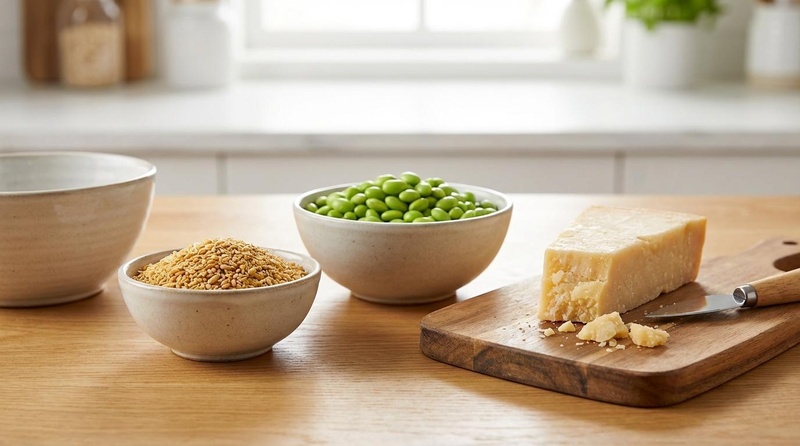
| Type | Natural Polyamine |
| Active Cmpd | Spermidine |
| Source | Wheat germ, Soybeans, Aged cheese |
| Dose Range | 1 – 6 mg/day (std); up to 40 mg tested |
| Half-life | Tightly regulated metabolism |
| Main Benefit | Autophagy induction |
| Absorption | High bioavailability |
¶ At a glance
Aliases
- Also known as: N-(3-aminopropyl)-1,4-butanediamine
- Chemical / botanical name: Spermidine
- Category: Natural polyamine / Caloric restriction mimetic
Key points
- Strongest Benefit: Induces autophagy by inhibiting the EP300 acetyltransferase, supporting cellular proteostasis and mitochondrial quality control.
- Notable Effect: Associated with significantly reduced cardiovascular and all-cause mortality in large-scale prospective cohort studies[1][2].
- Key Limitation: Cognitive benefits in human randomized controlled trials (RCTs) appear dose-dependent; low-dose supplementation (0.9 mg) failed to show primary benefits, while higher doses (1.2–3.3 mg) were more effective[3][4][5].
- Main Safety Concern: Generally considered highly safe with excellent tolerability; even high doses of 40 mg/day showed no significant adverse effects in short-term trials[6][7].
What people use it for
- Main goals: Autophagy induction, cognitive support, cardiovascular health, immune rejuvenation, and healthy aging.
- Evidence quality (overall): Moderate (for cognition/safety); Low (for long-term longevity/cardiovascular outcomes).
¶ What is Spermidine?
Spermidine is a ubiquitous polyamine found in all living organisms, from bacteria to humans. It plays a foundational role in cellular survival, including DNA replication, transcription, and translation.
- Definition: A low-molecular-weight polycationic compound essential for cell growth and survival.
- Natural sources: The highest concentrations are found in wheat germ, soybeans (especially fermented Natto), aged cheeses, mushrooms, and chicken liver.
- Traditional / historical use: Originally discovered in human semen in 1678 by Antonie van Leeuwenhoek, its biological importance for aging and autophagy was only fully realized in the early 21st century.
- Current regulatory status: Sold as a dietary supplement; in the European Union (EU), specific wheat-germ extracts are approved as "novel foods" with recommended upper limits for extracts (typically ~6 mg/day)[8]. In the United States, spermidine-rich wheat germ extract is classified as Generally Recognized As Safe (GRAS)[9].
- Key pharmacological property: A potent autophagy inducer that acts as a competitive inhibitor of the EP300 acetyltransferase.
¶ What are Spermidine’s main benefits?
The health benefits of spermidine primarily stem from its ability to rejuvenate cellular cleanup mechanisms and maintain mitochondrial health.
-
Cognitive Support:
- Direction of effect: Increase (Positive)
- Magnitude: Moderate (Dose-dependent)
- Population studied: Older adults with subjective cognitive decline (SCD) or mild dementia.
- Evidence quality: Moderate
- Summary: Higher doses (1.2–3.3 mg/day) have shown improvements in memory and global cognitive scores, though low-dose interventions (0.9 mg/day) show limited efficacy in primary outcomes[3:1][4:1][5:1].
-
Cardiovascular Longevity:
- Direction of effect: Increase (Positive)
- Magnitude: Moderate to Large
- Population studied: General adult population (observational).
- Evidence quality: Low (Observational)
- Summary: Higher dietary intake is strongly associated with a ~40% reduced risk of heart failure and significantly lower cardiovascular mortality[1:1].
-
Cellular Proteostasis (Autophagy):
-
Hair Vitality:
- Direction of effect: Increase (Positive)
- Magnitude: Moderate
- Population studied: Healthy adults.
- Evidence quality: Moderate (Single robust RCT)
- Summary: Supplementation has been shown to prolong the hair growth (anagen) phase and increase the expression of cellular proliferation markers in hair follicles[12].
¶ Evidence summary table (human outcomes)
| Outcome / Goal | Effect* | Consistency** | Evidence quality | Trials*** | Notes (population, duration, dose) |
|---|---|---|---|---|---|
| Memory Performance | Moderate | Moderate | 3 RCTs | Improved memory & MMSE at 1.2–3.3 mg/day; 0.9 mg/day dose was ineffective[3:2][4:2][5:2] | |
| Hair Follicle Growth | High | High | 1 RCT | Nutritional supplement significantly prolonged anagen (growth) phase after 90 days[12:1] | |
| Immune Rejuvenation | High | Moderate | 1 RCT | Boosted IgG antibody secreting cells and mitigated senescence in vaccine non-responders[13] | |
| Cardiovascular Mortality | High | Low | 1 Cohort | Prospective study: high dietary intake associated with ~40% heart failure risk reduction[1:2] | |
| All-Cause Mortality | Moderate | Low | 2 Cohorts | Dietary intake associated with significantly lower risk of death in NHANES and Bruneck cohorts[1:3][2:1] | |
| Safety & Tolerability | High | High | 5 RCTs | Safe and well-tolerated at doses from 0.9 mg/day up to 40 mg/day[3:3][5:3][6:1][14][7:1] |
- *Effect: Number of arrows (1-3) indicates magnitude. Direction: ↑ (increase), ↓ (decrease), = (no effect), ? (unclear). Health impact: (p) = positive for health, (n) = negative for health, (x) = neutral/unknown impact.
- **Consistency: Low (results conflict), Moderate (mixed but leaning one way), High (most trials agree)
- ***Trials: Number of RCTs or total trials informing this outcome.
¶ How does Spermidine work?
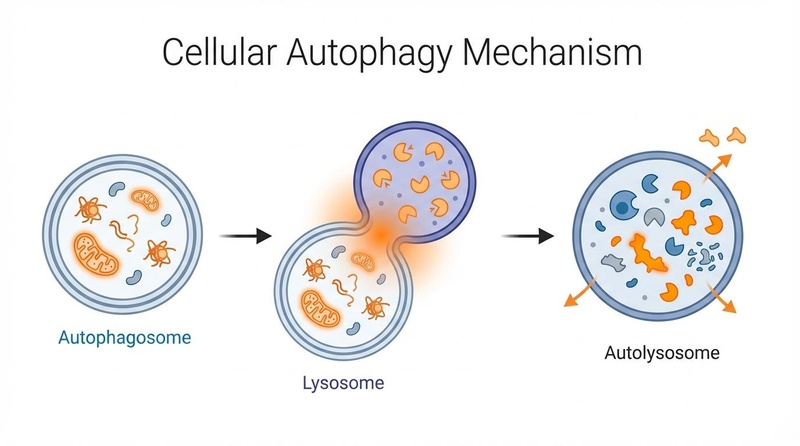
Spermidine functions as a caloric restriction mimetic, inducing autophagy—the cellular "cleanup" process where autophagosomes engulf and recycle damaged organelles like mitochondria.
Spermidine acts as a caloric restriction mimetic, triggering metabolic pathways similar to those activated during fasting.
¶ Primary Targets
- EP300 (E1A-associated protein p300): A histone acetyltransferase.
- eIF5A (Eukaryotic translation initiation factor 5A): Requires spermidine for activation (hypusination).
- TFEB (Transcription Factor EB): Master regulator of lysosomal biogenesis.
¶ Core Mechanisms
- Autophagy Induction (EP300 Inhibition): Spermidine competitively inhibits EP300, which normally suppresses autophagy by acetylating proteins like Atg5 and LC3. Inhibition leads to deacetylation and activation of these proteins, promoting cellular cleanup[10:1][15].
- Transcriptional Epigenetics: By inhibiting histone acetyltransferases, spermidine causes histone H3 hypoacetylation, upregulating the transcription of essential autophagy genes (Atg genes)[10:2][11:1].
- eIF5A-TFEB Axis: Spermidine is the substrate for hypusinating eIF5A. Active eIF5A is required for the ribosome to translate the triproline (PPP) motif of TFEB, which increases lysosomal activity and mitochondrial quality control (mitophagy)[13:1][16].
- Mitochondrial Protection: It stabilizes mitochondrial DNA and increases respiratory efficiency, reducing oxidative stress in neuronal and cardiac tissues[17][18].
¶ Pharmacokinetics
- Absorption: Highly bioavailable from both food and supplemental sources.
- Metabolism: Rapidly converted into other polyamines (spermine) or acetylated for excretion.
- Plasma Levels: Supplementation significantly increases plasma spermine (metabolite) but may not substantially raise plasma spermidine, suggesting tight homeostatic control or rapid tissue uptake[6:2][14:1][7:2].
¶ Effects on different systems
¶ Brain & Mental Health
In cognitive health, spermidine shows a distinct dose-response relationship. The SmartAge Trial (2022) found that a low dose of 0.9 mg/day over 12 months was insufficient to improve primary memory scores in adults with subjective cognitive decline (SCD), though it was safe and reduced some inflammatory markers[3:4]. However, a pilot study using 1.2 mg/day showed memory enhancement[4:3], and a multicentric trial with dementia patients found that 3.3 mg/day significantly improved Mini-Mental State Examination (MMSE) scores compared to placebo[5:4].
¶ Cardiovascular Health
The strongest evidence for cardiovascular benefit comes from the Bruneck Study, a 20-year prospective study of 829 individuals. Those in the highest third of spermidine intake had a ~40% reduced risk of heart failure and lower systolic blood pressure[1:4]. These effects are attributed to spermidine-induced autophagy in cardiomyocytes and improved arterial compliance via increased titin phosphorylation[1:5][18:1].
¶ Immune System
Spermidine levels decline sharply in aging immune cells (B-cells). Supplementation restores the hypusination of eIF5A, which is necessary for the translation of TFEB. This restoration rejuvenates autophagic flux, allowing aged B-cells to function like young cells, improving antibody responses to vaccines ex vivo and in vivo[13:2][16:1].
¶ Metabolic Health
As a caloric restriction mimetic, spermidine influences glucose and lipid metabolism. While human RCT data is sparse for weight loss, observational data (NHANES) links high intake to better metabolic profiles and reduced mortality, likely through the systemic reduction of Inflammaging[2:2].
¶ Dosage and how to take it
¶ Standard Dosing in Studies
- Dietary Baseline: The average Mediterranean diet provides 15–25 mg/day of spermidine, while standard Western diets provide 7–12 mg/day.
- Supplementation:
- Memory support: 1.2 mg to 3.3 mg per day (standard dosages in positive trials)[4:4][5:5].
- General health/Safety: Up to 6 mg per day is common in commercial extracts (aligned with EU novel food limits)[8:1].
- High-dose testing: Doses up to 40 mg/day have been tested for 28 days in older men without adverse signals[6:3].
¶ Forms and Bioavailability
- Wheat Germ Extract: The most common supplemental form. It contains spermidine alongside other polyamines (putrescine, spermine).
- Synthetic Spermidine (Trihydrochloride): Used in some research; it is highly pure but lacks the co-factors found in food extracts.
- Natto: A fermented soy food that is extremely rich in bioavailable spermidine (65–340 mg/kg)[12:2].
¶ Special Populations
- Pregnancy/Breastfeeding: Human data regarding efficacy and safety are absent.
- Children: Clinical data are absent. Given the physiological role of polyamines in rapid cellular proliferation, supplementation is not standard in pediatric populations.
- Oncology Context: Polyamines and autophagy play dual roles in oncology. While autophagy prevents tumor initiation, it can support the metabolic survival of established tumors.
¶ Safety and side effects
¶ Safety & Tolerability Summary Table
| Adverse Event / Risk | Severity / Frequency | Population & Context | Evidence Quality | Citation |
|---|---|---|---|---|
| Gastrointestinal Distress | Rare, mild | Standard oral supplementation (0.9–40 mg/day); similar to placebo | High | [3:5][6:4][14:2] |
| Systemic Toxicity | None observed | Older adults and healthy cohorts; liver, kidney, and blood parameters normal | High | [7:3] |
| Polyamine Accumulation | None observed | Older men taking high dose (40 mg/day); levels remain regulated | High | [6:5][14:3] |
| Gluten Exposure | High risk | Wheat-germ extracts; contraindicated for celiac disease / gluten sensitivity | High | [8:2][9:1] |
| Tumor Support | Theoretical risk | Active malignant tumors; autophagy may promote tumor survival | Low (Preclinical) | [11:2][15:1] |
¶ Common Side Effects
Spermidine is highly well-tolerated. Clinical trials report no significant difference in side effects (such as GI upset or headache) between spermidine and placebo groups[3:6][7:4].
¶ Less Common / Serious Concerns
There are no reported serious adverse events or organ toxicities in human trials using doses up to 40 mg/day. Its status as an endogenous molecule found in common foods (bread, cheese, vegetables) underscores its high safety profile.
¶ Who should be especially cautious or avoid it
- Celiac Disease / Gluten Sensitivity: Most spermidine supplements are derived from wheat germ. Patients with gluten-related disorders must ensure their supplement is certified gluten-free or derived from non-wheat sources (like soybeans).
- Active Cancer: As noted, the role of autophagy in cancer is dual; spermidine may be protective before cancer develops but theoretically could support established tumor growth[11:3].
¶ Drug and supplement interactions
¶ Pharmacokinetic Interactions
Spermidine is not known to significantly inhibit or induce major CYP450 enzymes at standard supplemental doses.
¶ Pharmacodynamic Interactions
- Autophagy Inducers: Theoretical synergy exists with other autophagy stimulators like Metformin, Rapamycin, or Resveratrol.
- Polyamines: Avoid combining with high-dose putrescine or spermine supplements unless specifically formulated, as polyamine balance is tightly regulated.
¶ Combining Spermidine with other supplements (“stacks”)
- The Longevity Stack: Often combined with NMN or Nicotinamide Riboside. Rationale: NAD+ boosters support sirtuin activity, while spermidine supports the downstream autophagic cleanup triggered by sirtuins.
- Metabolic Synergy: Combined with Quercetin or Fisetin to target both cellular senescence (senolytics) and cellular cleanup (autophagy inducer).
¶ Practical FAQ
How long does it take for spermidine to work?
Can I take spermidine long term?
Yes. Long-term studies (12 months) in humans have shown excellent safety. Epidemiological data suggests that high lifelong intake from food is associated with better health outcomes and longevity[1:6].
Is wheat germ extract the best way to get it?
Wheat germ extract is the most widely studied supplemental form. However, food sources like Natto or aged cheese provide high amounts and include the full spectrum of natural polyamines.
Does spermidine help with hair growth?
Polyamines are known to be essential for hair follicle cell proliferation. Clinical trials suggest that oral spermidine prolongs the growth (anagen) phase of the hair cycle, increasing hair bulb proliferation markers[12:3].
Can I take it with metformin?
There is no evidence of adverse interactions between spermidine and metformin. Both induce autophagy via different pathways (EP300 vs. AMPK), suggesting potential mechanistic synergy.
¶ How we evaluated the evidence
Evidence for spermidine was evaluated by prioritizing human randomized controlled trials (RCTs) and long-term prospective cohort studies. Mechanistic insights were derived from high-impact peer-reviewed journals (Science, Nature Medicine, JAMA).
- High Certainty: Mechanism of action (autophagy induction via EP300) and safety profile in humans.
- Moderate Certainty: Cognitive benefits (dose-dependent) and dietary association with cardiovascular mortality.
- Low Certainty: Direct longevity extension in humans (extrapolated from animal models and cohort data).
¶ References
Eisenberg, T., Abdellatif, M., Schroeder, S., et al. (2016). Cardioprotection and lifespan extension by the natural polyamine spermidine. Nature Medicine, 22(12), 1428-1438. https://pmc.ncbi.nlm.nih.gov/articles/PMC5806691/ ↩︎ ↩︎ ↩︎ ↩︎ ↩︎ ↩︎ ↩︎
Chinese Public Health Research Group / NHANES Cohort. (2022). Association between dietary spermidine and all-cause mortality: Evidence from NHANES. Frontiers in Public Health, 10, 949170. https://www.frontiersin.org/journals/public-health/articles/10.3389/fpubh.2022.949170/full ↩︎ ↩︎ ↩︎
Schwarz, C., Benson, G. S., Horn, N., et al. (2022). Effects of Spermidine Supplementation on Cognition and Biomarkers in Older Adults With Subjective Cognitive Decline (SmartAge): A Randomized Clinical Trial. JAMA Network Open, 5(5), e2213785. https://pubmed.ncbi.nlm.nih.gov/35616942/ ↩︎ ↩︎ ↩︎ ↩︎ ↩︎ ↩︎ ↩︎ ↩︎
Wirth, M., Benson, G., Schwarz, C., et al. (2018). The effect of spermidine on memory performance in older adults at risk for dementia: A randomized controlled trial. Cortex, 109, 181-188. https://pubmed.ncbi.nlm.nih.gov/30388439/ ↩︎ ↩︎ ↩︎ ↩︎ ↩︎
Pekar, T., Bruckner, K., Pauschenwein-Frantsich, S., et al. (2021). The positive effect of spermidine in older adults suffering from dementia: first results of a 3-month trial. Wiener Klinische Wochenschrift, 133(19-20), 1010-1017. https://pubmed.ncbi.nlm.nih.gov/33211152/ ↩︎ ↩︎ ↩︎ ↩︎ ↩︎ ↩︎ ↩︎
Senekowitsch, S., et al. (2024). Supplementation of spermidine at 40 mg/day has minimal effects on circulating polyamines: An exploratory double-blind randomized controlled trial in older men. Nutrition Research, 132, 29-37. https://pubmed.ncbi.nlm.nih.gov/39405978/ ↩︎ ↩︎ ↩︎ ↩︎ ↩︎ ↩︎
Schwarz, C., Stekovic, S., Wirth, M., et al. (2018). Safety and tolerability of spermidine supplementation in mice and older adults with subjective cognitive decline. Aging (Albany NY), 10(1), 19-33. https://pmc.ncbi.nlm.nih.gov/articles/PMC5807086/ ↩︎ ↩︎ ↩︎ ↩︎ ↩︎
Commission Implementing Regulation (EU) 2020/443: Authorising the change of the specifications of the novel food spermidine-rich wheat germ extract (Triticum aestivum). EUR-Lex. https://eur-lex.europa.eu/legal-content/EN/TXT/HTML/?uri=CELEX:32020R0443 ↩︎ ↩︎ ↩︎
GRAS Notice GRN 889: Wheat germ extract (containing spermidine). US Food and Drug Administration. https://www.fda.gov/media/138730/download ↩︎ ↩︎
Pietrocola, F., Lachkar, S., Enot, D. P., et al. (2015). Spermidine induces autophagy by inhibiting the acetyltransferase EP300. Cell Death & Differentiation, 22(3), 509-516. https://pmc.ncbi.nlm.nih.gov/articles/PMC4326581/ ↩︎ ↩︎ ↩︎
Madeo, F., Eisenberg, T., Pietrocola, F., & Kroemer, G. (2018). Spermidine in health and disease. Science, 359(6374), eaan2788. https://pmc.ncbi.nlm.nih.gov/articles/PMC6287690/ ↩︎ ↩︎ ↩︎ ↩︎
Rinaldi, F., Marzani, B., Pinto, D., & Ramot, Y. (2017). A spermidine-based nutritional supplement prolongs the anagen phase of hair follicles in humans: a randomized, placebo-controlled, double-blind study. Dermatology Practical & Conceptual, 7(4), 17-21. https://pmc.ncbi.nlm.nih.gov/articles/PMC5718121/ ↩︎ ↩︎ ↩︎ ↩︎
Alsaleh, G., Ali, M., Kayvanjoo, A. H., et al. (2026). Spermidine Mitigates Immune Cell Senescence and Boosts Vaccine Responses in Healthy Older Adults—A Pilot Study. Aging Cell. https://onlinelibrary.wiley.com/doi/10.1111/acel.70545 ↩︎ ↩︎ ↩︎
Senekowitsch, S., Wietkamp, E., Grimm, M., et al. (2023). High-dose spermidine supplementation does not increase spermidine levels in blood plasma and saliva of healthy adults: a randomized placebo-controlled pharmacokinetic and metabolomic study. European Journal of Nutrition, 62(4), 1621-1632. https://pmc.ncbi.nlm.nih.gov/articles/PMC10143675/ ↩︎ ↩︎ ↩︎ ↩︎
Sacitharan, P. K., et al. (2018). Spermidine restores dysregulated autophagy and polyamine synthesis in aged and osteoarthritic chondrocytes via EP300. Experimental & Molecular Medicine, 50(1), 1-10. https://pmc.ncbi.nlm.nih.gov/articles/PMC6397291/ ↩︎ ↩︎
Zhang, H. Y., Alsaleh, G., Falcon, J., et al. (2019). Polyamines Control eIF5A Hypusination, TFEB Translation, and Autophagy to Reverse B Cell Senescence. Molecular Cell, 76(1), 138-151. https://pmc.ncbi.nlm.nih.gov/articles/PMC6863385/ ↩︎ ↩︎
MDPI. (2024). Spermidine ameliorates mitochondrial function in young and aged human iPSC-derived neurons. Antioxidants, 13(12), 1482. https://www.mdpi.com/2076-3921/13/12/1482 ↩︎
Schroeder, S., et al. (2021). Spermidine improves cardiac mitochondrial function. Journal of Anatomy, 239(6), 1234-1245. https://pmc.ncbi.nlm.nih.gov/articles/PMC9773166/ ↩︎ ↩︎