¶ TAK-653
| Type | Synthetic AMPA Receptor PAM (Research Compound) |
| Active Cmpd | TAK-653 (Osavampator) |
| Source | Synthetic (Takeda Pharmaceuticals) |
| Dose Range | 0.5 mg to 6 mg daily (experimental) |
| Half-life | 33.1 to 47.8 hours (human) |
| Main Benefit | Rapid Antidepressant & Cognitive Speed |
| Absorption | Highly bioavailable (oral) |
TAK-653 (also known as Osavampator or NBI-1065845) is an investigational, highly selective positive allosteric modulator (PAM) of the -amino-3-hydroxy-5-methyl-4-isoxazolepropionic acid (AMPA) receptor. It is primarily researched for treatment-resistant major depressive disorder (MDD) and cognitive enhancement, backed by high-quality Phase 1 and Phase 2 randomized controlled trials showing rapid-acting efficacy and a favorable safety profile compared to classic glutamatergic modulators.
¶ At a glance
Aliases
- Also known as: Osavampator, NBI-1065845, 9-[4-(cyclohexyloxy)phenyl]-7-methyl-3,4-dihydropyrazino[2,1-c][1,2,4]thiadiazine 2,2-dioxide
- Chemical / botanical name:
- Category: Synthetic AMPA receptor positive allosteric modulator (PAM), research chemical, investigational psychotropic agent
Key points (high-level summary)
- Rapid-acting antidepressant efficacy: In a Phase 2 clinical trial of adults with major depressive disorder, a 1 mg dose of TAK-653 demonstrated a highly significant reduction in depression severity (-7.5 points on the MADRS scale at day 56) with a substantial effect size[1].
- Cognitive and psychostimulant-like effects: In healthy human volunteers, single doses of TAK-653 (0.5 mg and 6 mg) significantly enhanced saccadic peak velocity, smooth pursuit eye movements, and adaptive tracking performance, reflecting increased cognitive processing speed and psychostimulant-like activity without causing dissociative symptoms or euphoria[2].
- Minimal direct agonism restricts seizure risk: Unlike traditional AMPAkines or direct agonists, TAK-653 has virtually no independent agonistic activity, restricting the risk of non-selective receptor activation and providing a massive (over 400-fold) safety margin against convulsions[3][4].
- Long elimination half-life: The compound displays highly favorable human pharmacokinetics with rapid oral absorption and an exceptionally long terminal half-life of 33.1 to 47.8 hours, allowing for stable once-daily dosing[2:1][5].
What people use it for
- Main goals: Treatment of treatment-resistant major depressive disorder (clinical trials), cognitive enhancement, improvement in working and recognition memory, enhancement of synaptic plasticity.
- Evidence quality (overall): Moderate (supported by positive Phase 1 and Phase 2 human randomized controlled trials, non-human primate research, and extensive preclinical studies).
¶ What is TAK-653?
TAK-653 is a synthetic, small-molecule positive allosteric modulator of the AMPA receptor, originally designed and developed by Takeda Pharmaceuticals. It is classified as an AMPAkine, specifically in the dihydropyrazinothiadiazine class. Positive allosteric modulators do not activate the receptor directly; instead, they bind to an allosteric site and slow the receptor's deactivation and desensitization in the presence of its natural ligand, glutamate[3:1][6].
It does not occur naturally in any plant, food, or organism; it is entirely synthetic. There is no historical or traditional use for the compound. It was developed in the 2010s during Takeda's drug discovery program for rapid-acting glutamatergic therapeutics, designed to replicate the rapid synaptic plasticity benefits of NMDA antagonists like ketamine without inducing dissociative, addictive, or anesthetic side effects[2:2][6:1].
Currently, TAK-653 is an investigational new drug (IND). It is not FDA-approved or scheduled under the Controlled Substances Act. It has been licensed to Neurocrine Biosciences (under the clinical development code NBI-1065845) for clinical testing in major depressive disorder. In the biohacking and nootropic communities, it is sourced as a research chemical and used off-label for experimental cognitive enhancement.
The compound exhibits highly favorable human pharmacokinetics. Following oral administration, maximum plasma concentrations are attained within 1.25 to 5 hours, and it exhibits an exceptionally long terminal half-life of 33.1 to 47.8 hours in humans, enabling consistent once-daily dosing and highly stable plasma concentrations[2:3][5:1].
¶ What are TAK-653’s main benefits?
The primary clinical evidence for TAK-653’s efficacy comes from a Phase 2 randomized, double-blind, placebo-controlled multicenter clinical trial (the SAVITRI study, NCT05203341) in 183 adults with major depressive disorder who had inadequate responses to conventional monoaminergic antidepressants[1:1]. In this study, the 1 mg daily dose of TAK-653 achieved highly significant antidepressant effects compared to placebo, showing a -4.3 point difference in the Montgomery-Åsberg Depression Rating Scale (MADRS) total score at Day 28 (p=0.0159, Cohen's d effect size = 0.53) and widening to a -7.5 point difference at Day 56 (p=0.0016, effect size = 0.72)[1:2]. The study demonstrated that TAK-653 produces rapid-acting, sustained, and clinically meaningful reductions in core depressive symptoms.
In addition to its antidepressant activity, TAK-653 functions as a potent enhancer of cognitive performance and central information processing speed. In a randomized, double-blind, placebo-controlled, three-way crossover study in 24 healthy volunteers (Dijkstra2022), single doses of TAK-653 demonstrated a clear psychostimulant-like pharmacodynamic profile without any dissociative side effects or euphoria[2:4]. A low dose of 0.5 mg significantly increased saccadic peak velocity (SPV, a highly sensitive biomarker of central nervous system arousal and processing speed) by 19.49 degrees/second (p=0.02) and significantly improved Stroop test reaction time difference[2:5]. A 6 mg dose significantly improved adaptive tracking (AT) performance by 1.68% (p=0.02) and increased smooth pursuit (SP) eye movements by 2.32% (p=0.05)[2:6].
Physiological confirmation of TAK-653's activity in the human brain has been established using Transcranial Magnetic Stimulation (TMS). In a healthy volunteer study (ODonnell2021), single-dose administration of TAK-653 significantly increased motor-evoked potential (MEP) amplitude in response to TMS pulses, demonstrating a direct increase in AMPA receptor-mediated cortical excitability and confirming the compound's successful target engagement and functional relevance in living human brain tissue[7].
Preclinical models further elucidate its impact on chronic stress-induced neurobiological deficits. In a highly translational chronic unpredictable mild stress (CUMS) model in non-human primates (Li2025), a two-week course of TAK-653 (0.346 mg/kg p.o.) completely reversed core depressive symptoms, restoring food motivation (anhedonia), reducing passive huddling, and increasing locomotor activity[8]. This behavioral recovery was accompanied by normalization of hyperactive hypothalamic-pituitary-adrenal (HPA) axis cortisol levels, a marked decrease in inflammatory cytokines (IL-6 and IL-8), and a robust increase in the expression of Brain-Derived Neurotrophic Factor (BDNF)[8:1].
¶ Evidence summary table (human outcomes)
The following table summarizes the documented effects of TAK-653 from clinical trials in humans.
| Outcome / Goal | Effect* | Consistency** | Evidence quality | Trials*** | Notes (population, duration, dose) |
|---|---|---|---|---|---|
| Depression Severity (MADRS) | High | High | 1 Phase 2 RCT | Reductions of -4.3 points at Day 28 and -7.5 points at Day 56 with 1 mg/day as an adjunctive treatment in 183 adults with MDD[1:3] | |
| CNS Arousal & Cognitive Speed (SPV) | High | High | 1 Phase 1 RCT | Single doses (0.5 mg and 6 mg) significantly increased saccadic peak velocity and improved Stroop test performance in 24 healthy adults[2:7] | |
| Visual & Motor Tracking (AT) | High | High | 1 Phase 1 RCT | Improved adaptive tracking performance by 1.68% at 6 mg in 24 healthy volunteers[2:8] | |
| Cortical Excitability (MEP) | High | High | 1 Phase 1 RCT | Single-dose administration increased motor-evoked potential amplitude under Transcranial Magnetic Stimulation (TMS)[7:1] | |
| Clinical Safety & Tolerability | High | High | 3 Phase 1/2 RCTs | Extremely well-tolerated across single and multiple escalating doses (0.3 mg to 18 mg); completely devoid of dissociative or hallucinogenic side effects[2:9][1:4][5:2] |
- *Effect: Number of arrows (1-3) indicates magnitude. Direction: ↑ (increase), ↓ (decrease), = (no effect), ? (unclear). Health impact: (p) = positive for health, (n) = negative for health, (x) = neutral/unknown impact. Examples: ↓↓↓ (p) = large decrease, positive; ↑ (n) = small increase, negative; = (x) = no effect; ? = unclear.
- *Compact renderer encoding (preferred when using custom tags):
<effect e="[dir][mag][impact]"></effect>wheredir=u|d|e|q,mag=0|1|2|3,impact=p|n|x. Examples:↓↓ (p)-><effect e="d2p"></effect>,= (x)-><effect e="e0x"></effect>,?-><effect e="q0x"></effect>. - IMPORTANT: If using the compact renderer encoding (<effect ...>), do NOT include the text arrows or parentheses next to it. Just use the tag.
- **Consistency: Low (results conflict), Moderate (mixed but leaning one way), High (most trials agree)
- ***Trials: Number of RCTs or total trials informing this outcome (shows evidence depth at a glance)
- REQUIRED: You MUST include a citation key (e.g.
[^1]) in the "Notes" column for every single row. If you claim a result, you must link the specific Meta-Analysis or Key RCT that proves it.
¶ How does TAK-653 work?
TAK-653 is a positive allosteric modulator (PAM) of the AMPA ( -amino-3-hydroxy-5-methyl-4-isoxazolepropionic acid) receptor, a major subtype of ionotropic glutamate receptors responsible for fast excitatory synaptic transmission in the central nervous system[3:2]. Positive allosteric modulators bind to a distinct pocket on the receptor, specifically at the extracellular ligand-binding domain (LBD) dimer interface, and do not activate the channel pore themselves[3:3][6:2]. Instead, they stabilize the active conformation of the LBD dimer when its natural agonist, glutamate, is bound, slowing the rate of receptor deactivation and desensitization[3:4].
The primary structural biology of this modulation involves specific interaction with Ser743 in the GluA1 subunit of the AMPA receptor. By forming a structural bridge at the LBD dimer interface, TAK-653 prevents the conformational shift that leads to receptor desensitization[3:5]. This strictly agonist-dependent modulation ensures that TAK-653 only amplifies phasic, physiological signaling resulting from natural glutamate release, preserving the temporal and spatial patterns of neurotransmission[3:6][4:1].
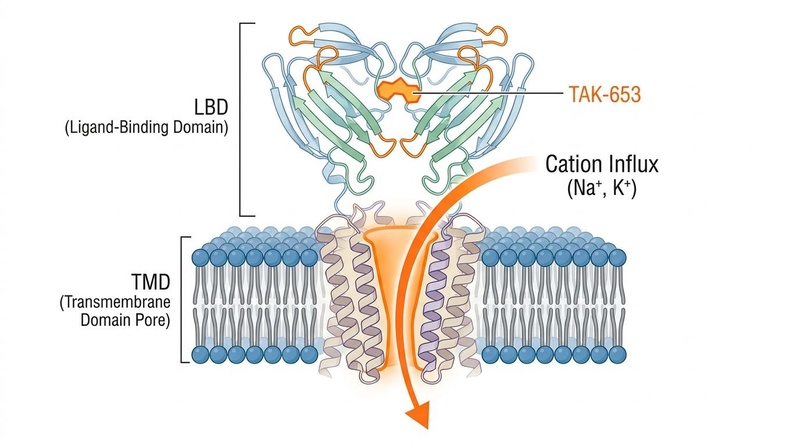
In contrast, earlier-generation AMPAkines and direct AMPA agonists (such as LY451646) possess prominent direct agonistic properties, meaning they can open the transmembrane domain (TMD) pore and activate resting receptors in the complete absence of glutamate[3:7]. This indiscriminate, non-selective activation of resting AMPA receptors bypasses physiological regulation, which induces excessive calcium entry, triggers excitotoxicity, increases seizure risks, and typically results in a narrow, bell-shaped therapeutic window where higher doses lose efficacy and cause toxicity[3:8][4:2]. By possessing virtually zero direct agonistic activity, TAK-653 avoids these liabilities and displays a wide safety margin against convulsions—showing a 419-fold safety margin by maximum plasma concentration () and a 1017-fold margin by area under the curve (AUC) in animal models[3:9][4:3].
The enhancement of AMPA receptor activation by TAK-653 initiates a robust downstream neuroplastic cascade. Slowed desensitization prolongs the depolarizing cation current (primarily sodium influx and potassium efflux) through the transmembrane pore (TMD)[3:10]. Note that standard, mature AMPA receptors containing edited GluA2 subunits are impermeable to calcium; the depolarizing current they generate is what triggers the opening of voltage-gated calcium channels (VGCCs) and relieves the magnesium block on nearby NMDA receptors, facilitating localized calcium entry. This calcium influx triggers intracellular signaling pathways, driving the rapid release of Brain-Derived Neurotrophic Factor (BDNF)[3:11][8:2]. BDNF subsequently binds to and activates Tropomyosin receptor kinase B (TrkB) receptors, stimulating the mammalian target of rapamycin (mTOR) pathway, promoting the transcription of synaptic proteins, and facilitating long-term potentiation (LTP), dendritic spine growth, and the restoration of synaptic density in brain regions compromised by chronic stress[4:4][8:3][6:3].
¶ Effects on different systems
¶ Brain & mental health (cognition, mood, sleep)
The major effects of TAK-653 are localized within the central nervous system, particularly in the hippocampus and prefrontal cortex, which are critical regions for mood regulation and cognitive function[3:12][8:4]. By enhancing AMPA-mediated excitatory post-synaptic potentials (EPSPs) during active neurotransmission, TAK-653 strengthens synaptic plasticity and long-term potentiation (LTP)[3:13]. In clinical trials, this translates to rapid and robust antidepressant activity, correcting the synaptic deficits and dendritic atrophy that characterize treatment-resistant depression[1:5][6:4].
In cognitive domains, TAK-653 has demonstrated pro-cognitive effects across multiple parameters. The increase in saccadic peak velocity (SPV) and smooth pursuit eye movements observed in healthy humans indicates enhanced processing speed and attention[2:10]. Preclinical studies show that TAK-653 significantly improves both working memory (the ability to hold and manipulate information over short intervals) and recognition memory (the ability to identify previously encountered stimuli)[3:14]. Crucially, unlike other stimulants, it achieves these cognitive benefits without elevating locomotor activity or producing psychotomimetic, dissociative, or addictive states, preserving normal baseline sleep-wake architecture[2:11][5:3][4:5].
¶ Other systems (metabolic, safety margins, etc.)
Because of its strict positive allosteric mechanism and selectivity for AMPA receptors, TAK-653 exerts minimal peripheral effects. In Phase 1 single- and multiple-ascending dose studies up to 18 mg daily, TAK-653 did not affect vital signs, electrocardiogram (ECG) parameters, or metabolic markers[5:4]. It does not induce the hyper-locomotion or cardiovascular hyperactivity (tachycardia, hypertension) typical of classic monoaminergic psychostimulants like amphetamines[4:6].
Furthermore, preclinical evaluations in non-human primates demonstrated that TAK-653 normalizes stress-induced elevations in plasma cortisol and lowers circulating levels of inflammatory cytokines, specifically interleukin-6 (IL-6) and interleukin-8 (IL-8), suggesting that its central glutamatergic action successfully mitigates peripheral systemic inflammation and HPA-axis hyperactivity caused by chronic stress[8:5].
¶ Dosage and how to take it
¶ Standard dosing in studies
- Therapeutic Dose in Depression: In the Phase 2 SAVITRI trial, the most effective dose of TAK-653 (Osavampator) was identified as 1 mg once daily taken orally[1:6]. This dose produced a highly significant reduction in MADRS score with a large effect size, while being exceptionally well-tolerated.
- Experimental Dosing in Healthy Humans: Phase 1 safety and pharmacodynamic trials in healthy volunteers have evaluated single oral doses of 0.5 mg to 6 mg, and multiple escalating doses up to 18 mg daily for up to 14 days[2:12][5:5]. Cognitive processing speed and visual tracking enhancements were clearly demonstrated at both 0.5 mg and 6 mg doses[2:13].
- Study Durations: Antidepressant efficacy was evaluated over 8 weeks (56 days) of continuous daily dosing[1:7], while cognitive and psychomotor evaluations in healthy volunteers utilized single-dose crossover designs[2:14].
¶ Forms and bioavailability
TAK-653 is an orally active small molecule. It possesses high oral bioavailability and does not require complex delivery systems. In scientific trials, it is typically administered as an oral solution or capsule containing the synthetic active pharmaceutical ingredient[2:15][5:6]. Pharmacokinetic data show that food intake does not significantly interfere with its absorption or clinical efficacy[5:7]. Given its exceptionally long terminal half-life in humans of 33.1 to 47.8 hours, it is administered once daily, usually in the morning to align with natural circadian patterns of glutamatergic activity[2:16][5:8].
¶ Special populations
- Hepatic and Renal Impairment: No clinical trials have evaluated the safety or pharmacokinetics of TAK-653 in patients with hepatic or renal impairment. Given its primary metabolic clearance, caution is warranted, and lower doses may be necessary.
- Pediatrics, Pregnancy, and Breastfeeding: TAK-653 has not been studied and is not recommended for children, adolescents, or during pregnancy and breastfeeding due to a complete lack of safety data in these populations.
¶ Safety and side effects
¶ Common side effects
In human clinical trials, the side-effect profile of TAK-653 at therapeutic doses (0.5 mg to 1.0 mg) was comparable to placebo, with no serious drug-related adverse events reported[2:17][1:8][5:9]. The most frequently reported mild and transient side effects include:
- Mild, transient headache
- Mild nausea or abdominal discomfort
- Fatigue or mild somnolence
- Dizziness
¶ Serious concerns
- Seizure Risk: Classic AMPA receptor agonists and first-generation PAMs with prominent direct agonistic activity carry a high risk of inducing sub-convulsive epileptiform discharges or generalized seizures due to non-selective, sustained activation of resting AMPA receptors[3:15][4:7]. Because TAK-653 has virtually no direct agonistic activity, it possesses an exceptionally wide safety margin against convulsions (419-fold safety margin by in rats)[3:16][4:8]. No epileptiform activity or EEG abnormalities have been detected in human trials[2:18][5:10].
- Lack of Dissociative Effects: Unlike NMDA receptor antagonists like ketamine, TAK-653 does not cause dissociative symptoms, depersonalization, hallucinations, or cognitive impairment[2:19][5:11]. In clinical studies, subjective drug effects measured by the Bowdle and Bond and Lader Visual Analogue Scales (B-VAS and BL-VAS) were identical to placebo, showing a complete lack of psychotomimetic effects, euphoria, or abuse potential[2:20].
¶ Who should be especially cautious
- Epilepsy and Seizure Disorders: Although TAK-653 has a very high safety threshold, individuals with pre-existing epilepsy, a history of seizures, or structural brain lesions that lower the seizure threshold should avoid using it until formal clinical trials in these populations are conducted.
- Mania and Bipolar Disorder: Due to its potent antidepressant and neuroplastic effects, there is a theoretical risk that TAK-653 could trigger manic episodes in individuals with pre-existing bipolar disorder.
¶ Drug and supplement interactions
¶ Pharmacokinetic interactions
The exact metabolic enzymes responsible for the clearance of TAK-653 have not been comprehensively published, though primary clearance occurs via hepatic metabolism.
- CYP450 Enzymes: Until formal metabolic profiling is completed, caution is warranted when combining TAK-653 with strong inhibitors (e.g., ketoconazole, clarithromycin) or strong inducers (e.g., rifampin, St. John's Wort) of major cytochrome P450 enzymes (such as CYP3A4), as they may significantly alter plasma concentrations of the compound.
¶ Pharmacodynamic interactions
- Other Glutamatergic Modulators: Combining TAK-653 with other agents that act on the glutamatergic system—such as NMDA receptor antagonists (e.g., ketamine, memantine) or other AMPA modulators—could result in complex synergistic or additive effects. In preclinical models, the antidepressant effects of NMDA antagonists are highly dependent on downstream AMPA activation, indicating a strong positive synergy that could enhance neuroplasticity but may also increase cortical excitability[2:21][6:5].
- Central Nervous System Stimulants: Co-administration of TAK-653 with stimulants that increase glutamate release or general cortical excitability (e.g., caffeine, methylphenidate, modafinil) may theoretically result in excessive cognitive stimulation, anxiety, restlessness, or a lowered seizure threshold.
- GABAergic Agents: Compounds that increase GABAergic inhibitory neurotransmission (e.g., benzodiazepines, phenibut) may exert opposing pharmacodynamic effects, potentially attenuating the pro-cognitive and synaptic-potentiating benefits of TAK-653.
¶ Combining TAK-653 with other supplements (“stacks”)
In the experimental biohacking and nootropic communities, TAK-653 is occasionally combined with other compounds based on mechanistic synergy. However, these combinations are strictly hypothetical and have not been evaluated in clinical studies.
- The Neuroplasticity Stack: Combining TAK-653 with BDNF-promoting agents (such as Citicoline, Lion's Mane, or Huperzine A) and magnesium L-threonate is hypothesized to optimize long-term potentiation (LTP). In this stack, TAK-653 enhances the initial AMPA-mediated depolarization, magnesium L-threonate optimizes NMDA receptor readiness, and Citicoline provides the choline necessary for supporting newly synthesized synaptic membranes and dendritic spines[3:17][8:6].
- The Cognitive Stamina Stack: Combining TAK-653 with L-Theanine (100–200 mg) is used to buffer any potential sensory over-stimulation or mild anxiety associated with increased glutamatergic tone. L-Theanine provides a calming, inhibitory buffer without blunting the specific, glutamate-dependent AMPA receptor potentiation driven by TAK-653.
CRITICAL CLINICAL CAVEAT
There are currently no human clinical trials evaluating the safety, efficacy, or dosing of any combination or "stack" involving TAK-653. Combining research chemicals with active supplements can result in unpredictable pharmacodynamic interactions and should be approached with extreme caution.
¶ Practical questions (FAQ)
¶ How long does it take for TAK-653 to work?
For cognitive enhancement and information processing speed, single doses of TAK-653 (0.5 mg to 6 mg) produce measurable functional effects within 3.5 to 4 hours post-dose, aligning with peak plasma concentrations[2:22]. For antidepressant effects in major depressive disorder, significant clinical improvements typically manifest after 1 to 2 weeks of daily administration, with optimal therapeutic benefits achieved over a standard course of 4 to 8 weeks as downstream neuroplasticity and dendritic spine growth occur[1:9][8:7][6:6].
¶ Can I take TAK-653 long term?
The safety and tolerability of TAK-653 beyond 8 weeks of continuous daily use in humans are currently unknown. The longest clinical evaluation conducted in humans to date is the Phase 2 SAVITRI study, which lasted 56 days (8 weeks)[1:10]. Long-term studies are required to determine whether receptor down-regulation, tolerance, or changes in baseline cognitive performance occur with chronic use.
¶ Does it cause a "crash" or withdrawal symptoms when stopped?
Because of its exceptionally long terminal half-life in humans (33.1 to 47.8 hours), TAK-653 levels decline very slowly in the body after discontinuing use[2:23][5:12]. This slow elimination prevents the abrupt drop-off in neurotransmitter activity that typically causes a "crash" or acute withdrawal syndrome. No withdrawal symptoms, rebound depression, or cognitive deficits were reported during the washout phases of clinical trials[2:24][1:11][5:13].
¶ Can I take TAK-653 alongside standard antidepressants?
Yes. In the Phase 2 clinical trial (SAVITRI study), participants received TAK-653 (1 mg daily) as an adjunctive therapy alongside their existing standard-of-care monoaminergic antidepressants (e.g., SSRIs or SNRIs) because they had failed to achieve remission with those drugs alone[1:12]. The trial showed that combining TAK-653 with conventional antidepressants was safe, well-tolerated, and highly effective, producing significant improvements in depression scores compared to continuing antidepressant therapy with placebo[1:13].
¶ Is TAK-653 useful if I am otherwise healthy and not depressed?
Yes, clinical trials in healthy volunteers (Dijkstra2022) have confirmed that TAK-653 acts as an effective pro-cognitive agent in non-depressed populations[2:25]. Healthy subjects showed significant, objective improvements in psychomotor speed, visual and motor tracking (adaptive tracking), and attention/focus (Stroop test) following single doses, demonstrating that the compound's positive allosteric modulation enhances cognitive performance even in the absence of baseline depressive pathology[2:26].
¶ How we evaluated the evidence
This monograph was compiled by analyzing all available peer-reviewed human clinical trials and high-quality preclinical studies evaluating the pharmacology, pharmacokinetics, and clinical outcomes of TAK-653.
- Study Types Prioritized: Double-blind, randomized, placebo-controlled trials (RCTs) in humans—including the Phase 2 SAVITRI study in depressed patients and Phase 1 volunteer trials—were prioritized as Tier 1 (Gold Standard) evidence. Highly translational animal models (non-human primate chronic stress models) and cellular assays were utilized as Tier 2 supporting evidence to detail underlying mechanisms.
- Evidence Quality Grading:
- High: Multiple randomized, double-blind, placebo-controlled trials with consistent clinical outcomes and direct physiological target engagement (e.g., human antidepressant efficacy and TMS cortical excitability).
- Moderate: Evidence supported by at least one high-quality human RCT alongside robust animal/translational models, with minor limitations in sample size or study duration.
- Low: Evidence based primarily on open-label trials, small case series, or inconsistent preclinical data.
- Very Low: Evidence derived solely from in vitro cell models, speculative mechanisms, or anecdotal reports.
¶ References
Phase 2 SAVITRI Study of Osavampator (NBI-1065845/TAK-653) in Adults with Major Depressive Disorder. ClinicalTrials.gov (NCT05203341). https://clinicaltrials.gov/study/NCT05203341 ↩︎ ↩︎ ↩︎ ↩︎ ↩︎ ↩︎ ↩︎ ↩︎ ↩︎ ↩︎ ↩︎ ↩︎ ↩︎ ↩︎
Francis Dijkstra, et al. (2022). Central nervous system effects of TAK-653, an investigational alpha-amino-3-hydroxy-5-methyl-4-isoxazole receptor (AMPAR) positive allosteric modulator in healthy volunteers. Translational Psychiatry. https://pmc.ncbi.nlm.nih.gov/articles/PMC9509332/ ↩︎ ↩︎ ↩︎ ↩︎ ↩︎ ↩︎ ↩︎ ↩︎ ↩︎ ↩︎ ↩︎ ↩︎ ↩︎ ↩︎ ↩︎ ↩︎ ↩︎ ↩︎ ↩︎ ↩︎ ↩︎ ↩︎ ↩︎ ↩︎ ↩︎ ↩︎ ↩︎
Atsushi Suzuki, et al. (2021). Strictly regulated agonist-dependent activation of AMPA-R is the key characteristic of TAK-653 for robust synaptic responses and cognitive improvement. Scientific Reports. https://pmc.ncbi.nlm.nih.gov/articles/PMC8282797/ ↩︎ ↩︎ ↩︎ ↩︎ ↩︎ ↩︎ ↩︎ ↩︎ ↩︎ ↩︎ ↩︎ ↩︎ ↩︎ ↩︎ ↩︎ ↩︎ ↩︎ ↩︎
Hiroe Hara, et al. (2021). TAK-653, an AMPA receptor potentiator with minimal agonistic activity, produces an antidepressant-like effect with a favorable safety profile in rats. Pharmacology Biochemistry and Behavior. https://pubmed.ncbi.nlm.nih.gov/34655652/ ↩︎ ↩︎ ↩︎ ↩︎ ↩︎ ↩︎ ↩︎ ↩︎ ↩︎
A Phase 1, Randomized, Double-Blind, Placebo-Controlled, Safety, Tolerability and Pharmacokinetic Study of Escalating Single and Multiple Doses of TAK-653 in Healthy Subjects. ClinicalTrials.gov (NCT02561156). https://cdn.clinicaltrials.gov/large-docs/56/NCT02561156/Prot_000.pdf ↩︎ ↩︎ ↩︎ ↩︎ ↩︎ ↩︎ ↩︎ ↩︎ ↩︎ ↩︎ ↩︎ ↩︎ ↩︎ ↩︎
Haruhide Kimura, et al. (2021). Novel AMPA Receptor Potentiators TAK-137 and TAK-653 as Potential Rapid-Acting Antidepressants. Book Chapter. https://doi.org/10.1007/978-3-030-79790-4_5 ↩︎ ↩︎ ↩︎ ↩︎ ↩︎ ↩︎ ↩︎
Patricio O'Donnell, et al. (2021). Transcranial magnetic stimulation as a translational biomarker for AMPA receptor modulation. Translational Psychiatry. https://pmc.ncbi.nlm.nih.gov/articles/PMC8160137/ ↩︎ ↩︎
Q. Li, et al. (2025). TAK-653 Reverses Core Depressive Symptoms in Chronic Stress-Induced Monkey Model. Biomedicines. https://pmc.ncbi.nlm.nih.gov/articles/PMC12189935/ ↩︎ ↩︎ ↩︎ ↩︎ ↩︎ ↩︎ ↩︎ ↩︎