¶ Therapeutic Plasma Exchange (TPE)
| Indication | Medical Use (Autoimmune, Neurological, etc.) vs Investigational (Longevity) |
| Access | Rx |
| Dosing Sched | Variable (e.g., Every 24-48h for acute conditions) |
| Safety Profile | Moderate (Well-established risks in clinical settings) |
| Key Marker | Disease-specific biomarkers, electrolyte balance, coagulation |
| Est. Cost | High (Procedure-dependent) |
Therapeutic plasma exchange (TPE) is a medical procedure that involves removing a patient's plasma and replacing it with an appropriate fluid, typically 5% albumin or fresh frozen plasma. This extracorporeal therapy is an established treatment for a variety of antibody- or toxin-mediated diseases, such as thrombotic thrombocytopenic purpura and myasthenia gravis, as recognized by guidelines from organizations like the American Society for Apheresis (ASFA) [1]. While its efficacy in these conditions is well-documented, TPE is also being explored for potential applications in age-related conditions and as a longevity intervention, though evidence in these areas remains largely investigational and requires further robust clinical trials [2][3].
¶ At a glance
Key points (high-level summary)
- Established efficacy: Highly effective for numerous autoimmune, neurological, and hematologic conditions by removing pathogenic substances from the blood [1:1][4][5].
- Longevity potential: Preclinical studies suggest plasma dilution may offer regenerative benefits, but human evidence for anti-aging or epigenetic age reversal is currently insufficient and investigational [2:1][3:1].
- Safety profile: Generally safe when performed by experienced personnel, but carries risks such as hypocalcemia, hypotension, and infection, requiring careful monitoring [6][7][8].
- Versatile application: Protocols are tailored to specific diseases, influencing replacement fluid, volume, and frequency of exchange [1:2][9].
What people use it for
- Main goals: Treating autoimmune diseases, neurological disorders, hematologic conditions, and in some cases, severe inflammation. Investigational use for longevity and age-related decline.
- Evidence quality: High for established indications, Low/Investigational for longevity/anti-aging.
¶ What is Therapeutic Plasma Exchange (TPE)?
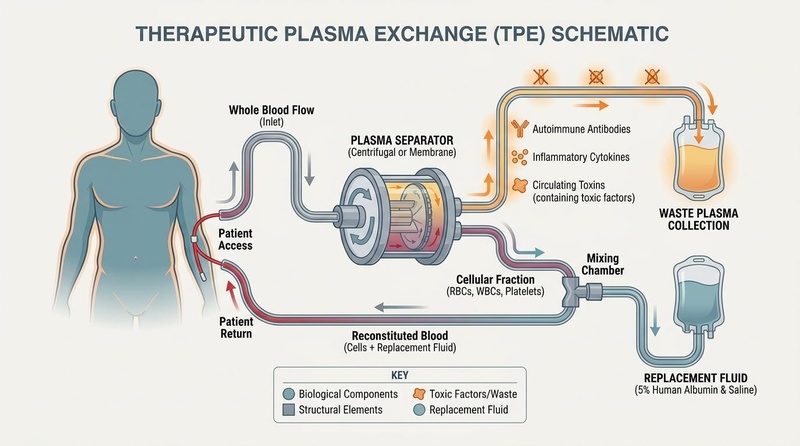
Therapeutic Plasma Exchange (TPE), also known as plasmapheresis, is an extracorporeal blood purification technique used to remove pathological substances from a patient's plasma. The process involves drawing whole blood, separating the plasma from cellular components (red blood cells, white blood cells, platelets) using centrifugal or membrane-based technologies, discarding the patient's plasma, and returning the blood cells reconstituted with a replacement fluid [1:3][4:1][9:1]. The choice of replacement fluid, most commonly 5% albumin or fresh frozen plasma, depends on the specific clinical indication and patient needs [1:4].
¶ Mechanisms of Action
TPE's therapeutic effects stem from several key mechanisms:
- Bulk Removal of Circulating Pathogens: TPE efficiently removes large molecular weight substances from the plasma, including autoantibodies, immune complexes, cryoglobulins, paraproteins, toxins, and inflammatory mediators such as cytokines and complement components. This rapid reduction in pathogenic factors can disrupt disease processes in conditions like autoimmune diseases and certain poisonings [4:2]. One plasma volume exchange can remove approximately 60-70% of intravascular constituents [9:2].
- Dilution and Replacement: The removed plasma is replaced with a fluid that lacks the harmful components. When albumin is used as a replacement, it can dilute existing toxic factors and alter the binding capacity within the plasma, potentially reducing the activity of remaining harmful substances. Fresh frozen plasma provides coagulation factors and immunoglobulins, which may be crucial in specific conditions [1:5][4:3].
- Neutral Blood Exchange Preclinical Evidence: Preclinical studies, particularly in mice, have explored "neutral blood exchange" where old blood plasma is exchanged with saline-albumin. These studies have shown that diluting the plasma with a saline-albumin solution can reduce inhibitory factors and improve tissue repair and function in multiple organs, suggesting a potential role for plasma manipulation in rejuvenating tissues and combating age-related decline [2:2]. However, the direct translation of these preclinical findings to human longevity or anti-aging interventions remains unproven [3:2].
- Immune Modulation: Beyond direct removal, TPE can indirectly modulate the immune system by altering B-cell and autoantibody dynamics, as well as complement activity, contributing to its efficacy in autoimmune disorders [4:4].
Schematic of Therapeutic Plasma Exchange (TPE) and Neutral Blood Exchange (NBE) showing extracorporeal separation, bulk removal of pathogenic circulating factors, and albumin-based plasma replacement.
¶ Evidence summary table (human outcomes)
| Outcome / Goal | Effect* | Consistency** | Evidence quality | Trials*** | Notes (population, duration, dose) |
|---|---|---|---|---|---|
| Autoimmune Neuromuscular Disorders (e.g., Myasthenia Gravis, GBS) | High | High | Multiple RCTs | Significant improvement in muscle strength and reduction of autoantibodies [5:1][10] | |
| Sepsis/Multiple Organ Dysfunction Syndrome (MODS) (in pediatric ICU) | Moderate | Moderate | Observational, small RCTs | Reduced mortality, though outcomes vary with severity and underlying cause [11][12] | |
| Pediatric Non-Neurological Diseases | Moderate | Moderate | Retrospective studies | Improved clinical outcomes in various conditions including renal and hematologic disorders [13] | |
| Alzheimer’s disease (AMBAR regimen) | Low | Low | 1 RCT (multicenter) | Slowed cognitive decline in moderate AD subsets; requires replication [14][15] | |
| Inflammatory cytokines (e.g., IL-6, TNF-α) | Low | Low | Small RCTs/observational | Transient reduction; effect varies by protocol and disease [16][17] | |
| Lipoprotein(a) (apheresis variants) | High | Moderate | Multiple trials | Significant reduction; technique-specific; not standard TPE [18] | |
| Epigenetic/Biological Age Reversal | Insufficient | Very Low | 0 RCTs | No confirmed human RCT evidence for direct effect [2:3][3:3] |
- *Effect: Number of arrows (1-3) indicates magnitude. Direction: ↑ (increase), ↓ (decrease), = (no effect), ? (unclear). Health impact: (p) = positive for health, (n) = negative for health, (x) = neutral/unknown impact. Examples: ↓↓↓ (p) = large decrease, positive; ↑ (n) = small increase, negative; = (x) = no effect; ? = unclear.
- **Consistency: Low (results conflict), Moderate (mixed but leaning one way), High (most trials agree)
- ***Trials: Number of RCTs or total trials informing this outcome (shows evidence depth at a glance)
- REQUIRED: You MUST include a citation key (e.g.
[^1]) in the "Notes" column for every single row. If you claim a result, you must link the specific Meta-Analysis or Key RCT that proves it.
¶ Dosage & Protocols
TPE protocols are highly individualized based on the patient's condition, weight, and the specific substance being targeted for removal.
- Volume of Plasma Exchanged: Typically, 1.0 to 1.5 plasma volumes (PV) are exchanged per session. One plasma volume is approximately 40-50 mL/kg of body weight [1:6][9:3]. Exchanging 1 PV removes about 60-70% of a circulating substance, while 2 PVs remove about 80-85% [9:4].
- Replacement Fluid:
- 5% Albumin: The most common replacement fluid, used for most indications due to its oncotic properties and lack of coagulation factors, minimizing the risk of infection or allergic reactions associated with plasma [1:7].
- Fresh Frozen Plasma (FFP): Used when there is a need to replace coagulation factors, such as in thrombotic thrombocytopenic purpura (TTP), or to replace specific plasma proteins [1:8].
- Combination: Sometimes a combination of albumin and FFP is used.
- Anticoagulation: Citrate (ACD-A) is commonly used as an anticoagulant during the procedure. It chelates calcium to prevent clotting in the extracorporeal circuit. Patients must be monitored for citrate-related hypocalcemia, and calcium supplementation may be necessary [6:1][8:1]. Heparin can also be used, particularly in patients with citrate intolerance.
- Frequency: The frequency of TPE sessions varies widely depending on the disease, its severity, and the half-life of the pathogenic substance being removed. For acute autoimmune conditions, sessions may be performed daily or every other day for 3-5 sessions. For chronic conditions or maintenance, weekly or monthly sessions might be prescribed [1:9][9:5].
- Vascular Access: Adequate vascular access is crucial for TPE. This can be achieved through peripheral veins with large bore needles or, more commonly, through a central venous catheter, especially for repeated procedures or in patients with poor peripheral access [1:10].
¶ Dosage at a glance
| Use case | Typical dose/volume | Timing | Notes |
|---|---|---|---|
| Antibody-mediated neurological diseases (e.g., GBS, Myasthenia Gravis) | 1.0–1.5 PV per session | Every 24–48 h (3–5 sessions) | 5% albumin replacement; adjust per labs [1:11][5:2][9:6] |
| Hyperviscosity syndrome | 1.0 PV | Single or repeated as needed | Consider plasma if coagulopathy present [1:12] |
| Pediatric Sepsis/MODS | 1.0–1.5 PV per session | Daily or every other day | 5% albumin, careful monitoring due to pediatric specific risks [11:1][13:1] |
| Alzheimer’s (AMBAR experimental protocol) | Low-volume exchanges | Weekly→monthly per protocol | Albumin replacement ± IVIG; investigational, not standard care [14:1][15:1] |
| Familial Hypercholesterolemia (apheresis variants) | 1.0–1.5 PV | Weekly to bi-weekly | Specific lipoprotein apheresis techniques; not standard TPE [18:1] |
¶ Safety and Contraindications
While generally safe when performed by experienced medical teams, TPE is an invasive procedure with potential side effects and contraindications.
¶ Common Side Effects
| Effect | Frequency/Notes | Route | Evidence |
|---|---|---|---|
| Citrate Hypocalcemia (paresthesia, tetany, muscle cramps) | Very common; dose-related; managed with calcium supplementation [6:2][8:2] | Extracorporeal (citrate effect) | High [6:3][8:3] |
| Hypotension (lightheadedness, fainting) | Common; related to volume shifts, vasovagal reactions, or rapid fluid shifts [6:4] | Systemic | High [6:5] |
| Allergic/Anaphylactic Reactions (hives, itching, shortness of breath, severe reactions) | Occasional, higher incidence with FFP replacement [6:6] | Systemic | Moderate [6:7] |
| Vascular Access Complications (infection, hematoma, thrombosis, air embolism) | Infrequent, depends on access type and duration [6:8] | Vascular access site | High [6:9] |
| Coagulation Abnormalities (bleeding or thrombosis) | Infrequent; more common with FFP use or specific underlying conditions [1:13][9:7] | Systemic | Moderate [1:14][9:8] |
| Nausea, Vomiting, Chills | Occasional | Systemic | Low [6:10] |
¶ Precautions and Contraindications
| Population/Condition | Precaution | What to monitor |
|---|---|---|
| Severe Cardiac Instability (acute myocardial infarction, unstable angina, severe arrhythmia) | Risk of exacerbation due to rapid fluid shifts and electrolyte disturbances [6:11] | Hemodynamic parameters (BP, HR, ECG), fluid balance, electrolytes |
| Active Bleeding or High Bleeding Risk | Increased risk of hemorrhage due to removal of coagulation factors (especially with albumin replacement) [1:15][9:9] | Coagulation parameters (INR, PTT, fibrinogen), platelet count, clinical signs of bleeding |
| Severe Hypocalcemia | Exacerbation of citrate-induced hypocalcemia [6:12][8:4] | Ionized calcium levels, clinical symptoms of hypocalcemia |
| Allergy to Replacement Fluids (albumin or FFP) | Risk of severe allergic or anaphylactic reaction [6:13] | Allergic reaction symptoms; pre-medication or alternative fluids may be needed |
| Uncontrolled Sepsis (without clear indication for TPE) | May worsen condition or introduce further complications [16:1][17:1] | Infection markers, hemodynamic stability, organ function |
| Young Children/Infants | Specific considerations for volume status, access, and risk of complications [11:2][13:2] | Close monitoring of vital signs, fluid balance, electrolytes, and vascular access |
¶ FAQs
-
Does TPE reverse biological (epigenetic) age?
- Currently, there is no confirmed human randomized controlled trial (RCT) evidence demonstrating that TPE directly reverses biological or epigenetic age [2:4][3:4]. While preclinical plasma dilution studies in mice have shown improvements in tissue function and reduced markers of aging, the direct translation of these findings to humans for anti-aging purposes is unproven and remains an active area of research [2:5]. The U.S. FDA has also issued warnings against plasma infusions marketed for unproven anti-aging treatments [3:5].
-
How long do the effects of TPE last?
- The duration of TPE effects varies significantly depending on the underlying disease and the half-life of the pathogenic substances being removed. Removed factors can rebound, and for many conditions, repeated sessions or maintenance therapy are required to achieve durable disease or biomarker changes [1:16][9:10].
-
Can albumin alone (without full plasma exchange) help conditions like Alzheimer’s disease?
- The AMBAR (Alzheimer Management by Albumin Replacement) study investigated a protocol that combined low-volume plasma exchanges with albumin replacement (sometimes with intravenous immunoglobulin, IVIG). This regimen reported signals of slowed cognitive decline in subsets of patients with moderate Alzheimer’s disease. However, these are experimental findings, and confirmatory trials are still needed before it can be considered a standard treatment [14:2][15:2].
-
Who should avoid TPE for “anti-aging” purposes?
- Healthy individuals should avoid TPE for anti-aging purposes outside of carefully designed clinical trials. The procedure carries inherent risks, and there is insufficient evidence to support its use for general longevity or biological age reversal [3:6]. Decisions to undergo TPE should be made in consultation with a qualified medical professional based on established medical indications.
¶ See also
¶ References
ASFA Apheresis Committee. Guidelines on the use of therapeutic apheresis in clinical practice—evidence-based approach (2023 update). J Clin Apher. 2023;38(Suppl). https://pubmed.ncbi.nlm.nih.gov/37017433/ ↩︎ ↩︎ ↩︎ ↩︎ ↩︎ ↩︎ ↩︎ ↩︎ ↩︎ ↩︎ ↩︎ ↩︎ ↩︎ ↩︎ ↩︎ ↩︎ ↩︎
Mehdipour M, et al. Rejuvenation of three germ layers tissues by exchanging old blood plasma with saline-albumin. Aging (Albany NY). 2020;12(11):8790–8819. https://pubmed.ncbi.nlm.nih.gov/32474458/ ↩︎ ↩︎ ↩︎ ↩︎ ↩︎ ↩︎
U.S. FDA. FDA warns against receiving young donor plasma infusions that are promoted as unproven treatments. 2019. https://www.fda.gov/news-events/press-announcements/fda-warns-against-receiving-young-donor-plasma-infusions ↩︎ ↩︎ ↩︎ ↩︎ ↩︎ ↩︎ ↩︎
Reeves HM, Winters JL. The mechanisms of action of plasma exchange. Br J Haematol. 2014;164(3):342–351. https://pubmed.ncbi.nlm.nih.gov/24172059/ ↩︎ ↩︎ ↩︎ ↩︎ ↩︎
Memon AB, Lisak RP. Use of Therapeutic Plasma Exchange in Autoimmune Neuromuscular Disorders. Muscle & nerve. 2026 Aug; https://pubmed.ncbi.nlm.nih.gov/41928376/ ↩︎ ↩︎ ↩︎
Winters JL. Complications of therapeutic plasma exchange. Transfusion. 2011;51(8):1781–1801. https://pubmed.ncbi.nlm.nih.gov/?term=Winters+complications+therapeutic+plasma+exchange ↩︎ ↩︎ ↩︎ ↩︎ ↩︎ ↩︎ ↩︎ ↩︎ ↩︎ ↩︎ ↩︎ ↩︎ ↩︎ ↩︎
Glatt TN, Gcayiya T, Skosana Y. The safety and cost of Gelofusine as a replacement fluid in therapeutic plasma exchange procedures - Feedback from low/middle-income countries. Transfusion and apheresis science. 2026 Apr; https://pubmed.ncbi.nlm.nih.gov/41643227/ ↩︎
Czempik PF, Osicki J, Dzięcioł K. Safety profile of therapeutic plasma exchange in neurological diseases: Insights from a Polish intensive care unit. Transfusion and apheresis science. 2025 Dec; https://pubmed.ncbi.nlm.nih.gov/41072170/ ↩︎ ↩︎ ↩︎ ↩︎ ↩︎
Kaplan AA. Therapeutic plasma exchange: core curriculum. Am J Kidney Dis. 2013;61(3):371–380. https://pubmed.ncbi.nlm.nih.gov/?term=Kaplan+Therapeutic+plasma+exchange+core+curriculum+2013 ↩︎ ↩︎ ↩︎ ↩︎ ↩︎ ↩︎ ↩︎ ↩︎ ↩︎ ↩︎ ↩︎
Dogan A, Aydeniz G. Evaluation of clinical response according to category and level of evidence for therapeutic plasma exchange indications: A Single-Center Experience. Pakistan journal of medical sciences. 2025 Sep; https://pubmed.ncbi.nlm.nih.gov/41070311/ ↩︎
Bingol I, Yavuz M, Ucmak H. Therapeutic Plasma Exchange in the Pediatric Intensive Care Unit: Analysis of Clinical Outcomes. Therapeutic apheresis and dialysis. 2026 Aug; https://pubmed.ncbi.nlm.nih.gov/41983309/ ↩︎ ↩︎ ↩︎
Vareesangthip K, Ounhasuttiyanon A, Pongsakornkullachart K. Therapeutic Plasma Exchange in Thailand: A 10-Year Retrospective Analysis. Therapeutic apheresis and dialysis. 2026 Aug; https://pubmed.ncbi.nlm.nih.gov/42015460/ ↩︎
Miklaszewska M, Błasiak M, Korohoda P. Safety and Efficacy of Therapeutic Plasma Exchange in Pediatric Non-Neurological Diseases. International journal of nephrology and renovascular disease. 2026; https://pubmed.ncbi.nlm.nih.gov/41877764/ ↩︎ ↩︎ ↩︎
Boada M, et al. A randomized clinical trial of plasma exchange with albumin replacement (AMBAR) in Alzheimer’s disease. Alzheimers Dement. 2020;16:1412–1425. https://pubmed.ncbi.nlm.nih.gov/32715623/ ↩︎ ↩︎ ↩︎
Boada M, et al. Albumin replacement therapy in Alzheimer’s disease: phase II results and post hoc analyses. J Alzheimers Dis. 2017;56(2): . https://pubmed.ncbi.nlm.nih.gov/?term=Boada+albumin+replacement+Alzheimer's+2017 ↩︎ ↩︎ ↩︎
Stahl K, Busch M, et al. Therapeutic plasma exchange in sepsis and systemic inflammation: a systematic review. Crit Care. 2020;24:278. https://pubmed.ncbi.nlm.nih.gov/?term=therapeutic+plasma+exchange+sepsis+systematic+review+2020 ↩︎ ↩︎
Busund R, et al. Plasma exchange in severe sepsis and septic shock: a prospective, randomized, controlled trial. Intensive Care Med. 2002;28(10):1434–1439. https://pubmed.ncbi.nlm.nih.gov/12373468/ ↩︎ ↩︎
Marcil M, O'Connell B, Krimbou L. High-density lipoproteins: multifunctional vanguards of the cardiovascular system. Expert review of cardiovascular therapy. 2004 May;2(3):417-30. https://pubmed.ncbi.nlm.nih.gov/15151487/ ↩︎ ↩︎