¶ Physical Health
Physical health is not merely the absence of clinical disease; it is the presence of robust, multi-dimensional biological reserves across key organ systems [1][2]. These reserves act as a physiological buffer, allowing the human body to resist, adapt to, and recover from external stressors (such as injuries, infections, surgeries, or age-related decay) [2:1][3].
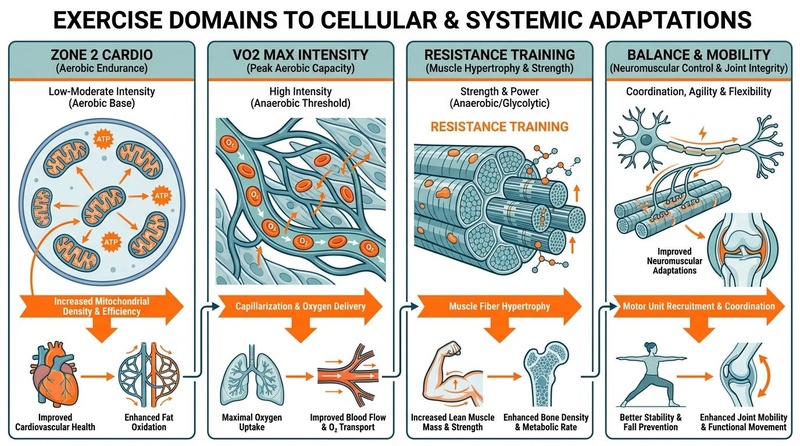
| Core Domains | Cardiorespiratory, Musculoskeletal, Neuromuscular, Metabolic |
| Key Bio-Markers | VO2 Max, Grip Strength, LMI, Fasting Insulin, BMD |
| Primary Intervention | Behavioral (Exercise, Daily Movement, Nutrition, Sleep) |
| Safety Profile | Extremely Safe (personalized progression) |
| Ultimate Goal | Maximizing functional healthspan & dynamic reserve |
To achieve long-term functional longevity, physical health must be treated as a unified system where cardiovascular endurance, muscular strength, skeletal density, joint range, and neural balance operate in absolute synergy [1:1][4].
¶ At a glance
This guide outlines the core pillars of physical health, how they decline, and the evidence-based strategies required to build and maintain lifelong biological reserves.
Key takeaways:
- Unified Health Span: The combination of high cardiorespiratory fitness (VO2 max) and high muscular strength yields the lowest risk of all-cause and cardiovascular mortality, outperforming either metric alone [1:2][2:2].
- Musculoskeletal Foundation: Preserving skeletal muscle mass (LMI) and bone mineral density (BMD) is our primary defense against age-related sarcopenia, osteopenia, and physical frailty [4:1][[5]].
- Metabolic Resilience: Metabolic health—marked by low fasting insulin and high glycemic flexibility—underpins all physical performance and tissue repair, protecting against systemic inflammaging [6].
- Neuromuscular Coordination: Mobility and balance are the software that directs our muscular hardware, protecting the aging bipedal human from catastrophic falls [7].
What people use it for:
- Main goals: Long-term physical independence, disease prevention, energetic vitality, joint pain-free movement, and cardiovascular durability.
- Evidence quality: High (derived from large prospective registries, gold-standard cohort studies, and systematic reviews of clinical trials).
¶ Safety "Traffic Light"
- ● GREEN LIGHT (Go): All individuals seeking to build baseline metabolic health, expand cardiorespiratory fitness, reverse physical deconditioning, and enhance musculoskeletal stability across their lifespan.
- ● YELLOW LIGHT (Caution): Individuals with chronic, managed conditions (e.g., controlled hypertension, mild osteoarthritis, or osteopenia). Physical loads and cardiovascular intensities must be customized and progressive.
- ● RED LIGHT (Stop/Avoid): Individuals with acute, unstable cardiovascular symptoms (uncontrolled arrhythmias, unstable angina) or unhealed orthopedic injuries. Seek clinical stabilization before starting moderate-to-vigorous training [8].
¶ Protocol Card: The Longevity Physical Matrix
A balanced lifestyle must target all domains of physical health. Use this weekly template to sequence training variables without overtraining.
| Domain | Weekly Target | Key Modalities | Target Intensity Parameters |
|---|---|---|---|
| Aerobic Base | 150–300 minutes | Cycling, rowing, brisk walking, swimming | Zone 2; heart rate at 60–70% HRmax; conversational "talk test" [6:1] |
| Cardiovascular Peak | 1–2 sessions (20–30 mins) | 4x4 intervals, incline treadmill, cycling sprints | Zone 5; heart rate at 90%+ HRmax; breathing is highly labored |
| Musculoskeletal Strength | 2–3 sessions (45–60 mins) | Compound weights, resistance bands, bodyweight | 60–80% 1-RM; RIR 1-3; RPE 7-9; focus on progressive overload [4:2] |
| Balance & Mobility | Daily micro-doses (10 mins) | CARs, single-leg stance, yoga, balance pads | Focus on controlled range, joint capsule space, and postural stability [7:1] |
¶ Bottom Line
Physical health is built on the dual anchors of high cardiovascular fitness (VO2 max) and robust muscular strength—maximizing these reserves is the single most powerful behavioral intervention for reducing all-cause mortality.
¶ The Four Pillars of Physical Longevity
Physical health is categorized into four primary physiological domains, each requiring distinct stimuli for maintenance and adaptation.
                           [ PHYSICAL LONGEVITY PORTAL ]
                                        |
      +--------------------+------------+------------+--------------------+
      |                    |                         |                    |
[Cardiorespiratory]  [Musculoskeletal]          [Neuromuscular]       [Metabolic]
  - VO2 Max (Peak)     - Muscle Mass (LMI)       - Joint Mobility     - Fasting Insulin
  - Stroke Volume      - Absolute Strength       - Vestibular Balance - Glycemic Flex
  - Capillary Density  - Bone Density (BMD)      - Motor Coordination - Triglycerides
¶ 1. Cardiorespiratory Fitness: The Aerobic Engine
Cardiorespiratory fitness, measured as VO2 max (maximum oxygen consumption during exercise), is the strongest independent predictor of all-cause mortality [2:3][3:1].
- The Survival Buffer: Prospective studies of over 120,000 adults demonstrate a clear, dose-dependent relationship: individuals in the "elite" fitness category exhibit a 5-fold reduction in hazard ratio for all-cause mortality compared to those in the "low" fitness category [3:2].
- Adaptations: Cardiorespiratory conditioning (primarily Zone 2 Training) drives structural adaptations including increased left ventricular stroke volume, enhanced arterial compliance, and expanded capillary networks in skeletal muscle [6:2].
¶ 2. Musculoskeletal Integrity: The Structural Grid
Your muscles and bones act as the structural framework that protects your vital organs and enables physical movement.
- Preserving Muscle Mass: Sarcopenia—the progressive, age-related loss of muscle mass and quality—accelerates post-50, leading to physical deconditioning, metabolic dysfunction, and loss of independence [5:1].
- Skeletal Density: Mechanically loading bones through Strength Training and high-impact exercises (bone loading) stimulates osteoblast activity, maintaining bone mineral density (BMD) and preventing osteoporotic fracture risk [4:3][5:2].
¶ 3. Neuromuscular Coordination: Mobility & Balance
The nervous system acts as the software that coordinates the physical movement of our joints.
- Active Mobility: Mobility is the ability to actively control a joint through its full range of motion. Unlike static flexibility, mobility requires muscular tension and motor unit activation, supporting functional gait patterns [7:2].
- Dynamic Balance: Postural stability declines as we age due to sluggish sensory integration between visual, vestibular, and proprioceptive networks. Dedicated Balance Training accelerates this "sensory reweighting," reducing real-world fall incidence [7:3].
¶ 4. Metabolic Health: The Cellular Energy Core
Metabolic health underpins all physical performance, recovery, and tissue repair.
- Insulin Sensitivity: Healthy metabolic function is marked by high insulin sensitivity—the ability of skeletal muscle to rapidly clear glucose from the blood in response to low levels of insulin [9].
- Inflammation Control: Chronic physical inactivity leads to visceral fat deposition and a state of low-grade systemic inflammation (inflammaging), which actively degrades cardiovascular and musculoskeletal health [5:3].
¶ Does It Work? (Evidence Snapshot)
The synergy of combined cardiorespiratory and musculoskeletal fitness is supported by rigorous prospective cohort registries:
| Outcome / Goal | Typical Effect | Consistency | Evidence Quality | Supporting Studies | Notes (population, duration, dose) |
|---|---|---|---|---|---|
| All-Cause Mortality Reduction | High | High | Kim 2018, Mandsager 2018 | Combined high cardiorespiratory fitness and grip strength yield the lowest hazard ratios across all ages [1:3][3:3] | |
| Frailty & Sarcopenia Prevention | High | High | Fiatarone 1994, Lu 2026 | Supervised progressive resistance training reverses physical frailty and double strength in 10-12 weeks [4:4][5:4] | |
| Cardiovascular Protection | High | High | Kodama 2009, Laukkanen 2026 | A 1-MET increase in cardiorespiratory fitness correlates with a 13% reduction in cardiovascular events [2:4] | |
| Glycemic Regulation | High | High | Rosa 2026, Młynarska 2025 | Continuous contraction-mediated glucose uptake (GLUT4) restores peripheral insulin sensitivity [9:1] | |
| Fall Mitigation | High | High | Mohammadi 2025, Tang 2026 | Multicomponent exercise (strength + balance + walking) reduces falls by 30-40% in older adults [7:4] |
¶ Lifespan Adaptation Strategies
Our physical priorities must shift across the decades to match evolving physiological needs:
¶ Young Adults (Ages 20–39): Maximizing the Biological Bank
- The Reserve Window: This is the optimal window to build peak bone mineral density, maximum muscle mass (LMI), and cardiorespiratory fitness (VO2 max) [4:5][3:4].
- Strategy: Heavy progressive resistance training, high-impact athletic movements, and vigorous cardiorespiratory training (such as HIIT/Zone 5 intervals) to build deep physical reserves [6:3].
¶ Middle-Aged Adults (Ages 40–64): Mitigation & Structural Durability
- The Sarcopenia Transition: Anabolic hormone signaling naturally declines, and joint/tendon tissues lose collagen elasticity.
- Strategy: Incorporate low-impact cardiovascular conditioning (cycling, rowing) to spare cartilage, perform heavy resistance training focusing on multi-joint compound movements, and dedicate time to dynamic mobility work to prevent occupational stiffness [6:4][7:5].
¶ Older Adults (Ages 65+): Functional Autonomy & Fall Prevention
- Reversing Frailty: Focus shifts to actively preventing sarcopenia, preserving bone mineral density, and protecting bipedal coordination [5:5][7:6].
- Strategy: Perform supervised progressive resistance training (PRT) at least twice weekly using controlled machine exercises, practice daily single-leg balance and vestibular coordination drills, and consume 1.2–1.5 g/kg/day of high-quality protein to overcome age-related anabolic resistance [4:6][5:6].
¶ Safety, Contraindications, and Red Flags
¶ Absolute Contraindications (Avoid physical exertion until cleared by a physician)
- Unstable chest pain (unstable angina)
- Recent heart attack (within 2 days)
- Uncontrolled cardiac arrhythmias causing symptoms
- Decompensated heart failure
- Severe symptomatic aortic stenosis
- Acute systemic infection accompanied by fever [8:1]
¶ Relative Contraindications (Modify volume and intensity; seek guidance)
- Uncontrolled resting hypertension (systolic >180 mmHg or diastolic >110 mmHg)
- Severe peripheral neuropathy (loss of foot sensation; requires visual/balance modifications)
- Advanced joint osteoarthritis (requires low-impact, joint-sparing movements) [4:7][7:7]
¶ Cardiac Red Flags (Stop Exercise Immediately & Seek Evaluation)
- Squeezing chest pressure or radiating arm/jaw pain
- Sudden, unexplained shortness of breath out of proportion to workload
- Sudden dizziness, confusion, ataxia (unsteady gait), or visual disturbances
- Feeling rapid, fluttering, or highly irregular heartbeats accompanied by sudden exhaustion [8:2]
¶ Tracking & What “Good” Looks Like
To ensure your physical health program is successfully building functional reserve, track key clinical biomarkers:
| Biomarker | Diagnostic Tool | Frequency | Target Goal (Physical Longevity) |
|---|---|---|---|
| VO2 Max | Clinical Metabolic Cart (or smartwatch estimate) | Annually | "Good" or "Excellent" for age/sex demographic [2:5][3:5] |
| Grip Strength | Hand Dynamometer (expressed in kg) | Quarterly | Above the 50th percentile; Sarcopenia threshold: >27kg (men), >16kg (women) [1:4][5:7] |
| Body Composition | DEXA Scan (Appendicular Lean Mass Index) | Annually | Keep LMI in upper quartiles; prevent age-related muscle loss [5:8] |
| Bone Density | DEXA Scan (T-Score at femur/spine) | Every 1-2 years | T-Score > -1.0 (Normal); prevent osteopenia and osteoporosis [4:8][5:9] |
| Insulin Sensitivity | Fasting Insulin (uIU/mL) & HOMA-IR | Annually | Fasting insulin < 5.0 uIU/mL; HOMA-IR < 1.0 (Highly sensitive) [9:2] |
| Dynamic Balance | Timed Up and Go (TUG) & 30-Sec Chair Stand | Quarterly | TUG < 10 seconds; Chair stands: >12-14 reps (demographic adjusted) [7:8] |
¶ FAQs
¶ What is the single most important physical test for longevity?
While VO2 max is the strongest predictor of cardiovascular and all-cause mortality, grip strength is the strongest simple musculoskeletal predictor of cognitive function and independent physical autonomy in older age. Combining both assessments provides the most comprehensive baseline [1:5][3:6][5:10].
¶ How can I improve my metabolic health through exercise?
Metabolic health is directly improved by increasing muscle mass and consistently moving. Muscle is your body's largest glucose sink. Performing structured strength training twice weekly increases insulin-independent GLUT4 clearance capacity, while regular daily walking breaks up sedentary blood sugar stagnation [4:9][6:5][9:3].
¶ Is it too late to build bone density after menopause?
No. High-intensity progressive resistance training paired with targeted impact (such as hopping or heavy leg presses) has been clinically proven to stimulate bone remodeling and stabilize or increase bone mineral density even in postmenopausal women with established osteopenia or osteoporosis [4:10][5:11].
¶ References
¶ Update Log
- 2026-07-07: Initial compilation of the canonical Physical Health portal.
Kim Y, White T, Wijndaele K, et al. The combination of cardiorespiratory fitness and muscle strength, and mortality risk. European Journal of Epidemiology. 2018;33(10):953-964. https://pubmed.ncbi.nlm.nih.gov/29594847/ ↩︎ ↩︎ ↩︎ ↩︎ ↩︎ ↩︎
Kodama S, Saito K, Tanaka S, et al. Cardiorespiratory fitness as a quantitative predictor of all-cause mortality and cardiovascular events in healthy men and women: a meta-analysis. JAMA. 2009;301(19):2024-2035. https://pubmed.ncbi.nlm.nih.gov/19454641/ ↩︎ ↩︎ ↩︎ ↩︎ ↩︎ ↩︎
Mandsager K, et al. Association of Cardiorespiratory Fitness With Long-term Mortality Among Adults Undergoing Exercise Treadmill Testing. JAMA Network Open. 2018;1(6):e183605. https://jamanetwork.com/journals/jamanetworkopen/fullarticle/2707428 ↩︎ ↩︎ ↩︎ ↩︎ ↩︎ ↩︎ ↩︎
Ruiz JR, Sui X, Lobelo F, et al. Muscular strength and adiposity as predictors of adulthood cancer mortality in men. Cancer Epidemiology, Biomarkers & Prevention. 2009;18(5):1468-1476. https://pubmed.ncbi.nlm.nih.gov/19366909/ ↩︎ ↩︎ ↩︎ ↩︎ ↩︎ ↩︎ ↩︎ ↩︎ ↩︎ ↩︎ ↩︎
Izquierdo M, de Souto Barreto P, Arai H, et al. Global consensus on optimal exercise recommendations for enhancing healthy longevity in older adults (ICFSR). The Journal of Nutrition, Health & Aging. 2025;29(1):100154. https://pubmed.ncbi.nlm.nih.gov/39743381/ ↩︎ ↩︎ ↩︎ ↩︎ ↩︎ ↩︎ ↩︎ ↩︎ ↩︎ ↩︎ ↩︎ ↩︎
Storoschuk KL, Moran-MacDonald A, Gibala MJ, Gurd BJ. Much Ado About Zone 2: A Narrative Review Assessing the Efficacy of Zone 2 Training for Improving Mitochondrial Capacity and Cardiorespiratory Fitness in the General Population. Sports Medicine. 2025;55(7):501-514. https://pubmed.ncbi.nlm.nih.gov/40560504/ ↩︎ ↩︎ ↩︎ ↩︎ ↩︎ ↩︎
Mohammadi S, Lotfi M, Zarei H, et al. The Effect of Perturbation-Based Balance Training on Fall Incidence, Mobility, Postural Control, and Fear of Falling of the Older Adults: A Systematic Review and Meta-Analysis. Journal of Applied Gerontology. 2025;44(3):112-124. https://pubmed.ncbi.nlm.nih.gov/41460084/ ↩︎ ↩︎ ↩︎ ↩︎ ↩︎ ↩︎ ↩︎ ↩︎ ↩︎
Williams MA, Feigenbaum MS, Jerôme GJ, et al. Resistance Exercise Training in Individuals With and Without Cardiovascular Disease: 2023 Update: A Scientific Statement From the American Heart Association. Circulation. 2023;148(24):1962-1985. https://www.ahajournals.org/doi/10.1161/CIR.0000000000001189 ↩︎ ↩︎ ↩︎
Rosa JL, Dos Santos Lino MH, Grecco MV, et al. Effect of resistance training combined with carbohydrate and protein supplementation on the HOMA-IR, glycemic, lipid profile and hypertrophy of older adults with Type II Diabetes: secondary data analysis of a triple-blind RCT. Aging Clinical and Experimental Research. 2026;38(1):45-56. https://pubmed.ncbi.nlm.nih.gov/41931150/ ↩︎ ↩︎ ↩︎ ↩︎