¶ Balance Training
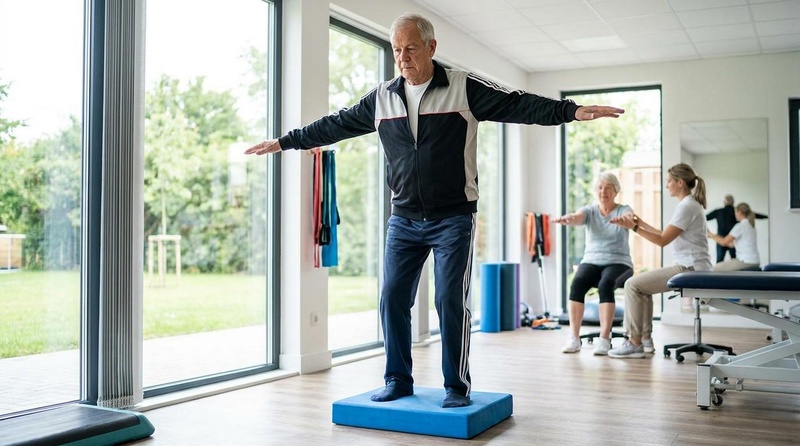
| Primary Target | Postural Control & Fall Prevention |
| Mechanisms | Sensory Reweighting, Motor Remodeling |
| Dosing Schedule | 3 sessions/week (15-30 min) or daily micro-doses |
| Safety Profile | Extremely Safe (with proper stabilization support) |
| Key Markers | Sway Path, Single-Leg Stance, BESTest Score |
| Est. Cost | $0 (Free, optional foam pad $20-$40) |
Balance training refers to targeted physical exercises designed to strengthen the neuromuscular pathways responsible for maintaining an upright posture and managing gravity-induced instability. This training represents a cornerstone of longevity-focused clinical exercise, protecting aging populations from traumatic falls and subsequent loss of functional independence.
¶ At a glance
¶ Key Takeaways
- The Ultimate Healthspan Shield: Balance training is the most effective behavioral intervention for mitigating real-world fall incidence, directly reducing the risk of osteoporotic fractures, hip injuries, and age-related hospitalization.
- Active Cognitive Loading: Postural stability is not a passive skeletal state; it is an active, cognitively intensive process driven by brainstem-cerebellar synthesis and executive-function pathways.
- Progressive Challenge Required: Conventional walking or basic strength training does not adequately develop dynamic and reactive balance. High-challenge interventions (unstable surfaces, sensory challenge, and physical perturbations) are required to force neurological adaptation.
¶ Target Goals & Evidence Quality
- Main Clinical Target: Fall prevention, dynamic gait adaptability, and stabilization of functional mobility.
- Evidence Quality: High (supported by numerous randomized controlled trials, systematic reviews, and long-term cohort studies).
¶ Safety "Traffic Light"
- ● GREEN LIGHT (Go): Individuals looking to optimize functional healthspan, reverse age-related neuromuscular deconditioning, or enhance athletic/proprioceptive performance.
- ● YELLOW LIGHT (Caution): Individuals with mild-to-moderate peripheral neuropathy, managed vestibulopathies, or history of controlled dizzy spells. Training must be conducted near a stable handhold (wall, counter) or under professional supervision.
- ● RED LIGHT (Stop/Avoid): Individuals experiencing acute, uncompensated vestibular crises (uncontrolled vertigo), severe orthopedic instability (unhealed fractures), or profound cognitive impairment rendering compliance impossible without dedicated clinical harness systems.
¶ Protocol Card
| Parameter | Starter Protocol (Beginner) | Standard Protocol (Intermediate) | Advanced / Perturbation Protocol |
|---|---|---|---|
| Frequency | 3 sessions per week | 3 sessions per week + daily integration | 2-3 sessions per week (highly focused) |
| Duration | 10–15 minutes per session | 15–20 minutes per session | 20–30 minutes per session |
| Primary Tasks | Static single-leg stands, tandem standing, and closed-eye static trials. | Standing on blue foam pad, slow head-shaking, and tandem walking. | Lateral/forward pelvic perturbations, exergaming, and dual-task balance-cognitive challenges. |
| Safety Setup | Stand within arm's reach of a sturdy counter or wall. | Stand near a counter or wall; have a spotter if performing head turns. | Conducted in a designated rehabilitation space or clinic; utilize harness systems or foam-padded landing spaces if needed. |
¶ Bottom Line
Balance training significantly reduces the rate of falls in older adults by 30% to 40% when programmed as a progressive, high-challenge intervention. Unlike pure strength work, balance training specifically targets the neural integration of visual, vestibular, and proprioceptive networks, driving plastic neuro-remodeling in the somatomotor cortex.
¶ The "Why" (Benefits)
¶ Preventing the Traumatic "Longevity Cliff"
As the human body ages, falls represent one of the most abrupt and severe threats to active longevity. A fall resulting in an osteoporotic hip fracture often initiates a downward spiral of rapid muscle wasting (sarcopenia), clinical depression, and loss of independence, carrying a 1-year mortality rate exceeding 20% to 30% in elderly cohorts [1]. By systematically training balance, you build a functional safety margin that prevents this trajectory from ever beginning.
¶ Preserving Gait Adaptability and Mobility
A key clinical outcome of aging is the slow, unconscious narrowing of step-recovery limits. Older adults with deconditioned balance strategies exhibit increased gait variability, rigid lower-limb muscular co-contraction (the "stiffening strategy"), and an intense, self-restricting "fear of falling" (FoF) [2][3]. Balance training reverses this deconditioning. It restores confidence, decreases gait variability under challenge, and improves dynamic walking speed across complex, real-world terrains [3:1][4].
¶ Reality Check & Clinical Context
¶ Human Upright Constraints vs. Mouse Models
A crucial aspect of balance science is its strict human-centric clinical focus. While preclinical longevity research heavily relies on rodent models, bipedal upright balance and gravity-challenged postural control cannot be effectively simulated in quadrupeds. Rodents do not experience the tall vertical center-of-mass (CoM) challenges or the lateral ankle-hip coordination strategies unique to upright bipeds. Therefore, our clinical understanding of balance, sensory reweighting, and posturographic reference standards is derived exclusively from high-quality human trials and human neuroimaging [5][6].
¶ Walking and Strength Work Are Not Enough
A common clinical misconception is that regular walking (such as hitting 10,000 steps daily) or standard lower-body strength training (squats, leg extensions) is sufficient to maintain balance.
- The Limit of Walking: High-quality cohort studies confirm that while walking maintains cardiorespiratory and metabolic baselines, it does not provide sufficient lateral instability or sensory mismatch to improve dynamic balance [7].
- The Limit of Strength: Lower-limb muscle mass is necessary for generating force, but force is useless if the nervous system cannot coordinate and recruit it rapidly enough to correct a slip. Balance training represents the "software" that directs the muscular "hardware" [1:1][8].
¶ Practical Integration
¶ The LiFE (Lifestyle-integrated Functional Exercise) Framework
For busy individuals, structured gym-based balance sessions often suffer from poor long-term adherence. To address this, clinical trials have validated the Lifestyle-integrated Functional Exercise (LiFE) protocol [9]. The LiFE framework embeds balance challenges directly into routine activities of daily living:
- Tandem Standing While Brushing Teeth: Stand heel-to-toe while brushing your teeth, forcing lateral stabilizing muscles (gluteus medius, peroneals) to maintain posture.
- Single-Leg Balance While Washing Dishes: Stand on one leg at the kitchen sink, alternating legs every 60 seconds.
- Base of Support Reduction During Transfers: When standing up from a chair, avoid using your hands and try keeping your feet as close together as possible, forcing rapid central-nervous-system adjustment of your center-of-mass.
By weaving these micro-habits into your daily routine, you accumulate hours of active neuromuscular training per week without stepping foot in a clinic [9:1].