¶ Zone 2 Cardiovascular Training for Longevity: Deep Dive
Zone 2 cardiovascular training is a submaximal exercise intensity characterized by a sustained effort where the body primarily utilizes fat for fuel, optimizes mitochondrial function, and enhances metabolic flexibility. This training zone is increasingly recognized as a cornerstone for improving healthspan and longevity, offering profound physiological adaptations beyond mere caloric expenditure.
¶ TL;DR (5 bullets max)
- Verdict: Zone 2 cardiovascular training is the single most efficient modality for increasing mitochondrial density, restoring metabolic flexibility, and building a broad cardiorespiratory fitness base [1][2].
- Who it's for: Indicated for all individuals seeking to maximize healthspan, improve blood glucose regulation, and reduce cardiovascular mortality; contraindicated only in acute cardiovascular events [3][4].
- Expected Impact: Substantial increases in fat oxidation efficiency (+20–30% in lipid oxidation capacity) and a 10-15% increase in VO2 max base over 12–16 weeks of consistent training [2:1][5].
- Key Risk(s): Orthopedic overuse injuries if training volume is increased too rapidly; cardiac drift and overreaching if training intensity is allowed to creep into Zone 3 [6][7].
- What to do next: Integrate 3–4 sessions per week, 30–60 minutes each, at an intensity where you can comfortably hold a conversation [6:1][8].
¶ Quick Answer (Feature Snippet style)
Zone 2 training is submaximal, continuous aerobic exercise performed at an intensity where blood lactate remains stable at 0.8 to 2.0 mmol/L [2:2]. It corresponds to 60% to 70% of maximum heart rate (HRmax), an RPE (Rate of Perceived Exertion) of 4 to 6 out of 10, and the "talk test" threshold (the ability to speak in full sentences but not sing) [2:3][6:2]. To stimulate mitochondrial biogenesis and improve metabolic flexibility, clinicians recommend a frequency of 3 to 4 sessions per week, with each session lasting a minimum of 30 to 45 minutes, up to 60 to 90 minutes [8:1][5:1].
¶ What It Is (Plain-English)
Zone 2 training is submaximal continuous endurance exercise that specifically targets and stresses Type I (slow-twitch) skeletal muscle fibers [2:4][9]. By keeping intensity below the first ventilatory threshold (VT1) and the first lactate threshold (LT1), Zone 2 allows the body to rely almost exclusively on lipid oxidation (fat burning) to synthesize adenosine triphosphate (ATP) via mitochondrial respiration, rather than relying on carbohydrate glycolysis [2:5].
- What counts: Continuous, steady-state low-intensity activities like cycling, brisk uphill walking, rowing, rucking, or running on a flat surface, where heart rate and power output remain stable.
- What doesn’t count: Functional fitness classes, weight lifting, interval training, or running up and down steep hills where the intensity fluctuates, forcing heart rate and lactate levels to spike into Zone 3 or above [7:1].
¶ Mechanism in 60 Seconds
Think of Zone 2 training as tuning a hybrid car's electric motor to run at peak efficiency so it rarely needs to burn gasoline. In the cell, the sustained metabolic stress of slow-twitch contraction increases the AMP/ATP ratio, directly activating AMPK (adenosine monophosphate-activated protein kinase), a vital energy sensor [8:2]. AMPK then phosphorylates and activates PGC-1α (peroxisome proliferator-activated receptor-gamma coactivator 1-alpha), the master regulator of mitochondrial biogenesis (creation of new, highly efficient mitochondria) [8:3]. Concurrently, metabolic stress and AMPK-mediated signaling trigger mitophagy (mitochondrial quality control and recycling of damaged organelles) via pathways such as PINK1/Parkin, keeping the mitochondrial population healthy and efficient [1:1][10]. Under steady-state low-lactate conditions, Type I slow-twitch muscle fibers also upregulate MCT-1 (monocarboxylate transporter 1) and mitochondrial lactate dehydrogenase (mLDH), allowing the cell to rapidly import lactate and convert it back into usable pyruvate for oxidative phosphorylation inside the mitochondria, preventing systemic lactate accumulation and acid buildup [9:1][11].
¶ Cellular Mechanisms of Zone 2 Adaptation
The intracellular metabolic pathways inside Type I slow-twitch skeletal muscle fibers during Zone 2 training are represented in Figure 1 below.
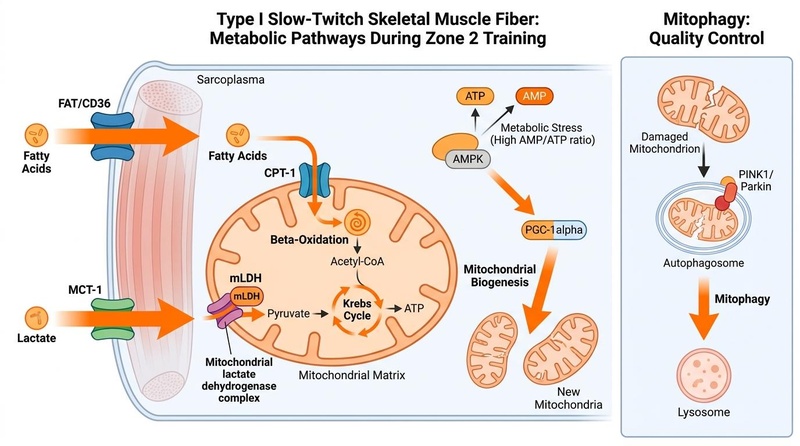
**Figure 1: Cellular mechanisms of Zone 2 training.** Inward unidirectional transport of fatty acids (via FAT/CD36) and lactate (via MCT-1) fuel mitochondrial respiration (beta-oxidation and the Krebs cycle). Metabolic stress (high AMP/ATP ratio) activates the AMPK/PGC-1α pathway to stimulate mitochondrial biogenesis, while mitophagy is managed independently as a quality control process [^1][^2][^3][^5].
¶ Does It Work? (Evidence Snapshot)
Zone 2 training is supported by a robust body of clinical and metabolic literature demonstrating its efficacy across various physiological outcomes:
| Outcome | Typical Effect | Certainty | Timeframe | Citations |
|---|---|---|---|---|
| VO2 Max Aerobic Base | Upregulation of stroke volume and peripheral capillary density, leading to a 10–15% increase in aerobic base. | High | 12–16 weeks | [7:2][5:2][12] |
| Mitochondrial Density & Function | Increase in citrate synthase activity and mitochondrial volume density in Type I muscle fibers (+20–40%). | High | 8–12 weeks | [8:4][5:3] |
| Insulin Sensitivity & Metabolic Flexibility | Enhanced GLUT4 translocation and increased lipid oxidation capacity (FATmax), reducing fasting insulin by 15–20% and restoring metabolic flexibility. | High | 12 weeks | [2:6][13][^20] |
| Lactate Clearance Capacity | Increased MCT-1 transporter and mLDH expression (+30–50%), delaying blood lactate accumulation and shifting LT1 to higher power outputs. | Moderate | 6–12 weeks | [9:2][14] |
| All-Cause & Cardiovascular Mortality | Incremental decrease in all-cause mortality (up to 5-fold reduction in hazard ratio comparing elite/high vs. low fitness cohorts). | Moderate | Multi-year longitudinal | [3:1][15][4:1] |
¶ Cardiorespiratory Fitness (VO2 Max Aerobic Base)
While High-Intensity Interval Training (HIIT) is highly effective at boosting peak cardiovascular power, Zone 2 training acts as the essential foundation for VO2 Max development [5:4][12:1]. By increasing stroke volume (the amount of blood pumped per beat) and peripheral capillary density, Zone 2 expands the cardiovascular grid, allowing for greater oxygen delivery to active tissues [12:2].
¶ Mitochondrial Quality Control (Mitophagy) & Density
By consistently activating the AMPK/PGC-1α pathway, Zone 2 training stimulates both the synthesis of new mitochondria and the degradation of dysfunctional mitochondria via mitophagy [1:2][10:1]. This prevents the accumulation of damaged mitochondria, which is a key driver of cellular aging and Mitochondrial Dysfunction [1:3].