¶ Humanin
Humanin (HN) 是一种由线粒体 16S 核糖体 RNA (MT-RNR2) 基因编码的 24 个氨基酸组成的肽。它是已知的一类被称为线粒体衍生肽 (MDPs) 的生物活性肽中第一个被鉴定出来的成员。Humanin 于 2001 年在阿尔茨海默病研究中被发现,其特点是具有强大的细胞保护作用,特别是其抑制细胞凋亡(程序性细胞死亡)以及保护细胞免受氧化应激和线粒体功能障碍影响的能力。
虽然 Humanin 在体内自然产生,但其水平会随着年龄的增长而逐渐下降,这一趋势在一些百岁老人群体中发生了逆转,表明它与极度长寿之间存在联系。
¶ 证据总结
- 证据等级: 有前景 (黄色)
- 主要益处: 神经保护、细胞保护、代谢调节。
- 关键机制: 抑制 Bax 介导的细胞凋亡;激活 STAT3 和 ERK 信号通路。
- 当前状态: 广泛的临床前证据(细胞/动物);观察性人类数据;尚无获批的治疗药物。
¶ 生物学起源与结构
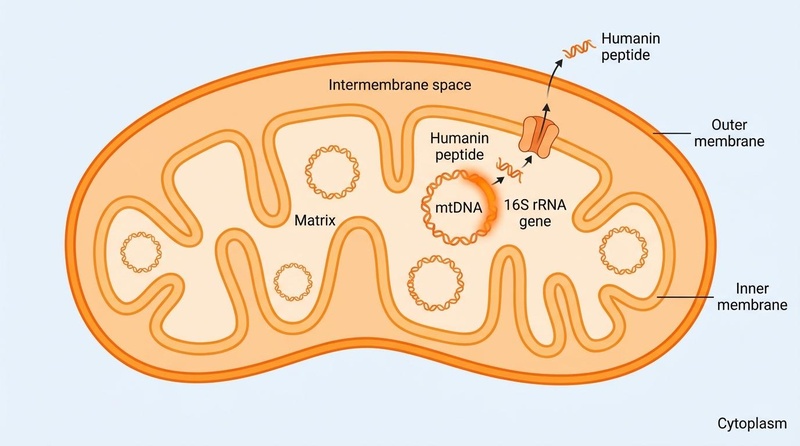
与大多数由核 DNA 编码的肽不同,Humanin 是在线粒体基因组中编码的。这种独特的起源将其归类为“线粒体因子 (mitokine)”——一种源自线粒体的信号分子,可将细胞应激状态传达给生物体的其余部分。
- 序列: 标准分泌形式由 24 个氨基酸组成:
Met-Ala-Pro-Arg-Gly-Phe-Ser-Cys-Leu-Leu-Leu-Leu-Thr-Ser-Glu-Ile-Asp-Leu-Pro-Val-Lys-Arg-Arg-Ala。 - 类似物: 为了提高稳定性和效力,通过将第 14 位的丝氨酸替换为甘氨酸,开发了一种名为 HNG (S14G-Humanin) 的合成类似物。在细胞保护测定中,HNG 的效力大约是天然 Humanin 的 1,000 倍[1][2]。
¶ 作用机制
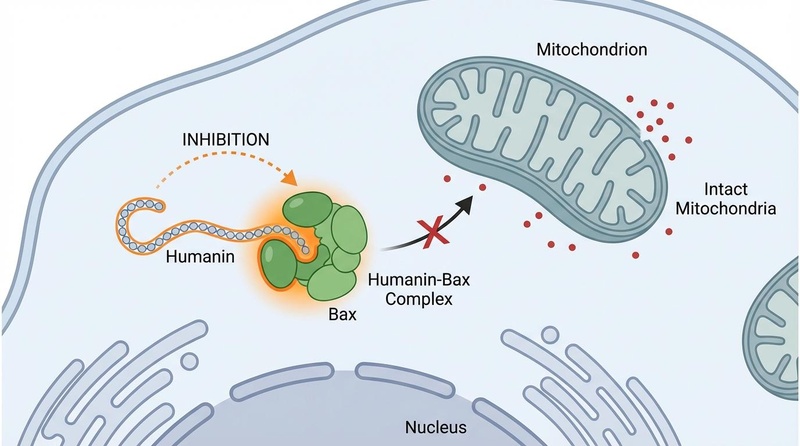
Humanin 通过双重机制发挥其保护作用:细胞内抑制细胞死亡机制和细胞外受体介导的信号传导。
¶ 细胞内:“分子盾牌”
在细胞内,Humanin 直接与 Bcl-2 家族的促凋亡蛋白相互作用,充当程序性细胞死亡的“刹车”。
- 抑制 Bax: 在细胞应激时,Bax 蛋白易位至线粒体以启动细胞死亡。Humanin 与 Bax 结合,阻止这种易位并维持线粒体的完整性[3][4]。
- 抑制 IGFBP-3: Humanin 与胰岛素样生长因子结合蛋白-3 (IGFBP-3) 结合,阻断其诱导细胞凋亡的能力,并可能调节 IGF-1 的可用性[5]。
¶ 细胞外:受体信号传导
分泌的 Humanin 通过结合特定的细胞表面受体,作为自分泌和旁分泌信号发挥作用:
- FPR2 受体: 与甲酰肽受体 2 (FPR2) 结合可激活 ERK1/2 信号通路,该通路与细胞存活和减少炎症有关[6]。
- 三聚体受体复合物: Humanin 与由 CNTFR、WSX-1 和 gp130 亚基组成的复合物结合。这会激活 JAK2/STAT3 通路,对神经保护和胰岛素敏感性至关重要[7]。
¶ 神经保护作用
Humanin 最初被发现是因为它能够拯救神经元免受与阿尔茨海默病 (AD) 相关的毒性。
¶ 阿尔茨海默病与淀粉样蛋白
临床前模型表明,Humanin 可以减轻淀粉样蛋白 (A) 斑块的毒性,这是 AD 的一个标志。
- 机制: Humanin 与 A 竞争结合 FPR2 受体,阻断由淀粉样蛋白积累引发的神经毒性信号。它还能防止 A 诱导的突触丢失和树突退化[8][9]。
- 证据: 在三转基因 AD 小鼠 (3xTg-AD) 中,使用 HNG 类似物治疗减少了 A 斑块负荷并改善了认知功能[10]。
¶ 卒中与缺血
Humanin 已显示出在减少卒中后脑损伤方面的功效。在大脑中动脉闭塞 (MCAO) 的小鼠模型中,HNG 预处理将梗死体积减少了约 50%,通过抗凋亡途径保护了脑组织[11]。
- 确定性: 中等(高质量的动物数据;缺乏人类干预试验)。
¶ 代谢与心血管健康
Humanin 在调节代谢和保护心血管系统免受与衰老相关的损伤方面发挥着重要作用。
¶ 动脉粥样硬化
内皮细胞中的氧化应激促使动脉中斑块的形成。Humanin 减少血管细胞中的活性氧 (ROS) 和细胞凋亡。在 ApoE 缺陷小鼠(一种标准的动脉粥样硬化模型)中,HNG 治疗显著减小了斑块大小并改善了内皮功能[12][13]。
¶ 胰岛素敏感性
Humanin 作用于下丘脑和外周组织以改善胰岛素敏感性。研究表明,它能降低糖尿病大鼠的血糖水平,并保护胰腺 β 细胞免受破坏[7:1][14]。
¶ 在长寿中的作用
Humanin 越来越被认为是健康衰老的生物标志物。
¶ 与年龄相关的下降
在小鼠、猴子和人类中,Humanin 的循环水平随着年龄的增长而下降。这种下降与线粒体功能障碍的积累和年龄相关疾病有关[15]。
¶ 百岁老人悖论
研究表明,极其长寿的个体(百岁老人)及其后代与同龄对照组相比,保持着显著更高的 Humanin 水平。这表明,维持高水平的 Humanin 可能是支持健康寿命的保护性因素[15:1]。
在 C. elegans(线虫)中,Humanin 的过表达延长了寿命,证实了其在简单生物体中的因果作用。在小鼠中,治疗改善了健康寿命参数(炎症、代谢),但尚未被证明能显著延长最大寿命[15:2]。
¶ 安全性特征与风险
¶ “双刃剑”
Humanin 的主要机制——阻断细胞凋亡——对预防神经退行性疾病是有益的,但在癌症方面存在理论上的风险。细胞凋亡是人体清除受损或癌变细胞的自然方式。
- 潜在风险: 通过抑制 Bax,Humanin 在理论上可能保护癌细胞免于死亡,从而导致肿瘤生长或化疗耐药性。一些研究表明,Humanin 在某些肿瘤(如胃癌、垂体瘤)中表达上调,并可能促进胶质母细胞瘤的化疗耐药性[16][17]。
- 保护作用: 相反,其他研究表明,HNG 可以保护正常组织免受化疗副作用的影响,而不会降低药物的抗肿瘤疗效[18]。
结论: 建议谨慎对待。其安全性特征可能取决于具体情况。
¶ 临床状态
目前,Humanin 及其类似物(如 HNG)在治疗应用方面仍处于临床前研究阶段。
- 观察性研究: 人体研究主要集中在测量内源性水平作为生物标志物。
- 干预性试验: 截至 2024 年,尚无 FDA 批准的 Humanin 药物,在主要临床试验注册机构中也未发现测试在人体内施用 Humanin 的活跃 I/II/III 期临床试验。
¶ 比较
- SHLP-2:一种同样来自线粒体 16S rRNA 基因的“表亲”肽,但具有特定的受体 (CXCR7),可驱动强大的产热和代谢作用。
- SS-31 (Elamipretide):Humanin 是一种专注于抑制细胞凋亡的线粒体衍生肽,而 SS-31 是一种合成肽,通过结合心磷脂在结构上稳定电子传递链。
- MOTS-c:一种主要调节代谢稳态并作为“运动模拟物”发挥作用的线粒体肽。
¶ 参考文献
Hashimoto Y, Niikura T, Tajima H, et al. A novel gene, designated Humanin, suppresses neuronal cell death. Biochem Biophys Res Commun. 2001;283(2):460-468. ↩︎
Moin H, et al. A Review on the Potential Role of Humanin Peptide and its Analogs. Protein & Peptide Letters. 2025. ↩︎
Guo B, Zhai D, Cabezas E, et al. Humanin peptide suppresses apoptosis by interfering with Bax activation. Nature. 2003;423(6938):456–461. ↩︎
Morris DL, et al. Humanin induces conformational changes in the apoptosis regulator BAX and sequesters it into fibers. J Biol Chem. 2019. ↩︎
Kim SJ, Guerrero N, Wassef G, et al. The mitochondrial-derived peptide humanin activates the ERK1/2, AKT, and STAT3 signaling pathways. Oncotarget. 2016;7(30):46899–46912. ↩︎
Matsuoka M, Hashimoto Y. Mechanisms of action of humanin. Mol Biol Cell. 2013. ↩︎
Kim SJ, et al. The mitochondrial-derived peptide humanin activates the ERK1/2, AKT, and STAT3 signaling pathways. Oncotarget. 2016. ↩︎ ↩︎
Romeo M, et al. Humanin Specifically Interacts with Amyloid-β Oligomers and Counteracts Their in vivo Toxicity. J Alzheimers Dis. 2017;57:857. ↩︎
Chai GS, et al. Humanin attenuates Alzheimer-like cognitive deficits and pathological changes induced by amyloid β-peptide in rats. Neurosci Bull. 2014;30:923–935. ↩︎
Niikura T, et al. A Humanin Derivative Reduces Amyloid Beta Accumulation and Ameliorates Memory Deficit in a Transgenic Mouse Model of Alzheimer's Disease. PLoS One. 2011. ↩︎
Xu X, et al. Humanin protects against cerebral ischemia/reperfusion injury in mice. Stroke. 2006;37(10):2613-9. ↩︎
Oh YK, Bachar AR, Zacharias DG, et al. Humanin preserves endothelial function and prevents atherosclerotic plaque progression in hypercholesterolemic ApoE deficient mice. Atherosclerosis. 2011;219(1):65–73. ↩︎
Bachar AR, et al. Humanin is expressed in human vascular walls and protects against oxidized LDL-induced apoptosis. Cardiovasc Res. 2010;88(2):360–366. ↩︎
Conte C, et al. Humanin: A new hope for the treatment of diabetes? World J Diabetes. 2022. ↩︎
Yen K, Mehta HH, Kim SJ, et al. The mitochondrial derived peptide humanin is a regulator of lifespan and healthspan. Aging (Albany NY). 2020;12(12):11185–11199. ↩︎ ↩︎ ↩︎
Asad AS, et al. Humanin boosts chemoresistance in glioblastoma cells. Cancers. 2023;15(16):4061. ↩︎
Ayala MAM, et al. Humanin Promotes Tumor Progression in Experimental Triple Negative Breast Cancer. Sci Rep. 2020;10:8542. ↩︎
Cohen P. The potent humanin analogue (HNG) protects germ cells and leucocytes while enhancing chemotherapy-induced suppression of cancer metastases in male mice. J Natl Cancer Inst. 2014;106(3):dju006. ↩︎