¶ TL;DR
- Retinoid Ladder: Retinoids are Vitamin A derivatives, ranging from over-the-counter (OTC) retinol and retinaldehyde to prescription-strength adapalene, tretinoin, tazarotene, and oral isotretinoin. Their potency increases up this ladder, requiring careful introduction and escalation [1].
- Mechanism of Action: Retinoids normalize keratinization, enhance cell turnover, reduce sebum production, and modulate inflammation. They stimulate collagen synthesis and inhibit collagen-degrading enzymes (MMPs), making them effective for acne, wrinkles, hyperpigmentation, and texture improvement [2], [3], [4], [5].
- Clinical Applications: Effective for treating acne (reducing comedones and inflammatory lesions), reducing fine lines and wrinkles, improving skin texture, and fading hyperpigmentation by promoting epidermal turnover and stimulating dermal collagen [1:1], [2:1], [4:1].
- Irritation Management: "Retinization" is an initial adaptation phase with potential redness, dryness, and peeling. Gradual introduction, buffering with moisturizers, and consistent sun protection are critical to minimize irritation [6].
- Pregnancy Contraindication: Oral isotretinoin and prescription topical retinoids (tretinoin, tazarotene) are strictly contraindicated during pregnancy due to severe teratogenic risks. Careful counseling and effective contraception are mandatory for women of childbearing potential [7], [8].
¶ Quick Answer
Retinoids and retinols are cornerstone dermatological agents derived from Vitamin A, widely recognized for their efficacy in managing diverse skin concerns, from acne and active blemishes to wrinkles and skin elasticity. They function by interacting with specific retinoic acid receptors (RARs) and retinoid X receptors (RXRs) within skin cells, which in turn regulate gene expression involved in cellular proliferation, differentiation, and inflammation [3:1]. This action leads to accelerated cell turnover, normalized follicular desquamation, reduced sebum production, and enhanced collagen synthesis, making them indispensable for improving acne, reducing fine lines, fading hyperpigmentation, and refining overall skin texture. The "retinoid ladder" describes the varying potencies and conversion pathways of these compounds, from less potent retinyl esters and retinol (OTC) to highly potent prescription forms like tretinoin and tazarotene, and systemic isotretinoin [1:2]. Careful management of potential irritation and strict adherence to contraindications, particularly regarding pregnancy, are essential for safe and effective use.
¶ Identify the Type/Candidate Fit: The Retinoid Ladder
The "retinoid ladder" categorizes various retinoid compounds by their potency and the number of conversion steps required to become retinoic acid (tretinoin), the biologically active form in the skin. Generally, the more conversion steps, the less potent the ingredient, but also the less irritating.
| Retinoid Type | Potency Level | Conversion Steps to Retinoic Acid | Primary Uses | Notes & Side Effects |
|---|---|---|---|---|
| Retinyl Esters (e.g., Retinyl Palmitate) | Very Low | 3+ (Retinyl ester → Retinol → Retinaldehyde → Retinoic Acid) | Mild anti-aging, antioxidant support | Least potent, lowest irritation. Often found in entry-level products. |
| Retinol (OTC) | Low | 2 (Retinol → Retinaldehyde → Retinoic Acid) | Mild-to-moderate wrinkles and skin elasticity, texture, pigmentation | Common OTC, better efficacy than esters, mild irritation possible. |
| Retinaldehyde (Retinal) (OTC/Cosmeceutical) | Moderate | 1 (Retinaldehyde → Retinoic Acid) | Moderate wrinkles and skin elasticity, acne and active blemishes, post-inflammatory hyperpigmentation and melasma, antibacterial | Converts more efficiently than retinol; good balance of efficacy and tolerability. Also has direct antibacterial activity [9]. |
| Adapalene (0.1% OTC, 0.3% Rx) | Moderate-High | 0 (Synthetic retinoid, selectively binds RARβ, RARγ) | Acne (all types), mild anti-aging | Less irritating than tretinoin, especially for acne [10]. OTC availability makes it a strong first-line option. |
| Tretinoin (Retinoic Acid) (Rx) | High | 0 (Directly active) | Acne, photoaging (wrinkles, fine lines, dark spots), texture | Gold standard, highly effective but more irritating. Dose-dependent efficacy and side effects [2:2]. |
| Tazarotene (Rx) | Very High | 0 (Prodrug, converts to active tazarotenic acid; binds RARβ, RARγ) | Severe acne and active blemishes, psoriasis, wrinkles and skin elasticity | Most potent topical retinoid; high efficacy but also highest irritation potential [11]. |
| Isotretinoin (Oral Rx) | Systemic/Very High | 0 (Systemic impact) | Severe nodulocystic acne | Oral medication; highly effective, targets all acne causes. Severe systemic side effects and teratogenicity [7:1]. |
¶ Evidence Snapshot
¶ Evidence Summary Table (Human Outcomes)
| Outcome | Effect | Quality | Consistency | Trials | Notes |
|---|---|---|---|---|---|
| Acne Lesion Reduction (Topical Retinoids - e.g., Adapalene, Tretinoin) | High | High | Numerous RCTs, SRs, Guidelines | Significantly reduces inflammatory and non-inflammatory lesions; considered first-line for acne [10:1], [12], [13]. | |
| Fine Line & Wrinkle Reduction (Topical Retinoids - e.g., Tretinoin, Retinol) | High | High | Multiple RCTs, SRs | Stimulates collagen, reduces collagenase activity, improves dermal matrix [2:3], [4:2], [5:1]. | |
| post-inflammatory hyperpigmentation and melasma (Dark Spots) Improvement (Topical Retinoids) | Moderate | High | RCTs, SRs | Accelerates epidermal turnover, helps shed pigmented cells, disperses melanin [2:4], [4:3]. | |
| dull skin, enlarged pores, and uneven texture & Smoothness Improvement (Topical Retinoids) | Moderate | High | RCTs | Promotes healthy keratinocyte differentiation, exfoliates, refines skin surface [4:4]. | |
| Collagen Synthesis Stimulation (Topical Retinoids) | High | High | In vitro, in vivo (human skin biopsies) | Upregulates procollagen gene expression, inhibits MMPs [3:2], [4:5], [5:2]. | |
| Sebum Production Reduction (Oral Isotretinoin) | High | High | Multiple RCTs, Guidelines | Drastically reduces sebaceous gland size and activity (up to 90%) [7:2], [14]. | |
| Sebum Production Reduction (Topical Retinoids) | Low | Mixed | In vitro, some human studies | Modest reduction in sebaceous gland activity compared to oral forms [1:3]. | |
| Irritation (Redness, Dryness, Peeling) (All Retinoids) | High | High | All clinical trials | Common side effect, particularly with stronger retinoids and during initiation phase [6:1]. |
¶ What Causes It / How It Works: The Molecular Mechanisms of Retinoids
Retinoids exert their profound effects on skin by interacting with nuclear retinoic acid receptors (RARs) and retinoid X receptors (RXRs). These receptors are ligand-activated transcription factors that, upon binding to active retinoid metabolites, form heterodimers (typically RAR-RXR) that then bind to specific DNA sequences (retinoic acid response elements or RAREs) in the promoter regions of target genes. This binding initiates or represses the transcription of numerous genes involved in critical skin processes [3:3].
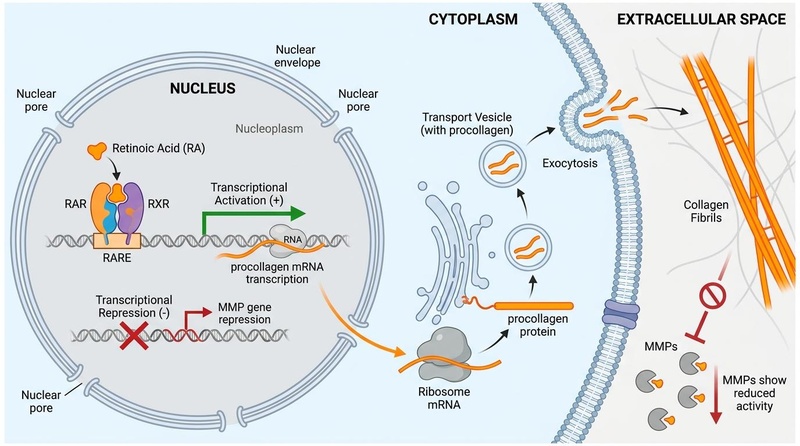
Key Mechanisms:
- Normalization of Follicular Keratinization: Retinoids regulate the differentiation of keratinocytes, preventing the abnormal shedding and stickiness of cells that lead to clogged pores and the formation of microcomedones (the precursor to all acne lesions) [3:4], [4:6].
- Increased Cell Turnover: By promoting epidermal cell proliferation and differentiation, retinoids accelerate the shedding of old, damaged skin cells and their replacement with new, healthy cells. This improves skin texture, reduces hyperpigmentation, and creates a more even skin tone [3:5], [4:7].
- Anti-inflammatory Effects: Retinoids directly inhibit various inflammatory pathways, reducing the redness, swelling, and pain associated with acne and other inflammatory dermatoses. They can suppress the activity of immune cells and reduce the production of pro-inflammatory cytokines [3:6].
- Sebum Reduction: While oral isotretinoin is the most potent for sebum reduction (up to 90%), topical retinoids also contribute to decreasing sebaceous gland activity and overall oil production, albeit to a lesser extent [7:3].
- Collagen Stimulation & MMP Inhibition: For anti-aging, retinoids are crucial. They upregulate the expression of procollagen genes (leading to new collagen synthesis) and inhibit matrix metalloproteinases (MMPs), which are enzymes that break down collagen and elastin. This dual action helps to reduce wrinkles, improve skin elasticity, and repair photodamaged skin [4:8], [5:3].
- Pigment Dispersion: By accelerating cell turnover, retinoids help to shed melanin-containing keratinocytes, which contributes to the fading of hyperpigmentation, including sun spots and post-inflammatory hyperpigmentation (PIH) [4:9].
¶ Starter Protocol: Navigating the Retinoid Ladder
Starting retinoids requires a careful, gradual approach, often called "retinization," to minimize irritation while allowing the skin to adapt.
¶ Beginner-Friendly (OTC Retinol/Retinaldehyde)
- Frequency: Start with 2-3 nights per week for 2 weeks, then increase to every other night for 2 weeks, then nightly as tolerated.
- Application: Apply a pea-sized amount to clean, dry skin after cleansing. Wait 10-15 minutes for skin to completely dry to reduce irritation.
- Buffering: Apply a non-comedogenic moisturizer before or after the retinoid to reduce direct contact and minimize irritation, especially for sensitive skin. The "sandwich method" (moisturizer, retinoid, then another layer of moisturizer) can be very effective.
- Sun Protection: Mandatory daily use of broad-spectrum SPF 30+ sunscreen, as retinoids increase photosensitivity.
- Avoid: Other strong actives (AHAs/BHAs, Vitamin C, Benzoyl Peroxide) on the same night initially. Introduce them slowly on alternating nights once tolerance is established.
¶ Stronger Add-On Path: Escalating to Prescription Retinoids
For persistent concerns or those seeking higher efficacy, a dermatologist may prescribe stronger retinoids.
- Adapalene 0.1% (OTC/Rx): Often the first prescription-strength retinoid considered due to its excellent tolerability and efficacy for acne.
- Protocol: Apply a pea-sized amount nightly to the entire affected area. Start every other night if sensitive.
- Tretinoin (0.025% to 0.1%): The gold standard for photoaging and acne.
- Protocol: Begin with the lowest concentration (0.025%) 2-3 times per week, gradually increasing frequency and concentration (e.g., 0.05% or 0.1%) as tolerated. Always apply to dry skin at night.
- Tazarotene (0.05% to 0.1%): The most potent topical retinoid, typically reserved for severe acne, psoriasis, and significant photoaging.
- Protocol: Due to high potency, usually started at 0.05% once every 2-3 nights, slowly escalating as tolerated. Often used in cases resistant to other retinoids.
Irritation Management for Stronger Retinoids:
- Patience: The "retinization" period (dryness, redness, peeling) can last 4-6 weeks. Do not discontinue unless irritation is severe.
- Hydration: Use bland, barrier-supporting moisturizers daily to assist with skin barrier repair, hydration, and texture.
- Frequency Adjustment: Reduce application frequency if irritation is persistent (e.g., from nightly to every other night).
- Avoid Waxing: Retinoids thin the skin, making waxing painful and risky for tears.
For scarring or texture enhancement, retinoids are frequently combined with professional treatments like chemical peels or microneedling.
¶ Clinical/Procedure Path: Oral Isotretinoin
Oral isotretinoin is a powerful systemic retinoid reserved for severe, recalcitrant nodulocystic acne that has not responded to other treatments. It targets all four primary pathophysiological factors of acne simultaneously [7:4].
- Mechanism: Drastically reduces sebaceous gland size and sebum production, normalizes follicular keratinization, decreases C. acnes populations, and suppresses inflammation [7:5].
- Protocol: Typically 0.5-1.0 mg/kg daily for 4-6 months, aiming for a cumulative dose of 120-150 mg/kg to minimize relapse [14:1], [15].
- Key Considerations:
- Teratogenicity: Strictly contraindicated in pregnancy due to severe birth defects. Female patients must enroll in risk management programs (e.g., iPLEDGE in the US) requiring monthly pregnancy tests and two forms of contraception [8:1].
- Side Effects: Common side effects include severe dryness of skin, lips, and eyes, muscle aches, and potential temporary elevations in liver enzymes and lipids. Less common but serious side effects include mood changes and severe headaches [7:6].
- Monitoring: Requires monthly blood tests (liver function, lipid panel) to monitor for adverse effects.
¶ What Usually Fails
- Starting Too Aggressively: Applying high-strength retinoids too frequently from the outset overwhelms the skin, leading to severe irritation, redness, and peeling (retinoid dermatitis), which often results in discontinuation.
- Inconsistent Use: Retinoids require consistent, long-term application (at least 12-16 weeks for visible results) to exert their effects. Sporadic use prevents the skin from adapting and achieving therapeutic benefits.
- Neglecting Sun Protection: Retinoids increase photosensitivity. Failing to use daily broad-spectrum SPF 30+ sunscreen leads to sunburn, exacerbates hyperpigmentation, and negates anti-aging benefits.
- Combining Too Many Actives: Using retinoids with other strong exfoliants (high-strength AHAs/BHAs, Vitamin C serums, benzoyl peroxide) on the same night, especially initially, can compromise the skin barrier and cause excessive irritation.
- Ignoring Skin Barrier Health: Over-drying the skin or failing to use bland, barrier-supporting moisturizers during retinoid therapy can worsen irritation and prevent the skin from properly acclimating.
- Unrealistic Expectations: Expecting immediate results or complete eradication of deep wrinkles/acne scars within weeks is unrealistic. Significant improvements take months of consistent use.
¶ Tracking Plan
Consistent tracking helps monitor progress, manage side effects, and optimize your retinoid regimen.
- Weekly Visual Assessment:
- Skin Texture: Note improvements in smoothness, pore appearance, and overall radiance.
- Acne Lesions: Count inflammatory (papules, pustules) and non-inflammatory (blackheads, whiteheads) lesions.
- Pigmentation: Observe fading of dark spots or sun damage.
- Fine Lines: Subjectively assess reduction in wrinkle depth, especially around eyes and mouth.
- Daily Side Effect Log:
- Irritation Scale: Rate redness, dryness, peeling, burning, or stinging (e.g., 0-3 scale).
- Moisture Levels: Note skin hydration and any compensatory oiliness.
- Photography: Take clear, consistent photos (same lighting, angle, distance) every 4-8 weeks to objectively track long-term changes in skin texture, pigmentation, and wrinkles.
- Journaling: Record product usage, diet changes, stress levels, and menstrual cycle (for women) to identify potential triggers or correlations impacting skin response.
- Dermatologist Consultations: Regular follow-ups (e.g., every 3-6 months) are crucial for prescription retinoids to adjust dosage, manage side effects, and monitor progress.
¶ Safety and Red Flags
¶ General Safety Considerations
- Photosensitivity: All retinoids increase susceptibility to sunburn. Strict daily sun protection is non-negotiable.
- Skin Barrier Impairment: Initial use can temporarily compromise the skin barrier, leading to dryness and sensitivity. Use gentle cleansers and rich moisturizers.
- Purging: An initial worsening of acne is common (especially with topical retinoids) as underlying microcomedones surface. This usually subsides within 4-6 weeks.
- Systemic Absorption: While topical retinoids have minimal systemic absorption, caution is advised for pregnant or breastfeeding individuals, especially with higher strengths and extensive application areas.
¶ Pregnancy Contraindications
- Oral Isotretinoin (Category X): Absolute contraindication in pregnancy due to severe, dose-dependent teratogenicity, including craniofacial, cardiac, and central nervous system malformations [8:2]. Women of childbearing potential must use two reliable forms of contraception and have monthly pregnancy tests.
- Topical Tretinoin and Tazarotene (Category C/X): While systemic absorption is low, these are generally avoided or used with extreme caution during pregnancy. Tazarotene is Category X, and tretinoin is Category C (though some guidelines permit low-dose use for limited periods under strict supervision). Given the risks, it's best to discontinue [8:3].
- Topical Adapalene (Category C): Has very low systemic absorption but is generally recommended to be avoided during pregnancy.
- OTC Retinol/Retinaldehyde: While less potent and with even lower systemic absorption, most dermatologists advise caution and discontinuation during pregnancy due to the general class effect of retinoids. Bakuchiol is often recommended as a safe alternative during pregnancy.
¶ Drug/Supplement Interactions
- Photosensitizing Drugs: Concomitant use with other photosensitizing medications (e.g., tetracycline antibiotics, some diuretics) can increase sunburn risk.
- Topical Exfoliants: Avoid concurrent use of strong alpha hydroxy acids (AHAs), beta hydroxy acids (BHAs), or benzoyl peroxide on the same night as retinoids, particularly during the initial retinization phase, to prevent excessive irritation.
- Vitamin A Supplements: Avoid high-dose oral Vitamin A supplements while using systemic isotretinoin to prevent hypervitaminosis A.
¶ FAQs
What is the difference between retinol and tretinoin?
Retinol is an over-the-counter retinoid that requires two conversion steps in the skin to become retinoic acid (tretinoin), the active form. Tretinoin is a prescription-strength retinoid that is already in the active retinoic acid form, making it significantly more potent and faster-acting, but also more irritating [1:4], [2:5].
How long does it take to see results from retinoids?
Visible improvements typically begin around 8-12 weeks for topical retinoids, with more significant results appearing at 6-12 months of consistent use for conditions like photoaging or acne. Oral isotretinoin can show improvements faster for severe acne, often within 1-2 months [1:5].
Can I use retinoids every night?
Initially, it's recommended to start 2-3 times per week and gradually increase frequency as your skin builds tolerance. Most people can eventually use milder retinoids nightly, but stronger prescription retinoids might be better tolerated every other night or even less frequently, depending on individual skin sensitivity and formulation [6:2].
Do retinoids make your skin thinner?
What is "retinoid purging"?
Retinoid purging is an initial, temporary worsening of acne that can occur when starting retinoids. It happens because retinoids accelerate cell turnover, bringing existing microcomedones (clogged pores) to the surface faster. This phase typically lasts 4-6 weeks and then subsides as the skin acclimates [1:6].
¶ References
Milosheska, D., & Roškar, R. (2022). Use of Retinoids in Topical Antiaging Treatments: A Focused Review of Clinical Evidence for Conventional and Nanoformulations. Advances in Therapy, 39(12), 5437–5460. https://pubmed.ncbi.nlm.nih.gov/36220974/ ↩︎ ↩︎ ↩︎ ↩︎ ↩︎ ↩︎ ↩︎
Baldwin, H. E., et al. (2013). 40 years of topical tretinoin use in review. Journal of Drugs in Dermatology, 12(6), 638–642. https://pubmed.ncbi.nlm.nih.gov/23839179/ ↩︎ ↩︎ ↩︎ ↩︎ ↩︎ ↩︎
Kang, S. (2005). The mechanism of action of topical retinoids. Cutis, 75(2 Suppl), 10–13. https://pubmed.ncbi.nlm.nih.gov/15773538/ ↩︎ ↩︎ ↩︎ ↩︎ ↩︎ ↩︎ ↩︎
Zasada, M., & Budzisz, E. (2019). Retinoids: active molecules influencing skin structure formation in cosmetic and dermatological treatments. Postepy Dermatologii i Alergologii, 36(4), 392–397. https://pubmed.ncbi.nlm.nih.gov/31616211/ ↩︎ ↩︎ ↩︎ ↩︎ ↩︎ ↩︎ ↩︎ ↩︎ ↩︎ ↩︎ ↩︎
Riahi, R. R., Bush, A. E., & Cohen, P. R. (2016). Topical Retinoids: Therapeutic Mechanisms in the Treatment of Photodamaged Skin. American Journal of Clinical Dermatology, 17(3), 265–276. https://pubmed.ncbi.nlm.nih.gov/26969582/ ↩︎ ↩︎ ↩︎ ↩︎ ↩︎
Valpaços, C., et al. (2023). Benefits of the Dermocosmetic Mineral 89 Probiotic Fractions Adjunct to Topical Retinoids for Anti-Aging Benefits. Clinical, Cosmetic and Investigational Dermatology, 16, 513–526. https://pubmed.ncbi.nlm.nih.gov/36798538/ ↩︎ ↩︎ ↩︎
Pile, H. D., & Patel, P. (2026). Isotretinoin. In StatPearls. StatPearls Publishing. https://pubmed.ncbi.nlm.nih.gov/30247824/ ↩︎ ↩︎ ↩︎ ↩︎ ↩︎ ↩︎ ↩︎
Nau, H. (2001). Teratogenicity of isotretinoin revisited: species variation and the role of all-trans-retinoic acid. Journal of the American Academy of Dermatology, 45(5), 785–789. https://pubmed.ncbi.nlm.nih.gov/11606951/ ↩︎ ↩︎ ↩︎ ↩︎
Pechère, M., Germanier, L., & Siegenthaler, G. (2002). The antibacterial activity of topical retinoids: the case of retinaldehyde. Dermatology (Basel, Switzerland), 205(2), 154–158. https://pubmed.ncbi.nlm.nih.gov/12218231/ ↩︎
Leyden, J., Stein-Gold, L., & Weiss, J. (2017). Why Topical Retinoids Are Mainstay of Therapy for Acne. Dermatology and Therapy, 7(3), 293–304. https://pubmed.ncbi.nlm.nih.gov/28585191/ ↩︎ ↩︎
Roeder, A., et al. (2004). Tazarotene: therapeutic strategies in the treatment of psoriasis, acne and photoaging. Skin Pharmacology and Physiology, 17(3), 111–118. https://pubmed.ncbi.nlm.nih.gov/15087589/ ↩︎
Kolli, S. S., et al. (2019). Topical Retinoids in Acne Vulgaris: A Systematic Review. American Journal of Clinical Dermatology, 20(3), 345–365. https://pubmed.ncbi.nlm.nih.gov/30674002/ ↩︎
Kakpovbia, E. E., et al. (2025). Efficacy of topical treatments for mild-to-moderate acne: A systematic review and meta-analysis of randomized control trials. Journal of the European Academy of Dermatology and Venereology : JEADV, 39(4), 1146–1158. https://pubmed.ncbi.nlm.nih.gov/38943431/ ↩︎
Rademaker, M. (2015). Making sense of the effects of the cumulative dose of isotretinoin in acne vulgaris. Journal of the European Academy of Dermatology and Venereology, 29(Suppl 1), 7–13. https://pubmed.ncbi.nlm.nih.gov/26471145/ ↩︎ ↩︎
Alves, A. L., et al. (2024). Acne Relapse and Isotretinoin Retrial in Patients With Acne. JAMA Dermatology, 160(3), 324–326. https://pubmed.ncbi.nlm.nih.gov/39813053/ ↩︎