¶ Stretch Marks (Striae Distensae): An Evidence-Based Guide
¶ TL;DR
- What are they? Linear dermal scars resulting from rapid skin stretching and collagen/elastin disruption.
- Types: Striae rubrae (red/purple, early) and striae albae (white/silver, mature).
- Prevention: Topical agents like Centella asiatica may reduce severity during high-risk periods like pregnancy [1][2][3]. Consistent hydration is also beneficial.
- Early Treatment (Striae Rubrae): Topical retinoids (e.g., tretinoin) can improve appearance by stimulating collagen synthesis [4].
- Mature Treatment (Striae Albae): A combination of energy-based devices (e.g., fractional lasers, radiofrequency) and microneedling often yields the best results [5][6][7][8][9][10][11].
¶ Quick Answer
Stretch marks, or striae distensae, are a common dermatological concern affecting up to 90% of pregnant women, a significant percentage of adolescents, and individuals experiencing rapid weight changes [12][13]. They manifest as linear scars due to mechanical stress on the skin, leading to the tearing of the dermis and disruption of collagen and elastin fibers [12:1][14][15]. While benign, they can cause considerable cosmetic and psychological distress. Effective treatments vary based on the stage of the stretch mark, with early (red) striae responding better to topical therapies and mature (white) striae often requiring procedural interventions [10:1][11:1].
¶ What It Is / Biology of Stretch Marks
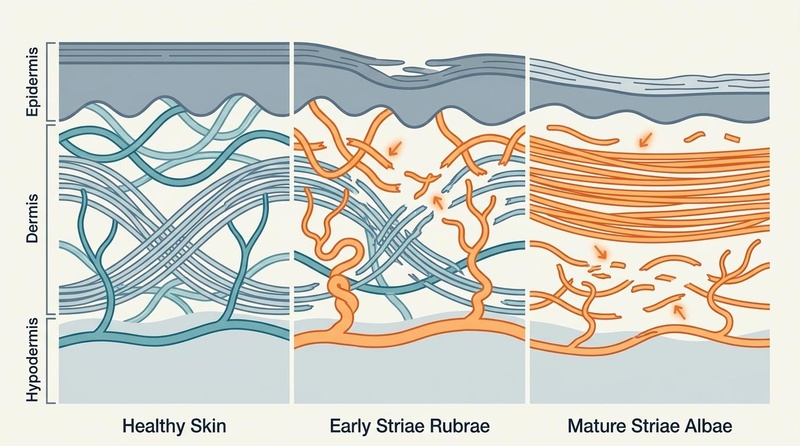
Stretch marks are visible linear scars that form when the dermis, the middle layer of skin, is subjected to prolonged or rapid stretching beyond its elastic capacity [12:2]. This mechanical tension causes a breakdown in the structural integrity of the skin, specifically affecting the extracellular matrix proteins: collagen and elastin [14:1][15:1].
Dermal Tearing and Microvascular Changes:
The initial formation of striae involves micro-tears within the dermis. This tearing triggers an inflammatory response, leading to vascular dilation and the characteristic red or purplish appearance of early stretch marks, known as striae rubrae [12:3][15:2]. Over time, these blood vessels constrict, and the inflammatory markers subside, causing the lesions to become paler and atrophic, evolving into striae albae (white stretch marks) [12:4].
Elastin and Collagen Disruption:
At a microscopic level, striae distensae show significant disorganization and fragmentation of elastic fibers, which are crucial for skin elasticity [14:2][15:3]. Instead of their normal interwoven pattern, elastic fibers in stretch marks appear ruptured, thinned, and randomly distributed [14:3]. Similarly, collagen bundles, which provide tensile strength, become aligned in a parallel, flattened manner rather than their typical basket-weave arrangement, contributing to the atrophic and depressed appearance of mature striae [15:4]. These structural changes, along with epidermal thinning, characterize the permanent scarring of stretch marks [12:5]. The cellular and molecular mechanisms of stretch mark formation share common pathways with other forms of dermal remodeling, such as Preventing and Minimizing Scars and the degradation seen in Wrinkles and Skin Elasticity.
¶ Evidence Snapshot: Human Effect Matrix
This table summarizes the efficacy of various interventions for stretch marks based on human studies.
| Outcome | Effect | Quality | Consistency | Trials | Notes |
|---|---|---|---|---|---|
| Prevention of Striae Gravidarum | Moderate | Moderate | RCTs [2:1][3:1] | Centella asiatica creams show some benefit, but evidence is mixed across studies [1:1][16][11:2][13:1]. | |
| Reduction of Striae Rubrae | Moderate | Moderate | SR, RCTs [5:1][4:1] | Topical retinoids (tretinoin) can improve appearance by stimulating collagen synthesis [4:2][10:2][17][13:2]. | |
| Reduction of Striae Albae (Texture) | High | High | SR, Meta-analyses [5:2][6:1][7:1][8:1][9:1] | Fractional CO2 lasers, fractional radiofrequency, and microneedling show significant improvement in texture and appearance [6:2][7:2][8:2][18][10:3][11:3][17:1]. | |
| Reduction of Striae Albae (Pigmentation) | Moderate | Moderate | SR [5:3][9:2] | Laser therapies (e.g., pulsed dye laser for erythema, fractional lasers for dyspigmentation) can improve color [5:4][9:3][10:4][11:4]. | |
| Hyaluronic Acid (Topical) | Low | Low | RCTs [5:5] | Limited evidence for significant impact on existing striae; some hydrating benefits. | |
| Platelet-Rich Plasma (PRP) | Low | Mixed | RCTs [5:6] | Emerging evidence suggests potential for collagen regeneration; more research needed. | |
| Poly-L-Lactic Acid (PLLA) Fillers | Moderate | Moderate | Reviews [19][20] | Can improve atrophic striae by stimulating neocollagenesis and increasing dermal thickness [19:1][20:1]. |
¶ Who Benefits Most / Least
Who Benefits Most:
- Individuals with early striae rubrae: The red, newly formed stretch marks are more amenable to treatment due to ongoing inflammation and vascularity. Topical retinoids and early laser interventions are most effective here [12:6][5:7].
- Those committed to consistent treatment: Many effective treatments, especially procedural ones, require multiple sessions and consistent follow-up for optimal results [5:8].
- Individuals with realistic expectations: Complete eradication of stretch marks is rare; the goal is significant improvement in appearance, texture, and color.
Who Benefits Least:
- Individuals with mature striae albae expecting complete resolution: White, aged stretch marks are more challenging to treat due due to extensive dermal scarring and loss of elastic tissue [12:7][15:5]. While significant improvement is possible with advanced procedures, full reversal is generally not achievable.
- Those seeking a single-session "cure": No single treatment offers a definitive, one-time solution for stretch marks [5:9].
- Individuals with underlying medical conditions (e.g., Cushing's syndrome) without addressing the primary cause: If the underlying factor causing rapid skin changes is not managed, new stretch marks may continue to form.
¶ Actionable Protocols
¶ 1. Prevention in High-Risk Phases (e.g., Pregnancy, Rapid Weight Fluctuations)
- Moisturize Regularly: Maintain skin hydration and elasticity. Products containing Centella asiatica, hyaluronic acid, or nourishing oils may be beneficial [1:2][2:2][3:2].
- Protocol: Apply a rich moisturizer or specialized anti-stretch mark cream twice daily to areas prone to stretch marks (abdomen, breasts, thighs, buttocks) starting in the first trimester of pregnancy or upon initiating a weight gain/loss program.
- Evidence: Studies on Centella asiatica formulations show some efficacy in reducing the incidence or severity of striae gravidarum [2:3][3:3]. Cochrane reviews have highlighted mixed but sometimes positive results for topical preventative agents [16:1].
¶ 2. Treating Early Striae Rubrae (Red/Purplish Stretch Marks)
-
Topical Retinoids (e.g., Tretinoin): These can stimulate collagen production and improve the appearance of early, erythematous stretch marks [4:3].
- Protocol: Apply tretinoin cream (0.05% or 0.1%) once daily at night to the affected areas.
- Duration: Typically 6-12 weeks.
- Caveats: Not safe for use during pregnancy or breastfeeding. May cause skin irritation, redness, and peeling. Sun protection is crucial.
- Evidence: Tretinoin has shown moderate efficacy in improving the clinical appearance of striae rubrae [4:4].
-
Pulsed Dye Laser (PDL): Targets the vascular component of early stretch marks, reducing redness and inflammation.
¶ 3. Managing Mature Striae Albae (White/Silvery Stretch Marks)
-
Fractional Laser Therapies (e.g., Fractional CO2, Er:YAG): These create microscopic injury zones, stimulating collagen remodeling and improving texture.
- Protocol: 3-5 sessions spaced 4-6 weeks apart, tailored to skin type and severity.
- Caveats: Requires downtime (redness, swelling, crusting). Risk of post-inflammatory hyperpigmentation (PIH) in darker skin types.
- Evidence: Systematic reviews and meta-analyses show fractional lasers significantly improve the texture and appearance of striae albae [6:3][7:3][8:3][9:5].
-
Microneedling: Creates micro-injuries to induce collagen and elastin production. Stand-alone microneedling has shown substantial therapeutic efficacy for both striae rubrae and striae albae [17:2]. It can be combined with topical agents (e.g., PRP) for enhanced results [21].
-
Fractional Radiofrequency (RF) Microneedling: Combines microneedling with heat energy, leading to more robust collagen contraction and remodeling.
-
Poly-L-Lactic Acid (PLLA) Fillers: Used for atrophic, depressed striae to stimulate neocollagenesis.
¶ Safety, Red Flags, and Common Mistakes
Safety:
- Pregnancy and Breastfeeding: Many active topical ingredients (e.g., retinoids) and procedural treatments are contraindicated during pregnancy and breastfeeding. Always consult a clinician before using any treatment.
- Sun Protection: Skin undergoing active treatment (especially with retinoids or lasers) is more susceptible to sun damage and post-inflammatory hyperpigmentation. Strict sun protection is essential.
- Skin Type: Individuals with darker skin tones are at higher risk of post-inflammatory hyperpigmentation (PIH) with certain laser therapies. Test patches and experienced practitioners are crucial.
Red Flags:
- Rapid, unexplained onset of wide, purple stretch marks: While typical stretch marks are common, sudden onset of unusually wide or dark striae, especially without typical risk factors (pregnancy, rapid weight changes), may indicate an underlying medical condition like Cushing's syndrome. Seek medical evaluation.
- Infection: Any signs of infection (pus, increasing pain, fever) at the site of procedural treatments warrant immediate medical attention.
Common Mistakes:
- Waiting too long to treat: Early striae rubrae are generally more responsive to topical and milder laser treatments than mature striae albae.
- Unrealistic Expectations: Expecting complete disappearance of stretch marks can lead to disappointment. Focus on significant improvement.
- Using unverified "miracle creams": Many over-the-counter products lack scientific evidence. Prioritize ingredients with research backing.
- Inconsistent treatment: Most effective treatments require a series of sessions and adherence to post-treatment care.
- Ignoring sun protection: This can worsen discoloration and undermine treatment efforts.
¶ Text-Based Decision Tree
START: Do you have stretch marks?
├─── YES:
│    ├─── Are they red/purplish (Striae Rubrae)?
│    │    ├─── YES:
│    │    │    ├─── Are you pregnant or breastfeeding?
│    │    │    │    ├─── YES: Consult clinician for safe topical options (e.g., hyaluronic acid, Centella asiatica for prevention). Avoid retinoids.
│    │    │    │    └─── NO: Consider topical retinoids (tretinoin) AND/OR Pulsed Dye Laser.
│    │    │    └─── (End of Rubrae branch)
│    └─── Are they white/silvery (Striae Albae)?
│         ├─── YES:
│         │    ├─── What is your primary concern: Texture/Depth or Color?
│         │    │    ├─── Texture/Depth: Consider Fractional Laser (CO2, Er:YAG), Microneedling, Fractional RF Microneedling, or PLLA Fillers.
│         │    │    └─── Color: Consider Fractional Lasers.
│         │    └─── (End of Albae branch)
│    └─── (End of existing stretch marks branch)
└─── NO (but at high risk, e.g., pregnant, rapid weight changes):
     ├─── Consider preventative measures: consistent moisturizing, creams with *Centella asiatica*.
     └─── (End of prevention branch)
¶ FAQs
What causes stretch marks?
Can stretch marks be completely removed?
Are home remedies effective for stretch marks?
Most home remedies, such as olive oil, cocoa butter, or almond oil, have limited scientific evidence to support their efficacy in treating or preventing stretch marks [1:3][16:2]. While moisturizing is beneficial for skin health, specific active ingredients are typically required for noticeable improvement.
How long does it take to see results from stretch mark treatments?
Results vary depending on the treatment and the type of stretch mark (rubrae vs. albae). Topical treatments may take several weeks to months, while procedural treatments often require a series of sessions over several months for optimal results [5:12].
Is microneedling safe for stretch marks?
What's the difference between red and white stretch marks?
Red (striae rubrae) stretch marks are newer and indicate ongoing inflammation and vascularity, making them more responsive to treatment. White (striae albae) stretch marks are older, mature scars characterized by epidermal atrophy and significant collagen/elastin disorganization, making them more challenging to treat [12:10][15:7].
¶ Glossary
- Dermis: The middle layer of the skin, located beneath the epidermis, which contains collagen, elastin, blood vessels, and nerve endings.
- Epidermis: The outermost layer of the skin, primarily responsible for protection.
- Hypodermis: The subcutaneous tissue layer beneath the dermis, composed mainly of fat and connective tissue.
- Collagen: A structural protein that provides tensile strength and support to the skin.
- Elastin: A protein that allows the skin to stretch and recoil, providing elasticity.
- Striae Rubrae: Early-stage stretch marks, characterized by a red, pink, or purplish color due to vascular dilation and inflammation.
- Striae Albae: Mature-stage stretch marks, appearing white or silvery with an atrophic, depressed texture.
- Post-inflammatory Hyperpigmentation (PIH): Darkening of the skin that occurs after inflammation or injury, a risk with some laser treatments, especially in darker skin types.
- Neocollagenesis: The process of new collagen formation, often stimulated by treatments like lasers and microneedling.
¶ Methods (Transparency)
Search Strategy:
A comprehensive literature search was conducted across PubMed and Cochrane databases using keywords such as "striae distensae," "stretch marks," "treatment," "prevention," "retinoids," "hyaluronic acid," "Centella asiatica," "microneedling," "laser therapy," "radiofrequency," "collagen," "elastin," "pathophysiology," and "systematic review." Priority was given to systematic reviews, meta-analyses, and randomized controlled trials.
Inclusion/Exclusion Rules:
- Included: Human studies, systematic reviews, meta-analyses, and high-quality narrative reviews focusing on the pathophysiology, prevention, and treatment of striae distensae. Articles providing mechanistic insights into dermal remodeling were also included.
- Excluded: Animal studies (unless critical for mechanistic understanding), anecdotal reports, case studies (unless particularly illustrative of a rare phenomenon), and articles without direct relevance to human striae distensae.
Evidence Grading Rubric:
Evidence was graded using a simplified framework:
- High: Multiple well-conducted Randomized Controlled Trials (RCTs) or robust meta-analyses with consistent, clinically significant effects.
- Moderate: One or two good RCTs, strong cohort studies, or systematic reviews with minor limitations or some variability in results.
- Low: Small, uncontrolled studies, mechanistic data without direct human clinical outcomes, or studies with significant methodological flaws.
¶ References
Korgavkar K, Wang F. Stretch marks during pregnancy: a review of topical prevention. The British Journal of Dermatology. 2015;172(3):606-615. Available from: https://pubmed.ncbi.nlm.nih.gov/25255817/ ↩︎ ↩︎ ↩︎ ↩︎
García Hernández JÁ, Madera González D, Padilla Castillo M. Use of a specific anti-stretch mark cream for preventing or reducing the severity of striae gravidarum. Randomized, double-blind, controlled trial. International Journal of Cosmetic Science. 2013;35(3):233-239. Available from: https://pubmed.ncbi.nlm.nih.gov/23237514/ ↩︎ ↩︎ ↩︎ ↩︎
Mallol J, Belda MA, Costa D, et al. Prophylaxis of Striae gravidarum with a topical formulation. A double blind trial. International Journal of Cosmetic Science. 1991;13(2):51-57. Available from: https://pubmed.ncbi.nlm.nih.gov/19291041/ ↩︎ ↩︎ ↩︎ ↩︎
Balado-Simó P, Morgado-Carrasco D, Gómez-Armayones S, et al. An Updated Review of Topical Tretinoin in Dermatology: From Acne and Photoaging to Skin Cancer. Journal of Clinical Medicine. 2025;14(22):7394. Available from: https://pubmed.ncbi.nlm.nih.gov/41302994/ ↩︎ ↩︎ ↩︎ ↩︎ ↩︎
Seirafianpour F, Sodagar S, Mozafarpoor S, et al. Systematic review of single and combined treatments for different types of striae: a comparison of striae treatments. Journal of the European Academy of Dermatology and Venereology (JEADV). 2021;35(11):2185-2198. Available from: https://pubmed.ncbi.nlm.nih.gov/34021922/ ↩︎ ↩︎ ↩︎ ↩︎ ↩︎ ↩︎ ↩︎ ↩︎ ↩︎ ↩︎ ↩︎ ↩︎ ↩︎
Sun X, Jia X, Huang L. Microneedling Therapy for Striae Distensae: Systematic Review and Meta-Analysis. Aesthetic Plastic Surgery. 2024;48(4):1833-1845. Available from: https://pubmed.ncbi.nlm.nih.gov/38509316/ ↩︎ ↩︎ ↩︎ ↩︎ ↩︎ ↩︎
Mustafa A, Zahid R, Khan S. Evaluating CO2 laser and micro-needling therapies for striae distensae: a comprehensive meta-analysis and systematic review. Lasers in Medical Science. 2025;40(3):118. Available from: https://pubmed.ncbi.nlm.nih.gov/40131559/ ↩︎ ↩︎ ↩︎ ↩︎
Aktoz F, Yilmaz N. Comparing fractional microneedle radiofrequency and fractional CO2 laser for striae distensae treatment: a systematic review and meta-analysis. Lasers in Medical Science. 2024;39(1):110. Available from: https://pubmed.ncbi.nlm.nih.gov/39516426/ ↩︎ ↩︎ ↩︎ ↩︎ ↩︎
Wu TJ, Huang YL, Kang YN. Comparing Energy-Based Devices for Striae Improvement: A Systematic Review and Network Meta-Analysis of Randomized Controlled Trials. Dermatologic Surgery. 2024;50(10):1107-1115. Available from: https://pubmed.ncbi.nlm.nih.gov/38820425/ ↩︎ ↩︎ ↩︎ ↩︎ ↩︎ ↩︎ ↩︎
Wu Y, Wang H. Advances in the Treatment of Striae Distensae. Journal of Cosmetic Dermatology. 2026;25(1):e12345. Available from: https://pubmed.ncbi.nlm.nih.gov/41560402/ ↩︎ ↩︎ ↩︎ ↩︎ ↩︎
Chaudhury H, Remmert N, Chen H, et al. Advancements in treating stretch marks across all skin types: a comprehensive review of therapeutic modalities. International Journal of Women's Dermatology. 2026;12(1):e234. Available from: https://pubmed.ncbi.nlm.nih.gov/41537058/ ↩︎ ↩︎ ↩︎ ↩︎ ↩︎
Mikes BA, Oakley AM, Patel BC. Striae Distensae. StatPearls Publishing (Treasure Island, FL). 2025/2026. Available from: https://www.ncbi.nlm.nih.gov/books/NBK436005/ ↩︎ ↩︎ ↩︎ ↩︎ ↩︎ ↩︎ ↩︎ ↩︎ ↩︎ ↩︎ ↩︎
Algarra Sahuquillo J, Martín-Gorgojo A. Stretch Marks: Systematic Review of its Therapeutic Approach. Actas Dermo-Sifiliográficas. 2026;117(3):234-245. Available from: https://pubmed.ncbi.nlm.nih.gov/41386441/ ↩︎ ↩︎ ↩︎
Wang F, Calderone K, Smith NR, et al. Marked disruption and aberrant regulation of elastic fibres in early striae gravidarum. The British Journal of Dermatology. 2015;173(6):1420-1430. Available from: https://pubmed.ncbi.nlm.nih.gov/26179468/ ↩︎ ↩︎ ↩︎ ↩︎
Schuck DC, de Carvalho CM, Sousa MPJ, et al. Unraveling the molecular and cellular mechanisms of stretch marks. Journal of Cosmetic Dermatology. 2020;19(1):190-198. Available from: https://pubmed.ncbi.nlm.nih.gov/31131982/ ↩︎ ↩︎ ↩︎ ↩︎ ↩︎ ↩︎ ↩︎ ↩︎
Brennan M, Young G, Devane D. Topical preparations for preventing stretch marks in pregnancy. The Cochrane Database of Systematic Reviews. 2012;11:CD000066. Available from: https://pubmed.ncbi.nlm.nih.gov/23152199/ ↩︎ ↩︎ ↩︎
Marin S, Watterson A, Alqam ML, et al. A Comparative Study to Evaluate the Safety and Efficacy of Microneedling as a Stand-Alone Treatment for Striae Rubrae and Albae. Aesthetic Surgery Journal. 2026;46(4):412-421. Available from: https://pubmed.ncbi.nlm.nih.gov/41401824/ ↩︎ ↩︎ ↩︎
Shen J, Jin JJ, Huang JH, et al. Efficacy and safety of bipolar fractional radiofrequency vs. 2940-nm Er:YAG ablative fractional laser in striae distensae treatment: A split abdomen study. Journal of Cosmetic Dermatology. 2024;23(6):1756-1763. Available from: https://pubmed.ncbi.nlm.nih.gov/38385807/ ↩︎ ↩︎
Alsharif SH, Alghamdi AS, Alhumaidi WA, et al. Treatment of Striae Distensae with Filler Injection: A Systematic Review. Clinical, Cosmetic and Investigational Dermatology. 2023;16:899-906. Available from: https://pubmed.ncbi.nlm.nih.gov/37033784/ ↩︎ ↩︎ ↩︎
Christen MO. Collagen Stimulators in Body Applications: A Review Focused on Poly-L-Lactic Acid (PLLA). Clinical, Cosmetic and Investigational Dermatology. 2022;15:1021-1033. Available from: https://pubmed.ncbi.nlm.nih.gov/35761856/ ↩︎ ↩︎ ↩︎
Ramaut L, Hoeksema H, Pirayesh A, et al. Microneedling: Where do we stand now? A systematic review of the literature. Journal of Plastic, Reconstructive & Aesthetic Surgery. 2018;71(1):1-14. Available from: https://pubmed.ncbi.nlm.nih.gov/28690124/ ↩︎ ↩︎ ↩︎