¶ Hyaluronic Acid

| Type | Glycosaminoglycan (GAG) |
| Active Cmpd | Sodium Hyaluronate |
| Source | Microbial fermentation / Endogenous |
| Dose Range | 80–300 mg/day (Oral) |
| Main Benefit | Dermal & Joint Hydration |
| Absorption | Microbial cleavage / Lymphatic |
Hyaluronic acid (HA) is a naturally occurring glycosaminoglycan ubiquitously distributed in human connective, epithelial, and neural tissues, serving as the primary hydration matrix for the skin and joint synovial fluid. A robust body of Tier 1 evidence supports oral supplementation (120–200 mg/day) as a clinically effective strategy for enhancing dermal hydration, elasticity, and structure, while providing symptomatic relief for mild-to-moderate osteoarthritis.
¶ At a glance
¶ Aliases
- Also known as: Hyaluronan, HA, Sodium hyaluronate.
- Chemical / biological name: (2S,3R,4R,5S,6R)-3-[(2S,3R,4R,5S,6R)-3-amino-4,5-dihydroxy-6-(hydroxymethyl)oxan-2-yl]oxy-4,5-dihydroxy-6-oxane-2-carboxylic acid.
- Category: Glycosaminoglycan (GAG), non-sulfated.
¶ Key points
- Dermal Rejuvenation: Oral HA (120–200 mg/day) significantly improves objective markers of skin hydration, elasticity, and wrinkle depth after 4 to 12 weeks of continuous use [1][2][3].
- Osteoarthritis Relief: Meta-analyses indicate that oral HA provides modest, statistically significant improvements in joint pain, stiffness, and physical function for patients with mild-to-moderate osteoarthritis [4][5][6].
- Absorption Mechanism: Once thought non-absorbable, HA is now known to be cleaved by gut microbiota into small oligosaccharides or absorbed directly via the mesenteric lymphatic system [7][8][9].
- Safety Profile: Exceptionally favorable; adverse effects are rare and typically limited to mild, self-limiting gastrointestinal discomfort [10][11].
¶ What people use it for
- Main goals: Skin hydration, anti-aging (wrinkle reduction), joint pain relief (osteoarthritis), dental/periodontal healing, and relief of dry eye symptoms.
- Evidence quality: High for skin hydration and elasticity; Moderate for osteoarthritis and wrinkle depth; Low for dental and sinonasal applications.
¶ What is Hyaluronic Acid?
Hyaluronic acid is a massive, high-molecular-weight anionic polysaccharide composed of repeating disaccharide units of D-glucuronic acid and N-acetylglucosamine [1:1]. It is a fundamental component of the extracellular matrix (ECM), possessing an extraordinary hydrophilic capacity to bind up to 1,000 times its own weight in water [7:1][12].
- Natural Sources: In the human body, approximately 50% of HA is located in the skin. It is also concentrated in synovial fluid, the vitreous humor of the eye, and umbilical cord tissue [1:2]. Dietary sources are minimal (principally animal connective tissues and skin), though oral supplements are typically produced via microbial fermentation of Streptococcus or other bacterial species [10:1].
- Current Regulatory Status: Marketed globally as a dietary supplement and over-the-counter topical ingredient. Intra-articular injections and dermal fillers are regulated as medical devices or prescription pharmaceuticals.
- Pharmacological Property: Highly hydrophilic signaling molecule and structural glycosaminoglycan.
¶ What are Hyaluronic Acid’s main benefits?
Oral hyaluronic acid has transitioned from a localized treatment (injections) to a scientifically validated systemic intervention for aesthetic and orthopedic health.
- Skin Hydration & Barrier Function: Systematic reviews demonstrate that oral HA elevates stratum corneum water content and significantly reduces transepidermal water loss (TEWL) [1:3][2:1][3:1].
- Dermal Structure & Elasticity: High-resolution ultrasonography and cutometry show that oral HA restores dermal density and elasticity by stimulating fibroblast proliferation and endogenous ECM synthesis [2:2][13].
- Osteoarthritis (OA) Symptom Management: As a Symptomatic Slow-Acting Drug for Osteoarthritis (SYSADOA), oral HA reduces pain scores (VAS) and improves joint function (WOMAC) in patients with knee and hip OA [4:1][5:1][6:1][14].
- Periodontal & Dental Healing: Adjunctive topical HA gels significantly improve clinical attachment levels and reduce pocket depth in non-surgical periodontal therapy [15][16].
- Ocular Lubrication: Topical HA eye drops are a standard-of-care for dry eye disease, improving tear film stability and reducing ocular surface staining [17].
¶ Evidence summary table (human outcomes)
| Outcome / Goal | Effect | Consistency | Evidence quality | Trials | Notes |
|---|---|---|---|---|---|
| Skin Hydration | High | High | 12+ RCTs | Significant increase in stratum corneum water content at 4–12 weeks [1:4][2:3][3:2] | |
| Skin Elasticity | High | High | 12+ RCTs | Restoration of viscoelastic snap-back properties via dermal remodeling [2:4][13:1] | |
| Wrinkle Depth | Moderate | Moderate | 7 RCTs | Reduction in periorbital 'crow’s feet' depth and skin roughness [1:5][3:3] | |
| Epidermal Thickness | Moderate | Moderate | 3 RCTs | Increased epidermal thickness and deep dermal density at 12 weeks [2:5][13:2] | |
| Knee Osteoarthritis Pain | Moderate | Moderate | 15+ RCTs | Statistically significant reduction in VAS pain and WOMAC scores [5:2][6:2][18] | |
| Joint Stiffness (OA) | Moderate | Moderate | 11+ RCTs | Improvements in physical function and reductions in morning stiffness [4:2][5:3] | |
| Periodontal Healing | Moderate | Moderate | 23 RCTs | Adjunctive gel improves clinical attachment levels in periodontitis [15:1][16:1] | |
| Dry Eye Relief | High | High | 20+ RCTs | Topical drops improve tear film break-up time and stability [17:1] | |
| TMJ Pain Relief | High | High | 10+ RCTs | Large reduction in pain scores via intra-articular injection [19] |
¶ How does Hyaluronic Acid work?
Orally administered HA functions as both a structural building block and a systemic signaling molecule.
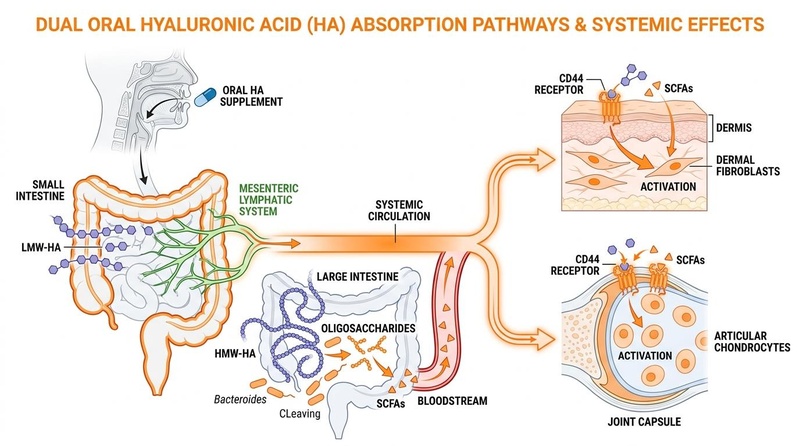
¶ Absorption and Pharmacokinetics
For years, the massive molecular weight (MW) of HA led to the assumption it was non-absorbable. Modern pharmacokinetic mapping has elucidated two distinct pathways:
- Microbial Fermentation (HMW-HA): High-molecular-weight HA (>1,000 kDa) travels to the large intestine, where Bacteroides spp. secrete hyaluronidases to cleave the polymer into small oligosaccharides (
 kDa) [7:2][8:1]. Concurrently, unabsorbed HA is fermented into short-chain fatty acids (SCFAs) like butyrate, which exert systemic anti-inflammatory effects [7:3].
 - Lymphatic Pathway (LMW-HA): Low-molecular-weight HA (<100 kDa) is rapidly taken up by the mesenteric lymphatic system, bypassing hepatic first-pass metabolism and prolonging its systemic half-life [9:1].
¶ Cellular Signaling
Once absorbed, HA fragments (oligosaccharides) bind to CD44 receptors and the Receptor for Hyaluronan-Mediated Motility (RHAMM) located on fibroblasts, keratinocytes, and chondrocytes [1:6][2:6][12:1].
- In Fibroblasts: CD44 activation upregulates the synthesis of endogenous HA, type I collagen, and elastin, fundamentally restructuring the dermal ECM [1:7][13:3].
- In Chondrocytes: HA binds to chondrocytes to stimulate proteoglycan production and inhibit pro-inflammatory cytokines such as IL-1β and TNF-α, reducing synovial inflammation [12:2].
¶ Effects on different systems
Skin & Dermal Health
Systemic oral supplementation (120–200 mg/day) serves as a baseline for "beauty from within" protocols.
- Hydration: RCTs confirm significant increases in stratum corneum moisture within 4–8 weeks [2:7][3:4].
- Structural Integrity: Long-term intake increases epidermal thickness and deep dermal density, providing visible improvements in skin smoothness and "plumpness" [2:8][13:4].
- Aesthetic Fillers: Injectable HA fillers (e.g., for lips, midface, or jawline) provide immediate, durable volume expansion lasting 6–12 months, though they carry risks of transient swelling [20][21][22].
Joint & Musculoskeletal Health
HA acts as a Symptomatic Slow-Acting Drug for Osteoarthritis (SYSADOA) via both oral and intra-articular routes.
- Osteoarthritis: Oral HA (80–300 mg/day) provides clinically meaningful reductions in knee and hip pain and stiffness [4:3][5:4][14:1][23][24].
- Temporomandibular Joint (TMJ): Meta-analyses of intra-articular HA injections show superior pain relief and improved maximal mouth opening compared to placebo or corticosteroids in the long term [19:1].
- Foot and Ankle: IA injections are used for acute ankle sprains and various pathologies, though they may have fewer complications than PRP or corticosteroids in some cohorts [25][26].
Dental & Periodontal Health
- Periodontitis: Adjunctive use of HA gels during scaling and root planing significantly enhances clinical attachment level (CAL) gains and probing pocket depth (PPD) reduction [15:2][16:2].
- Extraction Recovery: Topical HA application after third molar extractions has been shown to reduce post-operative pain, trismus (lockjaw), and soft tissue edema [27].
- Regenerative Endodontics: HA is increasingly studied as a scaffold in regenerative endodontics, showing comparable or superior outcomes to PRP in some models [28].
Ocular Health & Dry Eye Disease
Topical hyaluronic acid (0.1% to 0.4% concentration) is a cornerstone of dry eye therapy. It mimics the viscoelastic properties of natural tears, improving tear film break-up time (TBUT) and protecting the corneal epithelium from desiccation [17:2].
Sinonasal & Urological Health
- Sinonasal Surgery: Post-operative HA gel application or nebulization reduces synechiae (adhesion) formation and improves nasal obstruction scores [29].
- Vesicoureteral Reflux: Endoscopic treatment with a dextranomer/HA copolymer is used in pediatric urology, though it carries a small risk (7.2%) of inducing new-onset contralateral reflux [30].
¶ Dosage and how to take it
¶ Standard Dosing in Studies
- Skin Health: 120 mg to 200 mg per day. RCTs show that 60 mg/day is less effective than 120 mg/day for structural dermal density [2:9].
- Osteoarthritis: 80 mg to 300 mg per day. Long-term continuous use (3–12 months) is standard for maintaining rheumatic benefit [4:4][5:5][14:2].
¶ Forms and Bioavailability
- Molecular Weight (MW): Both High Molecular Weight (HMW) and Low Molecular Weight (LMW) HA formulations show clinical efficacy. HMW-HA produces anti-inflammatory SCFAs via microbial fermentation, while LMW-HA is absorbed via lymphatics [7:4][8:2][9:2].
- Sodium Hyaluronate: The most common supplement form, which is highly water-soluble.
- Timing: Can be taken with or without food. Because HA is highly hydrophilic, taking it with a full glass of water is recommended to facilitate hydration mechanics.
¶ Special Populations
- Pregnancy & Lactation: Insufficient data exists to establish safety in these populations; clinical consultation is recommended.
- Children: Limited data; primarily used endoscopically for urological conditions rather than as an oral supplement.
¶ Safety and side effects
Oral hyaluronic acid is exceptionally well-tolerated, as it is an endogenous biological molecule.
- Common Side Effects: Rare reports of mild gastrointestinal upset or transient headaches [10:2][11:1].
- Serious Concerns: Intra-articular injections and dermal fillers carry localized risks, including post-injection swelling, injection-site pain, and in extremely rare cases of intravascular filler occlusion, vision loss [31].
ONCOLOGY WARNING
Hyaluronic acid binds to CD44 receptors to stimulate cellular proliferation and angiogenesis. Because some aggressive tumor cells overexpress CD44 to fuel growth and metastasis, oral HA supplementation is theoretically contraindicated in individuals with a history of active malignancies.
¶ Drug and supplement interactions
- Pharmacokinetic Interactions: No documented interactions with the CYP450 enzyme system or major drug transporters.
- Pharmacodynamic Interactions:
- Anti-inflammatories: May have additive effects with NSAIDs or corticosteroids for joint pain relief.
- Boswellia serrata: Clinically studied combination that may enhance anti-inflammatory effects in osteoarthritis [8:3].
¶ Combining Hyaluronic Acid with other supplements (“stacks”)
- Skin Rejuvenation Stack: Often combined with Collagen Peptides (2.5–10g), Vitamin C (structural cofactor), and Biotin for comprehensive dermal and adnexal support.
- Joint Preservation Stack: Frequently paired with Glucosamine / Chondroitin and Boswellia serrata to target both the hydration matrix and the inflammatory cascade in articular cartilage [8:4].
¶ Practical FAQ
How long does it take for oral HA to work?
Is there a difference between high and low molecular weight HA?
Can HA help with dry eye disease?
Yes. While oral HA has some emerging evidence for dry eye, the gold standard remains topical HA eye drops (0.1–0.4%), which provide immediate hydration and surface protection [17:3].
Is it better than collagen?
They are complementary. Collagen provides the amino acid building blocks (proline, glycine) for dermal structure, while HA provides the water-binding matrix and signals fibroblasts to increase endogenous production. They are most effective when taken together.
¶ How we evaluated the evidence
Evidence for this monograph was evaluated using the Longevidence Evidence Grading System:
- Tier 1 (High): Systematic reviews and meta-analyses of multiple double-blind RCTs (e.g., Amin 2025, de Carvalho 2024).
- Tier 2 (Moderate): Individual high-quality RCTs (e.g., Doleckova 2025, Liu 2023).
- Tier 3 (Low): Observational studies, case reports, or mechanistic animal models.
Dermatological and rheumatic outcomes were prioritized based on the strength of meta-analytic confirmation and clinical effect sizes.
¶ References
Amin P, Sarabi A, Choe S, et al. Oral Hyaluronic Acid Supplement: Efficacy in Skin Hydration, Elasticity, and Wrinkle Depth Reduction. Journal of Drugs in Dermatology (JDD). 2025. https://pubmed.ncbi.nlm.nih.gov/40911749/ ↩︎ ↩︎ ↩︎ ↩︎ ↩︎ ↩︎ ↩︎ ↩︎ ↩︎
Doleckova I, et al. Oral sodium hyaluronate improves skin hydration, barrier function and signs of aging: a randomized, double-blind, placebo-controlled trial in 150 healthy adults. Scientific Reports. 2025. https://pubmed.ncbi.nlm.nih.gov/41422283/ ↩︎ ↩︎ ↩︎ ↩︎ ↩︎ ↩︎ ↩︎ ↩︎ ↩︎ ↩︎ ↩︎
Hsu TF, Su ZR, Hsieh YH, et al. Oral hyaluronan relieves wrinkles and improves dry skin: A 12-week double-blinded, placebo-controlled study. Nutrients. 2021. https://pubmed.ncbi.nlm.nih.gov/34203487/ ↩︎ ↩︎ ↩︎ ↩︎ ↩︎ ↩︎
de Carvalho JF, Davidson J. Oral Hyaluronic Acid in Osteoarthritis and Low Back Pain: A Systematic Review. Mediterranean Journal of Rheumatology. 2024. https://pmc.ncbi.nlm.nih.gov/articles/PMC11778613/ ↩︎ ↩︎ ↩︎ ↩︎ ↩︎
DuRaine GD, et al. Evaluation of oral hyaluronan for osteoarthritis symptom relief: A meta-analysis. International Journal of Rheumatic Diseases. 2020. https://www.neolifesalud.com/en/blog/prevention-and-anti-aging/the-power-of-oral-hyaluronic-acid-hydration-youthfulness-and-mobility-from-within/ ↩︎ ↩︎ ↩︎ ↩︎ ↩︎ ↩︎ ↩︎
Guadagna S, Barattini DF, et al. Oral hyaluronan for the treatment of knee osteoarthritis: a systematic review. Progress in Nutrition. 2018. https://www.mattioli1885journals.com/index.php/progressinnutrition/article/view/7581 ↩︎ ↩︎ ↩︎
Simek M, et al. The ability of hyaluronan as a dietary supplement to increase skin moisture and relieve knee pain: Bioavailability and metabolism. Carbohydrate Polymers. 2023. https://pubmed.ncbi.nlm.nih.gov/37182970/ ↩︎ ↩︎ ↩︎ ↩︎ ↩︎ ↩︎
Monaco E, et al. Potential benefits of oral hyaluronic acid and Boswellia serrata extract in patients with mild to moderate knee osteoarthritis. Joints. 2024. http://www.jointsjournal.org/2024/07/31/potential-benefits-of-oral-hyaluronic-acid-and-boswellia-serrata-extract-in-patients-with-mild-to-moderate-knee-osteoarthritis/ ↩︎ ↩︎ ↩︎ ↩︎ ↩︎
Hui M, et al. Absorption pathways of low-molecular-weight hyaluronic acid. Journal of Pharmaceutical Research International. 2025. https://www.journaljpri.com/index.php/JPRI/article/view/7698 ↩︎ ↩︎ ↩︎ ↩︎
UbieHealth. Are Hyaluronic Acid Supplements Safe? UbieHealth Doctor's Note. 2026. https://ubiehealth.com/doctors-note/hyaluronic-acid-supplements-joint-pain-evidence-9232e5 ↩︎ ↩︎ ↩︎
Medical News Today. Side effects and risks of hyaluronic acid. Medical News Today. 2025. https://www.medicalnewstoday.com/articles/326385 ↩︎ ↩︎
Wang B, et al. Role of oral hyaluronic acid for joint health: insights from rat models and clinical trials. Frontiers in Nutrition. 2025. https://www.frontiersin.org/journals/nutrition/articles/10.3389/fnut.2025.1691328/full ↩︎ ↩︎ ↩︎
Liu Z, Yuan C, et al. Oral administration of hyaluronic acid to improve skin conditions via a randomized double-blind clinical test. Skin Research and Technology. 2023. https://pmc.ncbi.nlm.nih.gov/articles/PMC10661223/ ↩︎ ↩︎ ↩︎ ↩︎ ↩︎
Cao KX, et al. Advances in hyaluronic acid therapy for knee osteoarthritis: monotherapy and combination strategies: an evidenced based review. Orthopedic reviews. 2026. https://pubmed.ncbi.nlm.nih.gov/41728202/ ↩︎ ↩︎ ↩︎ ↩︎
Dababseh D, et al. Adjunctive use of hyaluronic acid in non-surgical periodontal therapy: A systematic review and meta-analysis. Journal of Dentistry. 2025. https://pubmed.ncbi.nlm.nih.gov/39929311/ ↩︎ ↩︎ ↩︎
Rotundo R, et al. Efficacy of adjunctive use of hyaluronic acid in surgical and nonsurgical periodontal treatment. A systematic review and meta-analysis. Periodontology 2000. 2026. https://pubmed.ncbi.nlm.nih.gov/41992778/ ↩︎ ↩︎ ↩︎
Martinez-Perez C, et al. Optimizing hyaluronic acid therapy for dry eye disease: a systematic review, meta-analysis, and meta-regression by concentration and comparator type. Contact lens & anterior eye. 2026. https://pubmed.ncbi.nlm.nih.gov/41887128/ ↩︎ ↩︎ ↩︎ ↩︎
Bensa A, et al. Safety profile comparison of intra-articular corticosteroids, hyaluronic acid, platelet-rich plasma, and cell-based injections for knee osteoarthritis: A systematic review and meta-analysis by the ESSKA Orthobiologics Initiative. Knee Surgery, Sports Traumatology, Arthroscopy. 2025. https://pubmed.ncbi.nlm.nih.gov/41451630/ ↩︎
Flores-Fraile J, et al. Transforming TMJ pain relief: Hyaluronic acid's efficacy in focus - a comprehensive systematic review and meta-analysis of randomized controlled trials. Dental and medical problems. 2025. https://pubmed.ncbi.nlm.nih.gov/41201237/ ↩︎ ↩︎
Edward Wen Y, et al. Efficacy and Safety of Hyaluronic Acid Lip Fillers: A Systematic Review and Meta-Analysis of Randomized Controlled Trials. Aesthetic Surgery Journal. 2026. https://pubmed.ncbi.nlm.nih.gov/41186199/ ↩︎
Safia A, et al. Efficacy and Safety of Hyaluronic Acid Fillers for Midface Augmentation: A Systematic Review and Meta-Analysis. Medicina (Kaunas). 2025. https://pubmed.ncbi.nlm.nih.gov/41155810/ ↩︎
Hashemloo A, Milanifard M. Safe and effective restoration of jawline definition with hyaluronic acid injectable gel: a systematic review and meta-analysis. Acta Dermatovenerologica Alpina, Pannonica, et Adriatica. 2026. https://pubmed.ncbi.nlm.nih.gov/42241633/ ↩︎
Zhang D, et al. Comparison of Clinical Efficiency and Safety Between Intra-Articular Injection of Platelet-Rich Plasma and Hyaluronic Acid for Hip Osteoarthritis: A Systematic Review and Meta-Analysis. Pain Research & Management. 2026. https://pubmed.ncbi.nlm.nih.gov/42287090/ ↩︎
Migliorini F, et al. Intra-articular hyaluronic acid injections for hip osteoarthritis: a level I systematic review. European Journal of Orthopaedic Surgery & Traumatology. 2025. https://pubmed.ncbi.nlm.nih.gov/40343507/ ↩︎
Fucaloro SP, et al. Platelet-Rich Plasma Injections for Foot and Ankle Pathologies Have Significantly More Complications Compared With Hyaluronic Acid Injections, Saline Solution Injections, and Dry Needling: A Systematic Review. Arthroscopy. 2025. https://pubmed.ncbi.nlm.nih.gov/40209826/ ↩︎
Chen YT, et al. Platelet-rich plasma and hyaluronic acid in the treatment of acute ankle sprains: A review. Biomolecules & Biomedicine. 2025. https://pubmed.ncbi.nlm.nih.gov/41335046/ ↩︎
Mickevičius I, et al. The effect of local applications of hyaluronic acid gels on post-operative pain, trismus and soft tissue edema following third molar extraction: A systematic review. Journal of Stomatology, Oral and Maxillofacial Surgery. 2025. https://pubmed.ncbi.nlm.nih.gov/40582464/ ↩︎
Ahmad AMF, et al. Hyaluronic Acid vs. PRP, PRF, and Collagen in Regenerative Endodontics: A Systematic Review. Journal of Clinical Medicine. 2026. https://pubmed.ncbi.nlm.nih.gov/42279118/ ↩︎
Gao EY, et al. Hyaluronic Acid for Sinonasal Surgery: A Systematic Review and Meta-Analysis. International Forum of Allergy & Rhinology. 2025. https://pubmed.ncbi.nlm.nih.gov/39918546/ ↩︎
Chandrasekharam VVS, Babu R. New-onset contralateral vesicoureteral reflux after unilateral endoscopic treatment of primary vesicoureteral reflux with Dextranomer/Hyaluronic acid copolymer: A systematic review and meta-analysis. Journal of Pediatric Urology. 2026. https://pubmed.ncbi.nlm.nih.gov/41219040/ ↩︎
Kim H, et al. Systematic review and meta-analysis of ocular complications following hyaluronic acid filler injection. Plastic and Reconstructive Surgery. 2025. https://pubmed.ncbi.nlm.nih.gov/41453353/ ↩︎