¶ Boswellia serrata

| Type | Botanical (Oleo-gum resin) |
| Active Cmpd | Boswellic acids (AKBA, KBA) |
| Source | Boswellia serrata tree |
| Dose Range | 300–1,500 mg/day |
| Half-life | ~6 hours (AKBA) |
| Main Benefit | Joint pain and inflammation |
| Absorption | Low (improved with fats/oils) |
Boswellia serrata, commonly known as Indian frankincense, is a potent botanical resin used primarily for its anti-inflammatory properties, particularly in the management of osteoarthritis and chronic inflammatory conditions. Human evidence is robust for its efficacy in reducing joint pain and improving physical function, with emerging meta-analytic data supporting its role in improving glycemic control and lipid profiles in metabolic disorders.
¶ At a glance
Aliases
- Also known as: Indian frankincense, Shallaki, Olibanum.
- Chemical / botanical name: Boswellia serrata Roxb. ex Colebr.
- Category: Botanical resin / Anti-inflammatory.
Key points (high-level summary)
- Joint health: In patients with knee osteoarthritis, standardized Boswellia extracts (particularly modified formulations like Aflapin) significantly reduce pain and stiffness while improving joint function within 5–7 days[1][2].
- Metabolic support: Systematic reviews indicate that Boswellia supplementation significantly lowers HbA1c, total cholesterol, and LDL while increasing HDL in type 2 diabetic patients[3].
- Mechanism: Its primary action is the non-redox inhibition of 5-lipoxygenase (5-LOX), which reduces the synthesis of pro-inflammatory leukotrienes[4][5].
- Limitation: Standard boswellic acids have poor oral bioavailability; therapeutic outcomes are substantially enhanced by using phospholipid-complexed or non-volatile oil-enriched formulations[6][7].
- Safety: Generally safe and well-tolerated, with mild gastrointestinal upset being the most common side effect[8].
What people use it for
- Main goals: Osteoarthritis pain relief, metabolic health (glucose/lipids), inflammatory bowel disease (IBD) management, and respiratory support.
- Evidence quality (overall): High for knee osteoarthritis; Moderate for type 2 diabetes and ulcerative colitis; Low for asthma and neuroprotection.
¶ What is Boswellia serrata?
Boswellia serrata is a deciduous tree native to the dry, mountainous regions of India, Northern Africa, and the Middle East. It belongs to the Burseraceae family and is the primary source of Indian frankincense.
- Definition: A resinous botanical extract derived from the oleo-gum resin of the Boswellia serrata tree.
- Natural sources: The gum resin is collected by "tapping" the tree (making incisions in the bark) and allowing the exudate to solidify into "tears".
- Traditional / historical use: Historically used in Ayurvedic medicine for millennia (as "Shallaki") to treat chronic inflammatory diseases, respiratory ailments, and digestive disorders[9][10].
- Current regulatory status: Widely available as a dietary supplement in the US and Europe; standardized extracts are used in clinical practice for joint health and inflammation.
- Key pharmacological property: A selective non-redox inhibitor of the 5-lipoxygenase (5-LOX) pathway.
¶ What are Boswellia serrata’s main benefits?
¶ Joint Health (Osteoarthritis)
- Outcome: Knee osteoarthritis (pain, stiffness, and physical function)
- Direction of effect: Decrease in pain and stiffness; Increase in function
- Magnitude: Large reduction (up to 38-42% reduction in WOMAC scores)
- Population studied: Adults with mild-to-moderate knee osteoarthritis
- Evidence quality: High (Multiple systematic reviews and network meta-analyses of over 20 RCTs)
- Summary sentence: Boswellia is one of the most effective botanical interventions for knee osteoarthritis, providing rapid and sustained symptomatic relief.
¶ Metabolic Health (Diabetes & Lipids)
- Outcome: HbA1c, total cholesterol, and LDL
- Direction of effect: Decrease
- Magnitude: Moderate (HbA1c SMD: -1.01; Total Cholesterol SMD: -0.44)
- Population studied: Adults with type 2 diabetes mellitus
- Evidence quality: Moderate (Systematic review and meta-analysis of RCTs)
- Summary sentence: Boswellia improves glycemic markers and lipid profiles, potentially acting as a complementary therapy for metabolic syndrome management.
¶ Gastrointestinal Health (Ulcerative Colitis)
- Outcome: Clinical remission in ulcerative colitis
- Direction of effect: Increase (Induction of remission)
- Magnitude: Large (Comparable to sulfasalazine)
- Population studied: Patients with chronic colitis
- Evidence quality: Low/Moderate (Small-to-medium scale RCTs)
- Summary sentence: Preliminary trials suggest Boswellia is effective in inducing and maintaining remission in ulcerative colitis with fewer side effects than conventional medications.
¶ Evidence summary table (human outcomes)
| Outcome / Goal | Effect* | Consistency** | Evidence quality | Trials*** | Notes (population, duration, dose) |
|---|---|---|---|---|---|
| Knee OA Pain | High | High | 20 RCTs | 100–300 mg/day (modified) for 8–12 weeks[1:1][11] | |
| Joint Stiffness | High | High | 20 RCTs | 100–250 mg/day for 4–8 weeks in KOA[2:1][12] | |
| HbA1c (T2DM) | Moderate | Moderate | 5+ RCTs | 300–900 mg/day for 6–8 weeks in T2DM[3:1] | |
| Total Cholesterol | Moderate | Moderate | 5+ RCTs | 300–900 mg/day for 6–8 weeks in T2DM[3:2] | |
| LDL Cholesterol | Moderate | Moderate | 5+ RCTs | 300–900 mg/day for 6–8 weeks in T2DM[3:3] | |
| HDL Cholesterol | Moderate | Moderate | 5+ RCTs | Significant increase observed in T2DM[3:4] | |
| UC Remission | Low | Low/Moderate | 2 RCTs | 350 mg 3x/day for 6 weeks; comparable to sulfasalazine[13] | |
| Asthma Symptoms | Low | Low | 1 RCT | 300 mg 3x/day for 6 weeks; improved FVC[14] |
- *Effect: Number of arrows (1-3) indicates magnitude. Direction: ↑ (increase), ↓ (decrease), = (no effect), ? (unclear). Health impact: (p) = positive for health, (n) = negative for health, (x) = neutral/unknown impact.
- **Consistency: Low (results conflict), Moderate (mixed but leaning one way), High (most trials agree).
- ***Trials: Number of RCTs or total trials informing this outcome.
¶ How does Boswellia serrata work?
Boswellia's efficacy is driven by its unique ability to modulate inflammatory cascades at the molecular level, primarily through the actions of pentacyclic triterpenic acids known as boswellic acids.
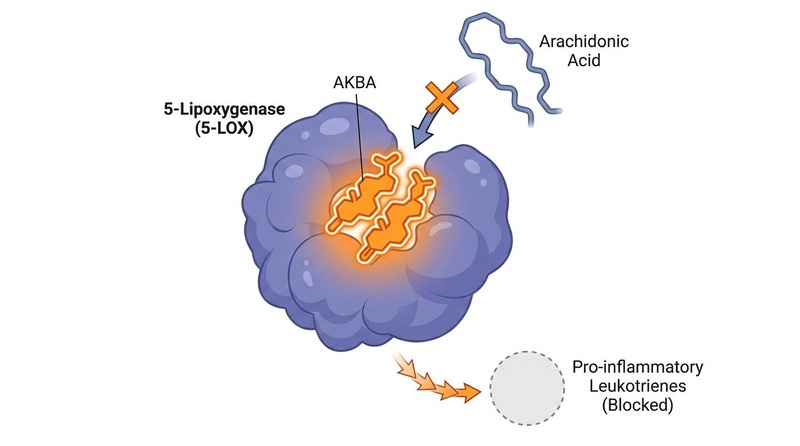
BioRender-style illustration of Boswellia's molecular mechanism: AKBA and other boswellic acids bind to and inhibit the 5-LOX enzyme, interrupting the cascade that produces inflammatory leukotrienes and downregulating NF-κB-driven cytokines.
- Primary targets: 5-Lipoxygenase (5-LOX), NF-κB, JAK-STAT3, and Matrix Metalloproteinase-3 (MMP-3)[4:1][9:1][15].
- Core mechanisms:
- 5-LOX Inhibition: Acetyl-11-keto-β-boswellic acid (AKBA) is a potent, non-redox, non-competitive inhibitor of 5-LOX, the enzyme responsible for synthesizing pro-inflammatory leukotrienes (LTC4, LTD4, LTE4)[5:1][16].
- NF-κB Modulation: Boswellic acids inhibit nuclear factor-kappa B (NF-κB) signaling, reducing the production of pro-inflammatory cytokines such as TNF-α, IL-1β, and IL-6[17][18].
- Chondroprotection: Modified extracts (like Aflapin) inhibit MMP-3, an enzyme that degrades joint cartilage, and help preserve glycosaminoglycan (GAG) levels[2:2][19].
- Guggulsterone Pathways: Boswellia also contains guggulsterones, which modulate Nrf2/HO-1, AMPK, and PI3K/Akt pathways, contributing to its antioxidant and metabolic effects[15:1].
- Pharmacokinetics:
- Absorption: Boswellic acids are lipophilic and have poor aqueous solubility, leading to low oral bioavailability. Absorption is significantly improved when taken with fatty meals or in specialized delivery systems (e.g., Phytosomes, non-volatile oil formulations)[6:1][7:1].
- Metabolism: Metabolized by cytochrome P450 enzymes (CYP3A4, CYP2C9)[20][21].
- Half-life: The terminal half-life of AKBA is approximately 6 hours in humans[6:2].
¶ Effects on different systems
¶ Joint & Musculoskeletal Health
Boswellia's most established application is for knee osteoarthritis (KOA). Network meta-analyses demonstrate that modified Boswellia formulations (BSM) show the most consistent functional benefits compared to conventional extracts[1:2]. Formulations like Aflapin (enriched with 20% AKBA and non-volatile oil) have shown significant pain reduction as early as 5–7 days[2:3]. A 2024 trial also highlighted synergistic effects when combined with oral hyaluronic acid, providing superior relief compared to monotherapy[22].
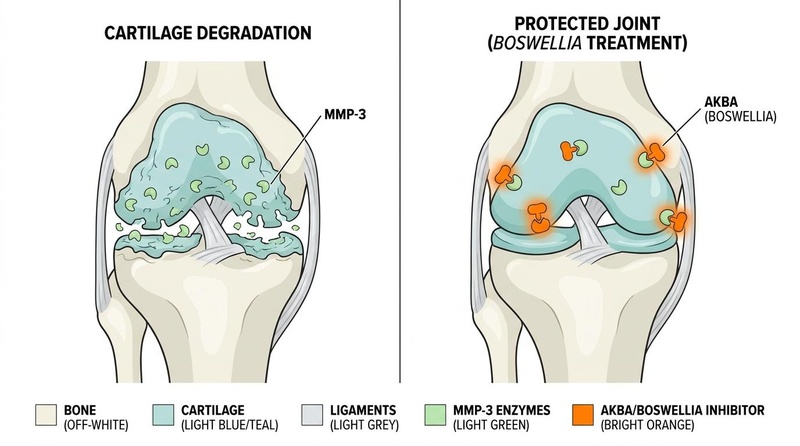
Knee joint illustration showing the protective effects of Boswellia serrata: AKBA inhibits MMP-3 to prevent cartilage degradation and preserve glycosaminoglycan levels.
¶ Metabolic Health
Recent systematic reviews have shifted the understanding of Boswellia's role in metabolic health. In type 2 diabetic patients, Boswellia supplementation significantly improves glycemic markers (HbA1c, FBG) and lipid profiles (TC, LDL, TG, HDL)[3:5]. These effects are attributed to AMPK activation, Nrf2 upregulation, and reduction of oxidative stress in pancreatic beta-cells[4:2][15:2].
¶ Brain & Mental Health
Preliminary research suggests neuroprotective potential for Boswellia. In preclinical models and reviews, boswellic acids have shown the ability to reduce neuroinflammation, decrease beta-amyloid accumulation, and increase Brain-Derived Neurotrophic Factor (BDNF) levels[4:3]. This has positioned Boswellia as a potential candidate for preventing or slowing cognitive decline and Alzheimer's disease, though robust human RCTs are still needed[4:4].
¶ Gastrointestinal & Respiratory Health
Boswellia's 5-LOX inhibition makes it particularly useful for conditions characterized by leukotriene-driven inflammation:
- Inflammatory Bowel Disease: Studies have found Boswellia extract to be as effective as sulfasalazine in inducing remission in patients with ulcerative colitis, with fewer reported side effects[13:1].
- Asthma: Clinical trials have shown improvements in forced vital capacity (FVC) and a reduction in asthma attacks, likely due to the suppression of bronchoconstrictive leukotrienes[14:1].
¶ Cardiovascular & Antiviral Resilience
Boswellic acids have been proposed as potential therapeutic agents for COVID-19, particularly in the elderly, due to their ability to suppress cytokine storms and reduce pulmonary inflammation through NF-κB and 5-LOX targeting[23].
¶ Dosage and how to take it
Standard dosing in studies
- Standard extract (30-65% boswellic acids): 300–500 mg, two to three times daily (total 900–1,500 mg/day).
- Enhanced-bioavailability formulations (e.g., Aflapin, 5-Loxin): 100 mg, once or twice daily (total 100–250 mg/day).
- Metabolic support: Studies in T2DM have utilized 300–900 mg/day for 6–8 weeks[3:6].
Forms and bioavailability
- Bioavailability issues: Bare boswellic acids have extremely low bioavailability (often below the therapeutic threshold).
- Lipid-based delivery: Always take Boswellia with a fat-containing meal to increase absorption up to 3-fold[7:2].
- Standardized extracts: Look for extracts standardized to at least 30% boswellic acids and 3–10% AKBA.
Special populations
- Pregnancy & Breastfeeding: Insufficient safety data; use is generally not recommended during pregnancy as it may have emmenagogue effects (stimulating blood flow to the uterus).
- Bleeding disorders: Use with caution in individuals with bleeding disorders due to theoretical anticoagulant effects.
¶ Safety and side effects
Common side effects
- Gastrointestinal: Mild GI upset, including nausea, bloating, diarrhea, and stomach pain, is reported in 3–5% of participants[24][25].
- Frequency: Generally similar to placebo in high-quality clinical trials.
Less common / serious concerns
- Liver health: Isolated cases of elevated liver enzymes have been reported with very high doses (>1000 mg/day) over long periods; however, systematic reviews generally find it to be hepatoprotective[3:7][26].
- Skin reactions: Rare reports of contact dermatitis or rashes in sensitive individuals.
Who should be especially cautious or avoid it
- Pre-surgery: Discontinue 2 weeks before scheduled surgery due to potential anticoagulant effects.
- Autoimmune conditions: While anti-inflammatory, its effects on the immune system are complex; patients with autoimmune diseases should monitor their response closely.
¶ Drug and supplement interactions
Pharmacokinetic interactions
- Cytochrome P450: Boswellia may inhibit CYP3A4, CYP2C9, and CYP2D6 enzymes, which could increase the blood levels of medications like statins, warfarin, and certain antidepressants[20:1][21:1].
- P-glycoprotein (P-gp): Guggulsterones in Boswellia may modulate P-gp activity, potentially affecting the absorption and resistance profile of various drugs and chemotherapy agents[15:3].
Pharmacodynamic interactions
- NSAIDS: May have additive effects with other anti-inflammatories, potentially allowing for lower NSAID doses in arthritis management[27].
- Antiplatelet/Anticoagulants: May increase the risk of bleeding when taken with aspirin, warfarin, or clopidogrel[28].
- Hypoglycemics: May enhance the effects of blood-sugar-lowering medications (e.g., metformin, insulin), requiring monitoring of blood glucose levels[3:8].
¶ Combining Boswellia serrata with other supplements (“stacks”)
- Joint Health Stack: Often combined with Curcumin. Network meta-analyses indicate that combined formulations provide robust pain relief, although they may not always be superior to high-bioavailability monotherapy extracts[1:3].
- Cartilage Support Stack: Combined with Glucosamine, Chondroitin, and Hyaluronic Acid for comprehensive structural and anti-inflammatory joint support[22:1][29][30].
- Metabolic Stack: Combined with Berberine or Omega-3s for additive effects on glycemic control and lipid profiles[3:9].
¶ Practical questions (FAQ)
-
How long does it take to feel results?
Enhanced-bioavailability extracts (like Aflapin) can reduce joint pain significantly within 5–7 days. Conventional extracts typically require 2–4 weeks of consistent use for noticeable effects. -
Can I take Boswellia on an empty stomach?
It is strongly recommended to take it with a meal containing fats (such as eggs, olive oil, or avocado) to ensure therapeutic levels are absorbed into the bloodstream. -
Does Boswellia help with muscle soreness?
While primarily studied for joint inflammation, its systemic anti-inflammatory effects (leukotriene inhibition) may theoretically support recovery from exercise-induced muscle damage, though specific trials are limited. -
Is it a substitute for NSAIDs?
In many trials, Boswellia has shown efficacy comparable to standard NSAIDs for osteoarthritis pain, but with a significantly lower risk of gastrointestinal side effects (like stomach ulcers).
¶ How we evaluated the evidence
- Study types prioritized: Systematic reviews and meta-analyses published between 2017 and 2026, and multi-center randomized controlled trials (RCTs).
- Evidence Grading:
- High: Multiple high-quality meta-analyses with consistent results (e.g., Knee Osteoarthritis).
- Moderate: Systematic reviews with some heterogeneity in study designs (e.g., Type 2 Diabetes, Ulcerative Colitis).
- Low: Based on single RCTs or primarily preclinical/mechanistic data (e.g., Asthma, Alzheimer’s).
- Magnitude: Assessed based on Standardized Mean Difference (SMD) and percentage change in validated clinical scales (WOMAC, VAS).
¶ References
Inprasit C, et al. (2026). Evaluating the efficacy and safety of Curcuma longa, Boswellia serrata, and their mixed formulation in treating knee osteoarthritis: A systematic review and network meta-analysis. Complementary therapies in medicine. https://pubmed.ncbi.nlm.nih.gov/41082950/ ↩︎ ↩︎ ↩︎ ↩︎
Suva MA, et al. (2017). Management strategies for knee osteoarthritis: Aflapin(®) (Boswellia serrata extract). Ayu. https://pubmed.ncbi.nlm.nih.gov/29861602/ ↩︎ ↩︎ ↩︎ ↩︎
Karimi M, et al. (2024). Effect of boswellia (Boswellia serrata L.) supplementation on glycemic markers and lipid profile in type 2 diabetic patients: a systematic review and meta-analysis. Frontiers in clinical diabetes and healthcare. https://pubmed.ncbi.nlm.nih.gov/39449720/ ↩︎ ↩︎ ↩︎ ↩︎ ↩︎ ↩︎ ↩︎ ↩︎ ↩︎ ↩︎
Gomaa AA, et al. (2021). Potential therapeutic effects of boswellic acids/Boswellia serrata extract in the prevention and therapy of type 2 diabetes and Alzheimer's disease. Naunyn-Schmiedeberg's archives of pharmacology. https://pubmed.ncbi.nlm.nih.gov/34542667/ ↩︎ ↩︎ ↩︎ ↩︎ ↩︎
Rall B, et al. (1996). Boswellic acids and proteoglycans. Mediators Inflamm. https://www.hindawi.com/journals/mi/1996/917089/ ↩︎ ↩︎
Sharma S, et al. (2004). Pharmacokinetic study of 11-keto beta-boswellic acid. Phytomedicine. https://www.sciencedirect.com/science/article/pii/S0944711304700172 ↩︎ ↩︎ ↩︎
Sterk V, et al. (2004). Effect of food intake on the bioavailability of boswellic acids from a herbal preparation in healthy volunteers. Planta Med. https://www.thieme-connect.com/products/ejournals/abstract/10.1055/s-2004-835844 ↩︎ ↩︎ ↩︎
Yu G, et al. (2020). Effectiveness of Boswellia and Boswellia extract for osteoarthritis patients: a systematic review and meta-analysis. BMC Complement Med Ther. https://bmccomplementmedtherapies.biomedcentral.com/articles/10.1186/s12906-020-02985-6 ↩︎
Singh S, et al. (2008). Boswellic acids: A leukotriene inhibitor also effective through topical application in inflammatory disorders. Phytomedicine. https://www.sciencedirect.com/science/article/pii/S0944711307002346 ↩︎ ↩︎
Sharma ML, et al. (1989). Anti-arthritic activity of boswellic acids in bovine serum albumin (BSA)-induced arthritis. Int J Immunopharmacol. https://www.sciencedirect.com/science/article/pii/0192056189900158 ↩︎
Vishal AA, et al. (2011). A double blind, randomized, placebo controlled clinical study evaluates the early efficacy of aflapin in subjects with osteoarthritis of knee. Int J Med Sci. https://www.ncbi.nlm.nih.gov/pmc/articles/PMC3195214/ ↩︎
Sengupta K, et al. (2008). A double blind, randomized, placebo controlled study of the efficacy and safety of 5-Loxin for treatment of osteoarthritis of the knee. Arthritis Res Ther. https://arthritis-research.biomedcentral.com/articles/10.1186/ar2461 ↩︎
Gupta I, et al. (1997). Effects of Boswellia serrata gum resin in patients with ulcerative colitis. Eur J Med Res. https://europepmc.org/article/med/9049593 ↩︎ ↩︎
Gupta I, et al. (1998). Effects of Boswellia serrata gum resin in patients with bronchial asthma: results of a double-blind, placebo-controlled, 6-week clinical study. Eur J Med Res. https://europepmc.org/article/med/9810030 ↩︎ ↩︎
Yang X, et al. (2026). Unlocking the hidden health benefits of guggulsterone isolated from ancient spices: a comprehensive review. Chinese journal of natural medicines. https://pubmed.ncbi.nlm.nih.gov/41708247/ ↩︎ ↩︎ ↩︎ ↩︎
Safayhi H, et al. (1992). Boswellic acids: novel, specific, nonredox inhibitors of 5-lipoxygenase. J Pharmacol Exp Ther. https://jpet.aspetjournals.org/content/261/3/1143.long ↩︎
Takada Y, et al. (2006). Acetyl-11-keto-beta-boswellic acid potentiates apoptosis, inhibits invasion, and abolishes osteoclastogenesis by suppressing NF-kappa B. J Immunol. https://www.jimmunol.org/content/176/5/3127.long ↩︎
Khajuria A, et al. (2008). Immunomodulatory activity of biopolymeric fraction BOS 2000 from Boswellia serrata. Phytother Res. https://onlinelibrary.wiley.com/doi/10.1002/ptr.2320 ↩︎
Zapata A, Fernández-Parra R. (2023). Management of Osteoarthritis and Joint Support Using Feed Supplements: A Scoping Review of Undenatured Type II Collagen and Boswellia serrata. Animals. https://pubmed.ncbi.nlm.nih.gov/36899726/ ↩︎
Frank A, Unger M. (2006). Analysis of frankincense from various Boswellia species with inhibitory activity on human drug metabolising cytochrome P450 enzymes. J Chromatogr A. https://www.sciencedirect.com/science/article/pii/S0021967306005088 ↩︎ ↩︎
Unger M, Frank A. (2004). Simultaneous determination of the inhibitory potency of herbal extracts on the activity of six major cytochrome P450 enzymes. Rapid Commun Mass Spectrom. https://onlinelibrary.wiley.com/doi/10.1002/rcm.1618 ↩︎ ↩︎
Monaco E, et al. (2024). Potential benefits of oral hyaluronic acid and Boswellia serrata extract in patients with mild to moderate knee osteoarthritis. Joints. http://www.jointsjournal.org/2024/07/31/potential-benefits-of-oral-hyaluronic-acid-and-boswellia-serrata-extract-in-patients-with-mild-to-moderate-knee-osteoarthritis/ ↩︎ ↩︎
Gomaa AA, et al. (2021). Boswellic acids/Boswellia serrata extract as a potential COVID-19 therapeutic agent in the elderly. Inflammopharmacology. https://pubmed.ncbi.nlm.nih.gov/34224069/ ↩︎
Kimmatkar N, et al. (2003). Efficacy and tolerability of Boswellia serrata extract in treatment of osteoarthritis of knee. Phytomedicine. https://www.sciencedirect.com/science/article/pii/S0944711302700267 ↩︎
Sontakke S, et al. (2007). Open, randomized, controlled clinical trial of Boswellia serrata extract as compared to valdecoxib in osteoarthritis of knee. Indian J Pharmacol. https://www.ijp-online.com/article.asp?issn=0253-7613;year=2007;volume=39;issue=1;spage=27;epage=29;aulast=Sontakke ↩︎
Almeida JR, et al. (2015). Boswellia serrata extract exhibits hepatoprotective effects in rats. Phytother Res. https://onlinelibrary.wiley.com/doi/10.1002/ptr.5363 ↩︎
Poeckel D, Werz O. (2006). Boswellic acids: biological actions and molecular targets. Curr Med Chem. https://www.ingentaconnect.com/contentone/ben/cmc/2006/00000013/00000028/art00002 ↩︎
Knaus U, Wagner H. (1996). Effects of boswellic acid of Boswellia serrata and other triterpenic acids on complement system. Phytomedicine. https://www.sciencedirect.com/science/article/pii/S0944711396800283 ↩︎
Sontakke S, et al. (2007). Open, randomized, controlled clinical trial of Boswellia serrata extract as compared to valdecoxib in osteoarthritis of knee. Indian J Pharmacol. https://www.ijp-online.com/article.asp?issn=0253-7613;year=2007;volume=39;issue=1;spage=27;epage=29;aulast=Sontakke ↩︎
Badria FA, et al. (2019). A new Boswellia extract decreases interleukin-6 and matrix metalloproteinase-3 in osteoarthritis patients. Phytother Res. https://onlinelibrary.wiley.com/doi/10.1002/ptr.6413 ↩︎