¶ MOTS-c:线粒体“运动模拟物”
证据: 在代谢健康和身体机能方面具有强有力的临床前数据。人类 1b 期试验(CB4211 类似物)显示出安全性及对肝脏的益处。
安全性: 在有限的人类试验中通常耐受性良好。存在叶酸消耗的潜在理论风险。
作用: 运动模拟物。被 WADA(世界反兴奋剂机构)禁用(S4 类)。
¶ 摘要 / 概览
MOTS-c(12S rRNA-c 线粒体开放阅读框)是一种由线粒体基因组编码的 16 氨基酸肽。与由核 DNA 编码的典型肽不同,MOTS-c 是一种 mitokine(线粒体因子)——一种源自线粒体的信号分子,与细胞核进行通讯以调节全身代谢。
- 主要目标:代谢调节、AMPK 激活和运动模拟。
- 主要区别:MOTS-c 被称为“运动模拟物”,即使在没有运动的情况下,也能诱导类似于体育锻炼的生理效应(增强胰岛素敏感性、脂肪酸氧化)。它是 mitohormesis(线粒体激效)中的关键参与者。
- 状态:天然肽广泛应用于长寿诊所和研究中。一种稳定的类似物(CB4211)已成功完成针对脂肪肝(NAFLD)的 1b 期临床试验。
- 监管警告:MOTS-c 在美国是一种未经批准的新药,并且被 WADA 明确禁止职业运动员使用。
¶ “为什么”:关键的长寿益处
MOTS-c 是最有前景的线粒体衍生肽(MDPs)之一,可用于应对“衰老标志”,特别是线粒体功能障碍(Mitochondrial Dysfunction)和营养感应失调(Deregulated Nutrient Sensing)。
¶ 1. 代谢稳态与胰岛素敏感性
MOTS-c 是葡萄糖和脂质代谢的强效调节剂。在研究模型中,它已被证明能够:
- 逆转胰岛素抵抗:通过易位 GLUT4 转运蛋白,绕过有缺陷的胰岛素信号通路,恢复骨骼肌中的葡萄糖摄取 [1][2]。
- 预防肥胖:即使在食用高脂饮食的情况下,接受 MOTS-c 治疗的小鼠也能通过增加能量消耗和棕色脂肪组织中的产热来保持健康的体重 [1:1][3]。
- 降低肝脏脂肪:MOTS-c 类似物 CB4211 的临床试验显示肝酶(ALT/AST)显著降低,表明肝脏健康得到改善且脂肪积累减少 [4][5]。
¶ 2. 身体机能与肌肉减少症
MOTS-c 是由运动自然诱导产生的。补充给药已被证明可以:
- 增强耐力:在衰老的小鼠中,MOTS-c 治疗显著改善了握力和奔跑能力,有效逆转了随年龄增长的身体机能衰退 [6][7]。
- 保护肌肉质量:通过抑制肌肉生长抑制素(一种肌肉生长抑制剂)并促进线粒体生物发生,它有助于预防肌肉减少症(与年龄相关的肌肉流失) [7:1]。
¶ 3. 骨骼健康与骨质疏松症
MOTS-c 通过 TGF-β/Smad 通路在骨代谢中发挥双重作用:
¶ 4. 延长寿命
在生命晚期给予 MOTS-c(从小鼠 23.5 个月大时开始)使中位寿命增加了 6.4%,最大寿命增加了 7%,这证明了其作为一种真正的抗衰老干预措施的潜力,而不仅仅是一种代谢调节剂 [11][7:2]。

¶ 现实检验 / 背景
¶ 商业与临床现状
虽然 MOTS-c 在长寿领域被广泛讨论,但其临床开发过程十分复杂:
- CB4211 的故事:主要的候选药物是 CB4211,这是一种稳定的类似物。它在 2021 年成功完成了针对 NAFLD/NASH 的 1b 期临床试验 [12][13]。然而,开发商(CohBar, Inc.)在 2023 年与 TuHURA Biosciences 合并,转向免疫肿瘤学领域。截至 2025 年,该线粒体研发管线已成为一项“遗留资产”,正在寻找买家或被许可方 [14][15]。
- 天然 MOTS-c:这种由 16 个氨基酸组成的天然肽作为研究化学品被广泛获取。与工程化类似物相比,它的半衰期明显更短,需要更频繁地给药 [16][10:1]。
- 百岁老人的联系:一种特定的 MOTS-c 基因变异(m.1382A>C)几乎只在具有极长寿命的人群中发现,例如日本的百岁老人,这表明具有高 MOTS-c 活性的人具有天然的生物学优势 [17][18]。
¶ 作用机制:叶酸轴
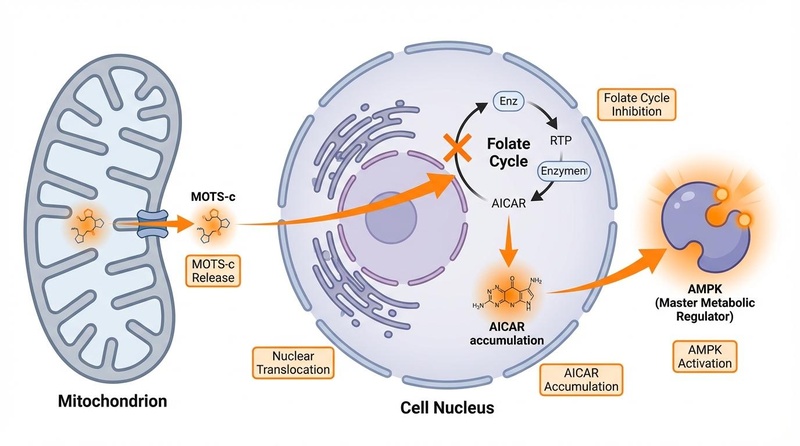
MOTS-c 通过一种独特的“逆行信号传导”(Retrograde Signaling)机制发挥作用,从线粒体移动到细胞核,以重写细胞的代谢程序。
¶ 1. 核易位
在代谢应激(例如葡萄糖限制)下,MOTS-c 会从线粒体易位到细胞核中。这是一个依赖于 AMPK(AMPK-dependent)的过程,它允许线粒体“告诉”细胞核切换状态 [cite: 1, 4, 14]。
¶ 2. 叶酸-AICAR-AMPK 轴
一旦进入细胞核,MOTS-c 就会靶向叶酸循环(Folate Cycle):
- 抑制: 它抑制 5-甲基四氢叶酸(5Me-THF),从而破坏从头(de novo)嘌呤生物合成 [19]。
- AICAR 积累: 这种破坏会导致 AICAR(5-氨基咪唑-4-甲酰胺核糖核苷酸)的积累 [6:1]。
- AMPK 激活: AICAR 是 AMPK(“主代谢开关”)的强效激动剂。激活的 AMPK 会刺激分解代谢途径:葡萄糖摄取、脂肪酸氧化和自噬(Autophagy) [19:1][20]。
¶ 3. Sirtuin 与 NAD+ 相互作用
MOTS-c 与 SIRT1 协同作用。它增加细胞内 NAD+ 水平,为 sirtuins 提供“燃料”以使 PGC-1α 等靶标脱乙酰化,从而驱动线粒体生物发生(mitochondrial biogenesis,即新线粒体的产生)[18:1][21]。
¶ 证据与科学
¶ 临床试验数据(类似物 CB4211)
在患有 NAFLD 的肥胖受试者中进行的 1b 期试验 (NCT03998514) 提供了首个人体概念验证:
- 肝酶: 与安慰剂相比,ALT (-21%) 和 AST (-28%) 显著降低 [22][23]。
- 葡萄糖: 空腹血糖水平降低了 6% [23:1]。
- 体重: 在 4 周的期间内观察到体重减轻的趋势 [5:1]。
¶ 证据分级
| 结果 | 确定性 (GRADE) | 人体数据 | 动物数据 |
|---|---|---|---|
| 胰岛素敏感性 | 高 | 中等(类似物) | 强 |
| 肝脏脂肪减少 | 中等 | 中等(类似物) | 强 |
| 体能表现 | 中等 | 观察性 | 强 |
| 寿命延长 | 低 | 不适用 | 中等 |
¶ 剂量与给药
- 给药途径:由于口服生物利用度差,皮下注射是标准途径。
- 常见方案:
- 剂量:每次注射 5 mg 至 10 mg。
- 频率:每周 1 至 3 次。
- 时机:通常在运动前立即给药,以最大化 AMPK 激活和代谢益处。
- 周期:周期通常持续 4–8 周,随后休息。
- 储存:必须冷藏(如果为冻干粉则需冷冻)。
¶ 安全性与副作用
- 注射部位反应:短暂的红肿、瘙痒或刺激(在许多多肽中很常见)。
- 叶酸消耗:由于 MOTS-c 会抑制叶酸循环,理论上长期使用可能导致叶酸缺乏。监测 B 族维生素水平是明智之举。
- 禁忌症:孕妇或患有活动性癌症者应避免使用。
¶ 法律地位
美国 (FDA)
- 未批准:MOTS-c 未经 FDA 批准。其类似物 CB4211 曾处于临床试验阶段,但尚未上市。
- 复方配制:它不在 503A 散装药物清单(503A Bulks List)上,因此截至 2025 年,美国药房不能合法配制。它作为研究用化学品出售。
世界反兴奋剂机构 (WADA)
- 禁用:MOTS-c 被明确列入 WADA 禁用清单中的 S4. 激素和代谢调节剂(具体作为改变细胞代谢的药物)。对运动员而言,它在任何时候都是被禁用的 [24]。
¶ 比较:MOTS-c 与 Humanin
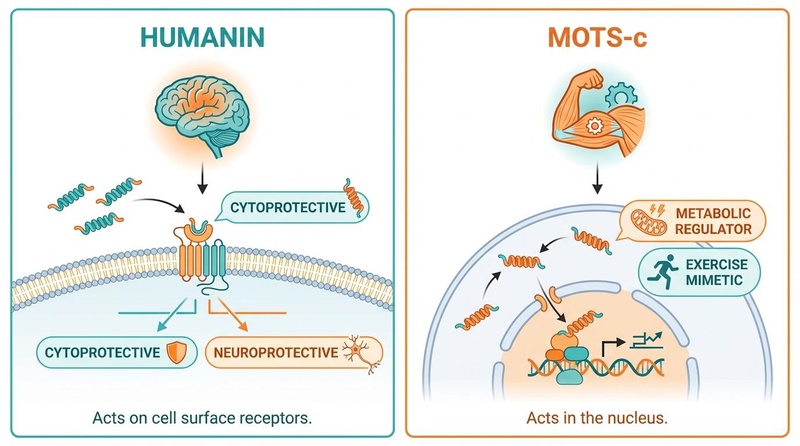
MOTS-c 经常被拿来与 Humanin(首个被发现的线粒体衍生肽)进行比较。虽然两者都是“线粒体因子(mitokines)”,但它们的作用截然不同:
| 特征 | MOTS-c | Humanin | SHLP-2 |
|---|---|---|---|
| 基因组来源 | 12S rRNA 区域 | 16S rRNA 区域 | 16S rRNA 区域 |
| 主要作用 | 代谢调节剂 | 细胞保护盾 | 代谢与神经 |
| 主要靶点 | 肌肉、肝脏、骨骼 | 大脑、心脏、眼睛 | 下丘脑、棕色脂肪 |
| 机制 | 核易位(AMPK) | 表面受体(抗凋亡) | CXCR7 受体 |
| 长寿特质 | “运动员” | “保镖” | “恒温器” |
¶ 协同与叠加使用
¶ 1. NAD+ 前体(NR / NMN)
MOTS-c 和 NAD+ 前体在 AMPK-SIRT1 轴上汇合。MOTS-c 启动应激信号(线粒体毒物兴奋效应,mitohormesis),而 NAD+ 为 sirtuin 酶执行适应性反应提供所需的底物 [25][21:1]。
¶ 2. 运动
MOTS-c 在运动期间会自然释放。外源性给药结合训练显示出比单纯运动对体能有更大的改善,因为它降低了适应的代谢阈值 [26][27]。
¶ 化学与深度解析
MOTS-c 是一种由 16 个氨基酸组成的肽,序列为:MRWQEMGYIFYPRKLR。它具有两亲性,使其能够轻松穿过细胞膜。其核易位是由线粒体 ATP 产量下降触发的,这发出需要进行全身代谢重新校准的信号 [28][1:2]。
¶ 参考文献
Kim, K. H., et al. (2018). The Mitochondrial-Encoded Peptide MOTS-c Translocates to the Nucleus to Regulate Nuclear Gene Expression in Response to Metabolic Stress. Cell Metabolism. https://pmc.ncbi.nlm.nih.gov/articles/PMC9854231/ ↩︎ ↩︎ ↩︎
Li, H., et al. (2023). MOTS-c: A promising mitochondrial-derived peptide for therapeutic exploitation. Frontiers in Endocrinology. https://pmc.ncbi.nlm.nih.gov/articles/PMC9866798/ ↩︎
Yi, X., et al. (2022). Mitochondria-derived peptide MOTS-c: effects and mechanisms. International Journal of Molecular Sciences. https://pmc.ncbi.nlm.nih.gov/articles/PMC9570330/ ↩︎
Loomba, R., et al. (2021). CB4211, a Novel Analog of MOTS-c, Improves Markers of Liver Injury and Metabolism in Obese Subjects with Nonalcoholic Fatty Liver Disease. AASLD Abstracts. https://d1io3yog0oux5.cloudfront.net/_708cf04ac3f5c70482e09ec7c4a65256/cohbar/db/391/2909/pdf/AASLD+2021+Poster+LB5+Final+for+Submission+25Oct2021.pdf ↩︎
Loomba, R., et al. (2021). CB4211, a Novel Analog of MOTS-c, Improves Markers of Liver Injury. https://d1io3yog0oux5.cloudfront.net/_708cf04ac3f5c70482e09ec7c4a65256/cohbar/db/391/2909/pdf/AASLD+2021+Poster+LB5+Final+for+Submission+25Oct2021.pdf ↩︎ ↩︎
Reynolds, J. C., et al. (2021). MOTS-c is an exercise-induced mitochondrial-encoded regulator of age-dependent physical decline and muscle homeostasis. Nature Communications. https://pmc.ncbi.nlm.nih.gov/articles/PMC7817689/ ↩︎ ↩︎
Reynolds, J. C., et al. (2021). MOTS-c is an exercise-induced mitochondrial-encoded regulator. Nature Communications. https://pmc.ncbi.nlm.nih.gov/articles/PMC7817689/ ↩︎ ↩︎ ↩︎
Hu, B. T., & Chen, W. Z. (2018). MOTS-c promotes osteogenic differentiation. European Review for Medical and Pharmacological Sciences. https://pubmed.ncbi.nlm.nih.gov/30468456/ ↩︎
Yi, X., et al. (2023). Role of MOTS-c in the regulation of bone metabolism. Frontiers in Physiology. https://www.frontiersin.org/journals/physiology/articles/10.3389/fphys.2023.1149120/full ↩︎
Alzheimer's Drug Discovery Foundation. (2021). MOTS-c Evidence Summary. https://www.alzdiscovery.org/uploads/cognitive_vitality_media/MOTS-c.pdf ↩︎ ↩︎
Alzheimer's Drug Discovery Foundation. (2021). MOTS-c Evidence Summary. https://www.alzdiscovery.org/uploads/cognitive_vitality_media/MOTS-c.pdf ↩︎
ClinicalTrials.gov. (2021). A Phase 1a/1b Study of Safety, Tolerability, and Pharmacokinetics of CB4211. https://www.clinicaltrials.gov/study/NCT03998514 ↩︎
Longevity.Technology. (2021). CohBar announces positive human data from obesity study. https://longevity.technology/news/cohbar-announces-positive-human-data-from-obesity-study/ ↩︎
TuHURA Biosciences. (2025). Second Quarter 2025 Financial Results. https://tuhurabio.com/tuhura-biosciences-inc-reports-second-quarter-2025-financial-results-and-provides-a-corporate-update/ ↩︎
SEC. (2023). CohBar Proxy Statement. https://www.sec.gov/Archives/edgar/data/1522602/000121390023065729/fs42023a1_cohbar.htm ↩︎
iPharmaPharmacy. (2025). MOTS-c Peptide Therapy: 2025 Blueprint. https://www.ipharmapharmacy.com/mots-c-peptide-therapy-2025-blueprint-metabolic-health-longevity-2/ ↩︎
Fuku, N., et al. (2015). The mitochondrial-derived peptide MOTS-c: a player in longevity and healthy aging? Aging (Albany NY). https://doi.org/10.18632/aging.100839 ↩︎
Mohtashami, Z., et al. (2022). Mitochondria-Derived Peptide MOTS-c: Effects and Mechanisms Related to Stress, Metabolism and Aging. International Journal of Molecular Sciences. https://www.mdpi.com/1422-0067/23/19/11991 ↩︎ ↩︎
Lee, C., et al. (2015). The mitochondrial-derived peptide MOTS-c promotes metabolic homeostasis and reduces obesity and insulin resistance. Cell Metabolism. https://pmc.ncbi.nlm.nih.gov/articles/PMC4350682/ ↩︎ ↩︎
Peptide Dosages. (n.d.). MOTS-c Dosage Protocol. https://peptidedosages.com/single-peptide-dosages/mots-c-10mg-vial-dosage-protocol/ ↩︎
Peptide Health Tracker. (n.d.). MOTS-c and NAD+ Guide. https://www.peptidehealthtracker.com/mots-c-nad-guide.html ↩︎ ↩︎
Patient Worthy. (2021). CB4211 Data Available: NASH & Obesity. https://patientworthy.com/2021/08/17/cb4211-data-available-nash-obesity/ ↩︎
FirstWord Pharma. (2021). CohBar announces positive topline results. https://firstwordpharma.com/story/5371545 ↩︎ ↩︎
USADA. (n.d.). What is MOTS-c Peptide? https://www.usada.org/spirit-of-sport/what-is-mots-c-peptide/ ↩︎
Kim, S. J., et al. (2023). Mitochondria-Derived Peptides in Diabetes and Aging. Diabetes & Metabolism Journal. https://pmc.ncbi.nlm.nih.gov/articles/PMC10244198/ ↩︎
NAD.com. (2024). Unlocking Youth: The Combined Power of NAD+ and Exercise. https://www.nad.com/news/unlocking-youth-the-combined-power-of-nad-and-exercise ↩︎
DeLauer, T. (2025). MOTS-c Exercise Benefits. https://www.youtube.com/watch?v=YwyD1xJwFgw ↩︎
Lee, C., et al. (2015). The mitochondrial-derived peptide MOTS-c promotes metabolic homeostasis and reduces obesity and insulin resistance. Cell Metabolism. https://pmc.ncbi.nlm.nih.gov/articles/PMC4350682/ ↩︎