¶ Indoor Air Quality
¶ TL;DR
- Verdict: Poor indoor air quality significantly impacts cognitive performance, sleep, and long-term cardiovascular and respiratory health. It is a modifiable risk factor for various chronic diseases.
- Who it’s for: Anyone spending significant time indoors, especially those in poorly ventilated spaces, urban environments, or with pre-existing health conditions.
- Expected magnitude + timeline: Improvements in air quality can lead to immediate benefits in cognitive performance and sleep quality (within days to weeks) and significant reductions in chronic disease risk over months to years.
- Key risk(s): Exposure to PM2.5, VOCs (like formaldehyde), and elevated CO2 levels can cause oxidative stress, inflammation, DNA damage, and impaired physiological function.
- What to do next: Monitor indoor air quality, implement mechanical ventilation or HEPA/activated carbon air filtration, and mitigate indoor pollutant sources like cooking fumes and mold.
¶ Quick Answer
Indoor air quality (IAQ) is a critical determinant of human health and longevity, often overlooked despite most individuals spending over 90% of their time indoors. Key indoor pollutants, including fine particulate matter (PM2.5), volatile organic compounds (VOCs) like formaldehyde, and elevated carbon dioxide (CO2) levels, have profound impacts. Research indicates that optimized IAQ can improve cognitive performance by 61-101% and significantly reduce cardiovascular and respiratory risks by improving blood pressure and reducing systemic inflammation.
¶ What It Is
Indoor air quality (IAQ) refers to the air within and around buildings, especially as it relates to the health and comfort of building occupants. While outdoor air pollution receives significant attention, indoor environments can harbor concentrations of pollutants far exceeding outdoor levels due to a combination of external infiltration and internal sources.
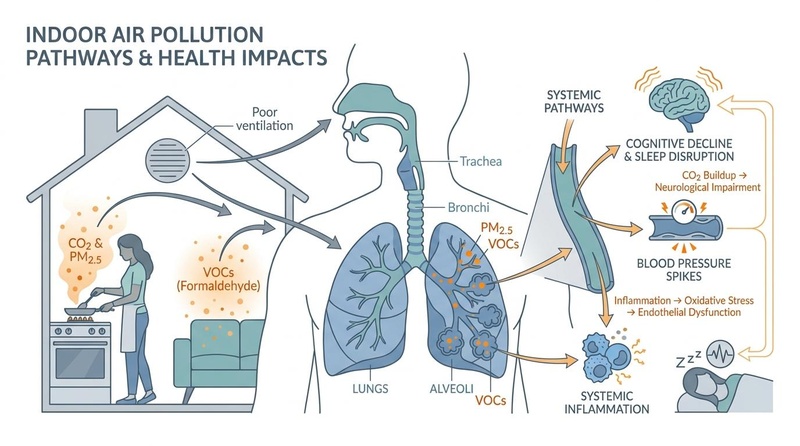
Key indoor air pollutants include:
- Fine Particulate Matter (PM2.5): Microscopic particles (2.5 micrometers or less in diameter) from combustion sources (cooking, candles, fireplaces), outdoor infiltration, and indoor activities. Due to their size, they can deeply penetrate the lungs and enter the bloodstream. (For a detailed analysis of airborne microplastics and nanoplastics, which are a major subset of particulate pollution, see Microplastics and Nanoplastics.).
- Volatile Organic Compounds (VOCs): Gaseous chemicals emitted from building materials, furniture, cleaning products, paints, and personal care items. Formaldehyde is a common VOC associated with many indoor sources.
- Carbon Dioxide (CO2): A byproduct of human respiration. While not directly toxic at typical indoor concentrations, elevated CO2 levels (above 800-1000 ppm) are a reliable indicator of inadequate ventilation and can directly impair cognitive performance.
- Combustion Products: Incomplete combustion from gas stoves, fireplaces, and unvented heaters can produce carbon monoxide (CO), nitrogen dioxide (NO2), and other harmful gases.
- Biological Aerosols and Fungal Spores: Mold genera such as Aspergillus, Penicillium, Cladosporium, and Rhizopus proliferate under high humidity and inadequate ventilation, particularly inside damp building materials and HVAC systems [1]. These bioaerosols can trigger severe respiratory symptoms and allergic responses in sensitive occupants.
Beyond air chemistry, the physical and spectral characteristics of indoor spaces—such as artificial illumination—heavily influence human physiology. For a detailed guide on optimizing indoor lighting to support sleep, mood, and circadian biology, see Light Environment. Additionally, indoor environments shape our behavioral patterns; for an analysis of how chronic isolation and loneliness affect neuroendocrine systems and systemic health, see Loneliness & Social Health.
¶ Mechanisms of Indoor Air Pollution on Human Health
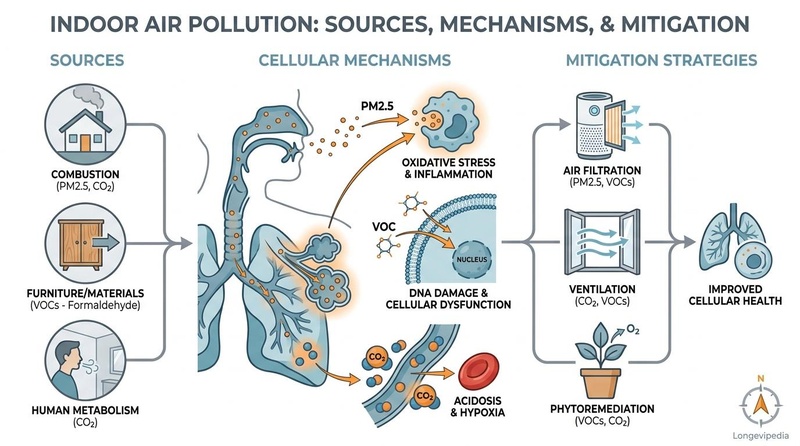
The mechanisms by which indoor air pollutants affect the body are multifaceted, primarily involving oxidative stress, inflammation, and direct cellular damage.
- PM2.5-Induced Damage: Upon inhalation, PM2.5 particles are internalized by cells (e.g., lung epithelial cells, macrophages) through endocytosis. Once inside, they can cause mitochondrial dysfunction, leading to the overproduction of reactive oxygen species (ROS). This creates oxidative stress, an imbalance that harms DNA, proteins, and lipids. PM2.5 also triggers systemic inflammatory responses by activating pathways like NF-κB, contributing to cardiovascular and respiratory diseases [2].
- VOCs (Formaldehyde) Toxicity: Formaldehyde, a pervasive indoor VOC, acts as an electrophile. It readily reacts with macromolecules such as DNA, RNA, and proteins, forming reversible adducts or irreversible DNA-protein crosslinks. This interference can lead to DNA damage, cellular dysfunction, and has been linked to increased cancer risk and respiratory irritation [3].
- CO2 and Cognitive Impairment: While not inducing direct cellular damage like PM2.5 or VOCs, elevated CO2 levels act as a proxy for poor ventilation and can directly impact neurocognitive function. Studies show that even moderately high CO2 concentrations (e.g., 1,000 ppm and above) can reduce decision-making abilities, attention, and overall cognitive performance [4][5]. This is thought to occur through mechanisms affecting cerebral blood flow and neuronal activity, although the precise pathways are still being elucidated.
- Mold and Mycotoxin Pathway: Fungal spore bioaerosols are dynamic and vary in size and aerosolization properties [1:1]. When inhaled, mycotoxins and spore-associated proteins damage respiratory epithelium, activate pulmonary alveolar macrophages, and can induce chronic inflammatory states that interact with other environmental stressors to compromise long-term health span [1:2][6].
¶ Does It Work? (Evidence Snapshot)
Mitigating indoor air pollution is an evidence-based intervention with significant health benefits.
| Outcome | Population | Effect Size | Quality of Evidence | Study Count & Type | Notes |
|---|---|---|---|---|---|
| Cognitive Performance (Executive Function, Decision-Making) | Office Workers | ↑↑↑ (p){.effect-pos-3} (61-101% higher scores in green vs. conventional buildings) | High | Controlled Exposure Trials [4:1] | Reduced CO2 and VOCs significantly improved cognitive function scores. |
| Cognitive Performance (Executive Function, Mental Flexibility) | Adults aged 40+ | ↑↑ (p){.effect-pos-2} (12% faster completion with HEPA) | Moderate | Randomized Crossover Trial [7] | HEPA filtration improved executive function and mental flexibility in older adults. |
| Classroom PM2.5 Reduction | Elementary School Students | ↓↓↓ (p){.effect-pos-3} (39.9% lower average PM2.5; p < 0.001) | High | Randomized Crossover Trial [8] | Adding portable HEPA filters to classrooms with MERV 13 HVAC decreased PM2.5 by 39.9% and cut outdoor infiltration by 13.8–82.4%. |
| Sleep Quality (Efficiency, Wake After Sleep Onset - WASO) | General Population | ↑↑ (p){.effect-pos-2} (4.0% higher efficiency, 15 min reduction in WASO with lower CO2/PM2.5) | Moderate | Observational Actigraphy, Field-Lab Study [9][10] | Higher bedroom PM2.5 and CO2 linked to decreased sleep efficiency and increased WASO. |
| Systolic Blood Pressure | Adults with elevated SBP (≥120 mmHg) | ↓↓↓ (p){.effect-pos-3} (2.8 mmHg mean reduction with HEPA) | High | Randomized Crossover Trial [11] | HEPA filtration significantly reduced SBP in at-risk individuals. |
| All-Cause Mortality | General Population | ↓↓↓ (p){.effect-pos-3} (8-10% reduction per 10 µg/m³ decrease in long-term PM2.5) | High | Systematic Reviews & Meta-analyses [5:1][12] | Long-term PM2.5 exposure is a significant risk factor for all-cause mortality. |
| Cognitive Disadvantage | Older Adults (India) | ↓↓ (p){.effect-pos-2} (Significant interaction of pollution and physical activity) | Moderate | Observational Study [13] | Explored gendered environmental disadvantages of indoor air pollution interacting with physical activity on late-life cognitive function. |
| VOC Removal by Plants | Indoor Environments | ↓ (n){.effect-neg-1} (Minimal; requires 10-1,000 plants/m²) | High | Systematic Review & Analysis [14] | Potted plants are ineffective at significantly improving IAQ compared to mechanical ventilation. |
¶ Who Benefits Most / Least
Benefits Most:
- Individuals in urban/industrial areas: Higher outdoor PM2.5 infiltration.
- Occupants of older, poorly ventilated buildings: Accumulation of CO2, VOCs, and indoor-generated pollutants.
- Patients with Asthma and COPD: Direct symptom relief and risk reduction [15]. Household air quality monitoring has a high clinical rationale for guiding home interventions in patients with chronic obstructive and asthmatic airway disease [15:1].
- Children and the elderly: More vulnerable to pollutant effects, showing direct cognitive benefits from active HEPA filtration [8:1][13:1].
- Those prioritizing cognitive performance and sleep quality: Direct benefits from reduced CO2 and PM2.5.
Benefits Least:
- Individuals living in environments with consistently low outdoor and indoor pollutant levels (e.g., pristine rural settings with modern, well-ventilated homes). However, even in such cases, certain indoor activities (e.g., cooking) can still temporarily degrade IAQ.
¶ How to Try It (Actionable Protocols)
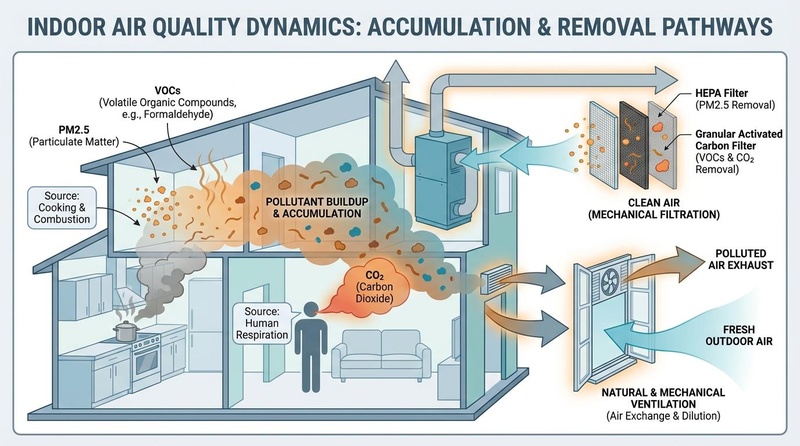
Effective indoor air quality management requires a multi-pronged approach: source control, ventilation, and filtration.
¶ Starter Protocol: Essential Indoor Air Protection
- Monitor Indoor Air Quality:
- Acquire an indoor air quality (IAQ) monitor that tracks PM2.5, VOCs, CO2, temperature, and relative humidity. Sribudda et al. (2026) demonstrated that real-time, multi-parameter IoT tracking provides highly actionable occupational and household risk management data [16].
- Goal: Maintain PM2.5 below 9 µg/m³ [17], CO2 below 800 ppm [9:1], and VOCs at the lowest detectable levels.
- Implement Targeted HEPA Filtration:
- Purchase a portable air purifier with a True HEPA filter and an activated carbon filter. Ensure its Clean Air Delivery Rate (CADR) is sufficient for your room size. Aim for at least 5 Air Changes Per Hour (ACH) for the primary space.
- Adding HEPA filtration to spaces even with existing central MERV 13 filtration provides massive improvements, dropping PM2.5 levels by approximately 39.9% and significantly blocking infiltration of outdoor fine particulates [8:2].
- Calculation for Required CADR (CFM):
(Room Area in sq ft × Ceiling Height in ft × Desired ACH) / 60 - Operate the purifier continuously in bedrooms and living areas.
- Improve Ventilation Habits:
- When outdoor air quality is good (check local AQI, ideally below 50 AQI), open windows for 10-15 minutes several times a day to dilute indoor pollutants.
- Always use externally-vented range hoods when cooking, and run bathroom exhaust fans during/after showering.
¶ Standard Protocol: Comprehensive Indoor Air Optimization
In addition to the starter protocol:
- Continuous Mechanical Ventilation:
- Consider installing an Energy Recovery Ventilator (ERV) or Heat Recovery Ventilator (HRV) system, especially in newer, airtight homes. These systems bring in fresh outdoor air while recovering energy from outgoing air, making them energy-efficient.
- Goal: Achieve at least 0.35 ACH for the entire home, as per ASHRAE recommendations [18].
- Studies show ERVs can reduce indoor CO2 by 29% and PM2.5 by 34% [19].
- Advanced Source Control and Spore Prevention:
- Cooking Mitigation: Refer to the comprehensive Cooking Fumes guide for specific protocols. Maximize use of ducted range hoods with high capture efficiency. Run the hood for several minutes before, during, and after cooking [20]. Switch from gas stoves (a significant source of NO2 and PM2.5, linked to childhood asthma [21]) to electric or induction cooktops.
- Building Materials, Furnishings & Humidity Control: Maintain indoor relative humidity below 50-60% to suppress Aspergillus and Penicillium growth [1:3]. Choose low-VOC paints, flooring, and furniture. Allow new items to off-gas in a well-ventilated area before bringing them indoors.
- Fungal Collection Technology: Surface-engineered filters using plasma-deposited perfluorocarbon thin-films represent an emerging, highly efficient method for the wettability-driven physical collection and removal of airborne fungal spores [22].
- Cleaning & Personal Care: Use fragrance-free, non-aerosol, and certified low-VOC cleaning products.
- Avoid Combustion Sources: Minimize or eliminate burning candles, incense, and using fireplaces, as these are significant sources of PM2.5.
- HVAC Upgrades: Upgrade central HVAC systems to high-performance MERV 13 filters and replace them regularly. If your system cannot support MERV 13 without restricting airflow, upgrade to the highest MERV-rated filter it can safely handle (typically MERV 11-12).
¶ Safety, Interactions, Red Flags
¶ Who Should Avoid Aggressive Interventions
- Individuals with severe respiratory conditions who may be sensitive to strong airflow or rapid changes in air pressure. Consult a clinician for personalized advice.
- Those with limited budgets should prioritize basic, effective strategies (e.g., opening windows when outdoor air is good, targeted HEPA filtration in bedrooms) before investing in whole-home mechanical ventilation systems.
¶ Common Side Effects and How to Mitigate
- Dry Air: Aggressive air filtration and ventilation can sometimes lower indoor humidity. Use a humidifier to maintain relative humidity between 40-60% as detailed in the Indoor Humidity guide.
- Noise: Air purifiers at higher fan settings can be noisy. Opt for models with a "sleep mode" or lower noise ratings for bedrooms.
- Energy Consumption & Maintenance: Factor filter replacement costs (typically every 6-12 months) and electricity usage into your budget.
¶ Stop Criteria and When to Talk to a Clinician
- Persistent or Worsening Symptoms: If respiratory symptoms (e.g., chronic cough, wheezing, shortness of breath), allergic reactions, or neurological symptoms (e.g., persistent headaches, dizziness, severe fatigue) persist or worsen despite consistent IAQ improvements, consult a clinician. Home-based IAQ monitoring should be actively discussed with a clinician for patients diagnosed with asthma or COPD [15:2].
- Unexplained Health Decline: Any unexplained decline in health, even with good IAQ practices, warrants medical evaluation to rule out underlying conditions.
- Suspected Mold Exposure: If you suspect mold growth (musty odors, visible growth), professional assessment and remediation are necessary. Refer to the comprehensive Mold & Mycotoxins guide, as air purifiers alone are insufficient for active mold infestations or large mold problems.
¶ Tracking & What “Good” Looks Like
Biomarkers & Objective Metrics:
- Indoor PM2.5: Consistently below 9.0 µg/m³ ("Good" EPA standard), ideally approaching outdoor background levels.
- Indoor CO2: Below 800 ppm for optimal cognitive function and sleep; ideally below 600 ppm.
- Indoor VOCs: As close to 0 ppb (parts per billion) as possible.
- Air Changes Per Hour (ACH): Maintain a minimum of 0.35 ACH for whole-home ventilation, and 5 ACH for localized air purification in occupied rooms.
Simple N-of-1 Template:
- Phase A (Baseline): For 2-4 weeks, monitor indoor PM2.5, VOCs, CO2, temperature, and relative humidity using an IoT-enabled monitor [16:1]. Log subjective symptoms (e.g., sleep quality, cognitive performance, respiratory comfort) daily.
- Phase B (Intervention): Introduce a HEPA/activated carbon air purifier in your bedroom and living area, and implement improved ventilation habits. Compare data from Phase A and B to observe the difference in peak levels and average concentrations.
¶ Common Mistakes & Myths
- Myth: "If I can't see it, the air is clean."
- Reality: Many harmful pollutants like PM2.5, VOCs, and CO2 are invisible. An IAQ monitor is essential for accurate assessment.
- Myth: "Indoor plants significantly purify the air."
- Reality: While plants do perform some gas exchange, studies show their capacity to remove significant amounts of PM2.5 or VOCs from an average room is negligible compared to mechanical ventilation or air purifiers [14:1]. You would need hundreds of plants to make a noticeable difference.
- Mistake: Relying solely on outdoor AQI.
- Reality: Indoor air quality can be vastly different from outdoor air quality, often worse, due to specific indoor sources (cooking, cleaning, building materials).
¶ Decision Tree (Text-Based)
- If you live in an urban area, near heavy traffic, or industrial zones → Prioritize continuous outdoor AQI monitoring, invest in high-CADR HEPA/activated carbon air filtration for all frequently occupied indoor spaces, and refer to the Wildfire Smoke guide during extreme particulate events.
- If you or family members have asthma, allergies, cardiovascular conditions, or COPD → Immediately implement high-efficiency HEPA filtration in bedrooms and living areas, actively manage indoor pollutant sources, implement household air quality monitoring to suppress PM2.5 and allergen exposure, and consult with a clinician about personalized IAQ strategies [15:3].
- If your indoor air quality monitor consistently shows CO2 above 800 ppm, PM2.5 above 9 µg/m³, or elevated VOCs → Increase mechanical or natural ventilation (when outdoor air quality is good), identify and eliminate internal sources of pollution (e.g., switch from gas stove), and ensure your air purifiers are correctly sized and maintained.
- If you are undertaking home renovations or purchasing new furniture → Choose low-VOC certified products, ensure ample ventilation during and after installation, and allow for significant off-gassing time before re-occupying the space.
¶ FAQs (People Also Ask targets)
¶ What are the ideal indoor CO2 levels for health and cognition?
For optimal health and cognitive function, indoor CO2 levels should ideally remain below 800 ppm. Levels exceeding 1,000 ppm are associated with noticeable decrements in decision-making and cognitive performance [4:2][5:2]. Outdoor CO2 levels are typically around 400-450 ppm.
¶ How does indoor air quality affect sleep?
Poor indoor air quality, particularly elevated PM2.5 and CO2, can significantly reduce sleep quality. Studies show higher bedroom PM2.5 and CO2 levels are linked to decreased sleep efficiency and increased wakefulness after sleep onset (WASO) [9:2][10:1]. Improving IAQ can lead to more restorative sleep.
¶ Can cooking significantly impact indoor air quality?
Yes, cooking, especially with gas stoves and frying, is a major source of indoor PM2.5, NO2, and VOCs. These pollutants can rapidly increase to unhealthy levels. Using an externally-vented range hood with high capture efficiency is crucial to mitigate cooking emissions [20:1]. Gas stove use is also associated with an increased risk of childhood asthma [21:1].
¶ Do air purifiers help with mold?
HEPA air purifiers can capture airborne mold spores, which can help reduce exposure and allergy symptoms. However, they do not remove the source of mold growth. Effective mold remediation requires identifying and eliminating the moisture source, cleaning affected areas, and ensuring proper ventilation. Air purifiers are an adjunctive tool, not a solution for active mold growth.
¶ Glossary
- Air Changes Per Hour (ACH): A measure of how many times the entire volume of air in a room or building is replaced with new air within one hour.
- ASHRAE: American Society of Heating, Refrigerating and Air-Conditioning Engineers, which sets standards for indoor air quality and ventilation.
- Carbon Dioxide (CO2): A gaseous byproduct of respiration and combustion, used as an indicator of ventilation effectiveness.
- Clean Air Delivery Rate (CADR): A metric indicating the volume of filtered air an air purifier delivers, measured in cubic feet per minute (CFM).
- Energy Recovery Ventilator (ERV): A mechanical ventilation system that exchanges heat and moisture between incoming fresh air and outgoing stale air, improving energy efficiency.
- HEPA Filter: High-Efficiency Particulate Air filter, designed to remove at least 99.97% of airborne particles 0.3 micrometers in diameter.
- Particulate Matter (PM2.5): Fine inhalable particles with diameters generally 2.5 micrometers and smaller, a major component of air pollution.
- Volatile Organic Compounds (VOCs): Organic chemicals that have a high vapor pressure at room temperature and are released as gases from various solids or liquids, contributing to indoor air pollution.
¶ Methods (Transparency)
This deep dive was developed through a comprehensive review of peer-reviewed scientific literature, including systematic reviews, meta-analyses, randomized controlled trials, and observational studies, primarily from PubMed, ScienceDirect, and academic journals. Additional information was drawn from reputable health organizations such as the U.S. Environmental Protection Agency (EPA) and the World Health Organization (WHO). Search terms included "indoor air quality," "PM2.5," "VOCs," "formaldehyde," "carbon dioxide," "ventilation," "HEPA filtration," "cognitive function," "sleep quality," "cardiovascular health," and "respiratory health." Emphasis was placed on human-based evidence and higher-tier studies. Evidence was graded according to Longevidence internal rubric guidelines.
¶ References
¶ Update Log
- 2026-07-06: Expanded and updated to integrate clinical outcomes on HEPA crossover trials, mold physically-sampled aerosolization, surface-engineered perfluorocarbon filters, IoT real-time monitoring applications, and gender-disadvantaged elderly air pollution cognitive effects. Added multi-panel schematic maps.
- 2025-10-26: Initial comprehensive article creation based on current scientific literature and WHO/EPA guidelines, incorporating mechanisms, health impacts, and intervention strategies for PM2.5, VOCs, and CO2 in indoor environments.
Mishra J, Przystas W. Methods for Determining the Number of Mold Fungi in the Air-Current Trends. Environmental microbiology reports. 2026. https://pubmed.ncbi.nlm.nih.gov/42402254/ ↩︎ ↩︎ ↩︎ ↩︎
Wang, X., et al. (2020). Urban PM2.5 Induces Cellular Toxicity, Hormone Dysregulation, Oxidative Damage, Inflammation, and Mitochondrial Interference in the HRT8 Trophoblast Cell Line. Frontiers in Endocrinology, 11, 75. https://www.frontiersin.org/journals/endocrinology/articles/10.3389/fendo.2020.00075/full ↩︎
World Health Organization. (2010). WHO Guidelines for Indoor Air Quality: Selected Pollutants. Geneva: World Health Organization. (Formaldehyde section, pp. 103-156). https://www.who.int/publications/i/item/9789289002134 ↩︎
Allen, J. G., MacNaughton, P., Satish, U., Santanam, S., Vallarino, J., & Spengler, J. D. (2016). Associations of Cognitive Function Scores with Carbon Dioxide, Ventilation, and Volatile Organic Compound Exposures in Office Workers: A Controlled Exposure Study of Green and Conventional Office Environments. Environmental Health Perspectives, 124(6), 805–812. https://pmc.ncbi.nlm.nih.gov/articles/PMC4892924/ ↩︎ ↩︎ ↩︎
Satish, U., Mendell, M. J., Shekhar, K., Hotchi, T., Sullivan, D., Streufert, S., & Fisk, W. J. (2012). Is CO2 an Indoor Pollutant? Direct Effects of Low-to-Moderate CO2 Concentrations on Human Decision-Making Performance. Environmental Health Perspectives, 120(12), 1671–1677. https://pmc.ncbi.nlm.nih.gov/articles/PMC3548274/ ↩︎ ↩︎ ↩︎
Adedoyin AT, Ogunsona SB, Eludire OO. Valorization of African walnut (Tetracarpidium Conophorum) husks for green synthesis of silver nanoparticles and sustainable control of indoor mycotoxigenic fungi. Discover nano. 2026. https://pubmed.ncbi.nlm.nih.gov/42400733/ ↩︎
The Conversation. (2026, April 16). HEPA air purifiers may boost brain power in adults over 40 – new research. https://theconversation.com/hepa-air-purifiers-may-boost-brain-power-in-adults-over-40-new-research-280885 ↩︎
Simona SC, Bartell SM, Vieira VM. Classroom air quality in a randomized crossover trial with portable HEPA air cleaners. Journal of Exposure Science & Environmental Epidemiology. 2025. https://pubmed.ncbi.nlm.nih.gov/42395610/ ↩︎ ↩︎ ↩︎
Martinez-Ales, G., et al. (2023). Associations of bedroom PM2.5, CO2, temperature, humidity, and noise with sleep: An observational actigraphy study. Sleep Health. https://pubmed.ncbi.nlm.nih.gov/37076419/ ↩︎ ↩︎ ↩︎
Fan, X., Liao, C., Matsuo, K., et al. (2023). Ventilation causing an average CO2 concentration of 1,000 ppm negatively affects sleep: A field-lab study on healthy young people. Building and Environment. https://www.sciencedirect.com/science/article/pii/S0360132323011459 ↩︎ ↩︎
Brook, R. D., et al. (2025). Effect of HEPA Filtration Air Purifiers on Blood Pressure: A Pragmatic Randomized Crossover Trial. Journal of the American College of Cardiology, 86(8), 577-589. https://www.jacc.org/doi/10.1016/j.jacc.2025.06.037 ↩︎
Orellano, P., et al. (2024). The effect of long-term PM2.5 exposure on all-cause mortality estimated using meta-regression: a meta-analysis of concentration–response by air pollution exposure assessment method. Air Quality, Atmosphere & Health. https://link.springer.com/article/10.1007/s11869-026-01936-3 ↩︎
Das S, Ayalon L. Physical activity, indoor air pollution, and cognitive function among older-adults in India: Evidence of gendered environmental disadvantage. Social science & medicine (1982). 2026. https://pubmed.ncbi.nlm.nih.gov/42385470/ ↩︎ ↩︎
Cummings, B. E., & Waring, M. S. (2020). Potted plants do not improve indoor air quality: a review and analysis of reported VOC removal efficiencies. Journal of Exposure Science & Environmental Epidemiology, 30, 253–261. https://www.nature.com/articles/s41370-019-0175-9 ↩︎ ↩︎
González-Colom R, Gómez-López A, Aguado A. Should household air quality monitoring be considered in selected patients with asthma and COPD? BMJ open respiratory research. 2026. https://pubmed.ncbi.nlm.nih.gov/42386347/ ↩︎ ↩︎ ↩︎ ↩︎
Sribudda S, Harnpicharnchai K, Nankongnab N, et al. Development of a Hospital Air Quality Monitoring Application Utilizing IoT Technology and Google Workspace. Studies in health technology and informatics. 2026. https://pubmed.ncbi.nlm.nih.gov/42394035/ ↩︎ ↩︎
U.S. Environmental Protection Agency. (2024, March 6). Reconsideration of the National Ambient Air Quality Standards for Particulate Matter; Final Rule. Federal Register. https://www.federalregister.gov/documents/2024/03/06/2024-02637/reconsideration-of-the-national-ambient-air-quality-standards-for-particulate-matter ↩︎
ASHRAE. (2023). ASHRAE Standard 62.2: Ventilation and Acceptable Indoor Air Quality in Residential Buildings. (Various editions and addenda). https://www.ashrae.org/technical-resources/bookstore/standards-62-1-62-2 ↩︎
Wu, Y., et al. (2023). The residential application of chain recooling energy recovery ventilator system in a hot and humid climate. Energy and Buildings, 286, 112954. https://pmc.ncbi.nlm.nih.gov/articles/PMC10209410/ ↩︎
Zhao, Z., et al. (2023). Performance assessment of the range hood with an air supply system in cooking kitchen for improving air quality and thermal comfort. Energy and Buildings, 278, 112613. https://www.sciencedirect.com/science/article/abs/pii/S1359431125001632 ↩︎ ↩︎
Gruenwald, T., Seals, B. A., Knibbs, L. D., & Hosgood, H. D., 3rd. (2023). Population Attributable Fraction of Gas Stoves and Childhood Asthma in the United States. International Journal of Environmental Research and Public Health, 20(1), 75. https://pmc.ncbi.nlm.nih.gov/articles/PMC9819315/ ↩︎ ↩︎
Affan HU, Lenehan C, Fryar S. Surface-Engineered Filters for Wettability-Driven Collection of Airborne Fungal Spores. Global challenges (Hoboken, NJ). 2026. https://pubmed.ncbi.nlm.nih.gov/42394765/ ↩︎