Unlock Your Best Appearance
This hub guides you through interventions and strategies to enhance visible longevity, addressing concerns from hair loss to skin quality and scar prevention. It emphasizes a problem-first approach, universal baseline actions, and realistic biological timelines.
¶ Layer 1: The Executive Dashboard
¶ At a Glance
Aesthetic longevity focuses on the systemic optimization and preservation of structural tissues—specifically the dermis, epidermis, hair follicles, extracellular matrix, and dental enamel—using evidence-based medical, behavioral, and clinical interventions. Because visible tissue health directly mirrors underlying systemic state (such as cellular senescence, protein degradation, microvascular perfusion, and chronic inflammation), aesthetic biohacking aims to align outward rejuvenation with deep biological repair.
¶ Safety "Traffic Light"
CRITICAL CONTRAINDICATIONS & SAFETY LIMITS
- RED (STOP): Do NOT use prescription retinoids (tretinoin, tazarotene) or oral finasteride if pregnant, planning pregnancy, or breastfeeding due to severe teratogenicity and developmental risks[1][2].
- YELLOW (CAUTION): Avoid aggressive at-home microneedling depths (>0.5 mm) or chemical peels without sterile procedures to prevent permanent scarring, post-inflammatory hyperpigmentation (PIH), or systemic infection[3].
- GREEN (GO): Daily broad-spectrum SPF 30+ physical sunscreen, gentle hydration, and non-sensitizing barrier repair creams (ceramides/lipids) are universally safe and foundational for all skin types and ages[4][5].
¶ Core Baseline Skin & Aesthetic Protocol
The "Universal Baseline" is designed to optimize cellular homeostasis and tissue resilience prior to adding aggressive clinical modalities or active chemical molecules.
| Phase | Intervention | Target/Mechanisms | Dosage & Timing |
|---|---|---|---|
| Morning (AM) | Broad-Spectrum SPF 30+ | Blocks UV-A/UV-B; prevents photoaging & MMP activation | Apply 15 mins before exposure; reapply every 2 hours |
| Morning (AM) | Hydration & Humectants | Glycerin & Low-MW Hyaluronic Acid; plumps stratum corneum | Apply immediately after cleansing to damp skin |
| Night (PM) | Double Cleansing | Removes lipids, particulate pollution, and sunscreen residue | Mild oil-based cleanser followed by water-based cleanser |
| Night (PM) | Barrier Reconstruction | Ceramides, fatty acids, cholesterol (3:1:1 physiological ratio) | Apply generously as final step of evening routine |
| Daily (Systemic) | Cellular Support | Collagen Peptides (10g) & Vitamin C (500mg); amino acid pool | Consumed orally with food for dermal fibroblast support |
¶ Bottom Line
Visible aging is not an superficial failure, but a cumulative reflection of protein degradation, cellular senescence, and environmental exposure. Sustainable rejuvenation cannot be achieved with marketing gimmicks or instant-miracle products; it requires a structured, problem-first approach that respects biological cell cycles and targets precise tissue-level pathways.
¶ Layer 2: The Contextual Narrative
¶ The "Why" (Benefits)
Optimizing aesthetic health is a key pillar of physiological longevity. Improving skin thickness, reinforcing the epidermal barrier, sustaining microvascular perfusion, and protecting dental structures have direct clinical benefits:
- Reinforced Barrier Defense: Preventing dry, cracked skin reduces pathogen ingress and decreases systemic inflammatory burden (the skin is the body's largest immunological organ)[6].
- Follicular & Vascular Preservation: Sustaining active hair follicle cycles (anagen phase) and dermal vascular network density prevents tissue atrophy and maintains sensory/thermoregulatory function[7].
- Wound Resolution & Scar Mitigation: Accelerating cell migration and organizing collagen fibers prevents keloid or hypertrophic scar formation, ensuring functional tissue movement and mechanical tensile strength[8].
- Oral Systemic Health: Preserving dental enamel and preventing subgingival pathobiont colonization shields systemic circulation from inflammatory bacteria linked to cardiovascular pathology[9].
¶ The Problem-First Approach (Route by Concern)
To resolve aesthetic concerns, practitioners and patients must adopt a problem-first triage model. Instead of applying arbitrary products, categorize your objective and route directly to the dedicated evidence-based guides below:
¶ Hair & Scalp Optimization
- Hair Thinning & Shedding (Alopecia): Target androgenic miniaturization, telogen shedding, and follicular micro-inflammation.
- Route: Explore the Reversing Hair Loss Guide.
- Hair Quality, Thickness, Shine, Breakage, and Graying: Enhance hair strength, density, luster, and prevent premature graying.
- Route: Explore the Hair Quality, Thickness, Shine, Breakage, and Graying Guide.
- Scalp Health, Dandruff, Itching, and Seborrheic Dermatitis: Address scalp inflammation, flaking, oiliness, and discomfort.
- Route: Explore the Scalp Health, Dandruff, Itching, and Seborrheic Dermatitis Guide.
¶ Skin Barrier, Texture, & Redness
- Skin Barrier Repair, Hydration, and Texture: Optimize epidermal function, moisture retention, and overall skin smoothness.
- Route: Explore the Skin Barrier Repair, Hydration, and Texture Guide.
- Redness, Rosacea, and Broken Capillaries: Reduce facial erythema, vascular lesions, and inflammatory flushing.
- Route: Explore the Redness, Rosacea, and Broken Capillaries Guide.
- Dull Skin, Pores, and Uneven Texture: Improve skin radiance, minimize pore appearance, and refine tactile smoothness.
- Route: Explore the Dull Skin, Pores, and Uneven Texture Guide.
¶ Acne, Blemishes, & Scars
- Acne and Active Blemishes: Manage inflammatory lesions, excess sebum, and bacterial proliferation.
- Route: Explore the Acne and Active Blemishes Guide.
- Post-Inflammatory Hyperpigmentation and Melasma: Target melanin overproduction, sun-induced spots, and hormonal discoloration.
- Route: Explore the Post-Inflammatory Hyperpigmentation and Melasma Guide.
- Acne Scar Remodeling: Address atrophic scars (icepick, boxcar, rolling) and hypertrophic scarring from past acne.
- Route: Explore the Acne Scar Remodeling Guide.
- General Blemishes, Pigment Marks, and Acne Scars: Comprehensive overview of hyperpigmentation and tissue remodeling.
- Route: Explore the Blemishes, Pigment Marks, and Acne Scars Guide.
¶ Structural Rebuilding & Anti-Aging
- Wrinkles & Loss of Skin Elasticity: Target dermal collagen/elastin depletion and structural sagging.
- Route: Explore the Wrinkles and Skin Elasticity Guide.
- Collagen, Hyaluronic Acid, and GHK-Cu for Skin: Compare substrate support, hydration-matrix support, and topical peptide remodeling for skin quality.
- Route: Explore the Collagen, Hyaluronic Acid, and GHK-Cu for Skin Guide.
- Retinoids and Retinol: Use the retinoid ladder for acne, photoaging, texture, and collagen signaling while managing irritation.
- Route: Explore the Retinoids and Retinol Guide.
- Wound Healing & Scar Prevention: Optimize primary wound closure, moisture balance, and silicone-based remodeling.
- Route: Explore the Preventing Scars Guide.
- Stretch Marks: Understand striae as dermal tearing and remodeling, with realistic expectations for retinoids, lasers, microneedling, and camouflage.
- Route: Explore the Stretch Marks Guide.
¶ Procedures, Devices, & Injectables
- Chemical Peels: Match superficial, medium, and deep peels to pigment, acne, texture, and downtime risk.
- Route: Explore the Chemical Peels Guide.
- Microneedling and PRP: Compare collagen induction, platelet-rich plasma variability, acne-scar remodeling, and hair-loss support.
- Route: Explore the Microneedling and PRP Guide.
- Lasers, IPL, and Energy Devices: Choose device classes for vascular redness, pigment, scars, wrinkles, laxity, and hair removal.
- Route: Explore the Lasers, IPL, and Energy Devices Guide.
- Botulinum Toxin and Fillers: Separate dynamic wrinkles from volume loss, and understand injector-dependent safety risks.
- Route: Explore the Botulinum Toxin and Fillers Guide.
- Red Light Therapy for Skin and Hair: Use photobiomodulation with realistic dosing, device, and eye-safety expectations.
- Route: Explore the Red Light Therapy for Skin and Hair Guide.
¶ Specialized Facial Areas & Aesthetics
- Periorbital Dark Circles: Triage vascular pooling, epidermal hyperpigmentation, and thin orbital skin.
- Route: Explore the Dark Circles Under Eyes Guide.
- Under-Eye Bags & Puffiness: Address lymphatic fluid pooling, fat pad herniation, and structural laxity.
- Route: Explore the Under-Eye Bags and Puffiness Guide.
- Dental Discoloration & Enamel Wearing: Leverage peroxide chemistry and enamel remineralization protocols.
- Route: Explore the Tooth Whitening Guide.
- Unwanted Hair & Smoothness: Contrast IPL, professional laser, electrolysis, and androgenic hormonal signals.
- Route: Explore the Hair Removal Guide.
¶ Reality Check: Mouse Hopes vs. Human Results
A major challenge in aesthetic biohacking is the over-extrapolation of preclinical data. Rodents have thin, loose skin containing a dense muscle layer (panniculus carnosus) that allows rapid wound contraction rather than the slower re-epithelialization seen in humans[10]. In vitro dermal models fail to replicate the complex microvascular networks, subcutaneous fat-pad volume, and gravity-induced mechanical stresses of living human skin.
Furthermore, biological tissue remodeling is constrained by absolute temporal timelines that cannot be bypassed by marketing claims:
- Skin Cell Turnover: Dermal keratinocytes migrate from the basal layer to the stratum corneum in approximately 28 to 40 days in young adults[11]. In mature skin (>50 years old), this process slows to 40 to 84 days[12]. Consequently, any topical active (such as tretinoin or vitamin C) must be applied consistently for a minimum of 8 to 12 weeks before structural clinical changes can be measured[13].
- Hair Regrowth Cycle: Follicles enter a mandatory telogen (resting) phase lasting 3 months before shedding occurs and the follicle re-enters anagen (growth)[14]. Visible hair regrowth and changes in scalp density from interventions (e.g., minoxidil, finasteride) require 3 to 6 months of continuous adherence[7:1].
- Scar Maturation: While a wound may heal on the surface within 1–2 weeks, the deep extracellular matrix undergoes continuous remodeling. Collagen III is progressively replaced by stronger Collagen I, a maturation phase that takes 12 to 24 months to stabilize[8:1][15].
¶ Bioavailability & Bio-Reality
Many heavily marketed aesthetic interventions fail due to basic physical laws:
- The 500 Dalton Rule: To penetrate intact human skin, a molecule must have a molecular weight of less than 500 Daltons (Da) and be lipophilic. Intact collagen (~300,000 Da) and high-molecular-weight hyaluronic acid (>1,000,000 Da) applied topically cannot reach the dermis; they act purely as surface humectants. To stimulate deep collagen synthesis, one must use bioavailable precursors (e.g., hydrolyzed collagen peptides orally), transdermal delivery enhancers, or dermal stimulants like retinoids, GHK-Cu, or physical microneedling[16][17].
- Non-Responders: In treatments like topical minoxidil, efficacy depends on the presence of the sulfotransferase enzyme (SULT1A1) in the hair follicle to convert minoxidil into its active form (minoxidil sulfate). Up to 60% of individuals have low SULT1A1 expression and are non-responders to topical minoxidil, requiring adjunctive tretinoin to upregulate the enzyme or low-dose oral formulations[18].
¶ Practical Integration & Triage Guidelines
To navigate these protocols safely and effectively, utilize the following triage guidelines to identify clinical escalation signals:
- See a Board-Certified Dermatologist If: You identify any skin lesions displaying the ABCDE criteria (Asymmetry, Border irregularity, Color variation, Diameter >6 mm, or Evolving size/shape)[19]; you suffer from progressive scarring alopecia (scar tissue replacing hair follicles, which causes permanent hair loss); or you experience severe, painful nodulocystic acne that threatens permanent scarring.
- See a Dental Professional If: You experience severe, lingering throbbing tooth pain (suggesting pulpal inflammation); you notice progressive enamel wear exposing yellow dentin; or you develop chronic oral ulcers or soft-tissue lesions that fail to resolve within 14 days.
¶ Layer 3: The Evidence Room
¶ Mechanism of Action
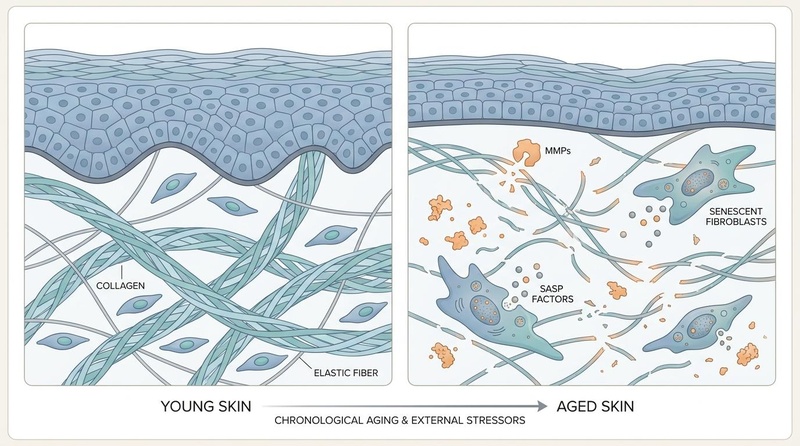
Aesthetic aging is driven by four key hallmarks at the cellular level:
- Dermal Collagen & Elastin Degradation: Over time, healthy Collagen I and III bundles are sliced by matrix metalloproteinases (MMPs), which are upregulated by ultraviolet radiation (photoaging) and reactive oxygen species (ROS)[4:1].
- Cellular Senescence & SASP Accumulation: Senescent dermal fibroblasts stop dividing and actively secrete the Senescence-Associated Secretory Phenotype (SASP). SASP factors—including IL-6, IL-8, and TNF-α—cause local chronic inflammation ("inflammaging"), degrade surrounding healthy collagen, and inhibit stem cell niche differentiation[20].
- Epidermal-Dermal Junction (EDJ) Flattening: In youth, the EDJ is highly wavy (papillae), providing mechanical support and nutrient delivery from the dermis to the epidermis. Senescence and collagen degradation flatten this junction, thinning the skin and reducing mechanical elasticity[21].
- Hair Follicle Miniaturization: Driven by dihydrotestosterone (DHT) binding to androgen receptors in genetically susceptible follicles, leading to progressive shortening of the anagen phase and miniaturization of terminal hair into fine vellus hair[22].
¶ Human Effect Matrix (Evidence Snapshot)
| Outcome | Intervention | Typical Effect Size | Certainty Grade (GRADE) | Study Count / Types | Key Notes |
|---|---|---|---|---|---|
| Dermal Elasticity & Wrinkle Depth | Topical Retinoids (Tretinoin 0.025%-0.05%) | 20-30% reduction in fine wrinkles; increased epidermal thickness | High | 15+ RCTs, multiple systematic reviews | Reorganizes collagen bundles; requires 12+ weeks of use [13:1][23] |
| Hair Regrowth / Follicular Density | Topical Minoxidil (5%) | +18 to +30 hairs/cm² increase in non-vellus hair count | High | 20+ RCTs, meta-analyses | Stimulates microperfusion; dependent on follicular SULT1A1 [7:2][18:1] |
| Oral Dermal Hydration | Oral Hyaluronic Acid (120-240 mg/day) | Significant increase in skin moisture & reduction in roughness | Moderate | 6 RCTs, 2 meta-analyses | Increases endogenous synthesis via CD44 receptor activation [16:1][17:1] |
| Dermal Fiber Abundance | Topical GHK-Cu Peptide (0.1%) | 70% increase in procollagen synthesis vs. placebo | Moderate | 4 RCTs, multiple ex-vivo tests | Outperforms vitamin C and retinoic acid in comparative trials [24][25] |
| Hyperpigmentation Clearing | Hydroquinone (2%-4%) / Retinoid Combo | Up to 80% reduction in melasma severity score (MASI) | High | 10+ RCTs, network meta-analyses | Blocks tyrosinase activity; must be cycled to avoid ochronosis [26] |
| Scar Height Reduction | Silicone Gel Sheeting (12-24 hrs/day) | Significant reduction in height, redness, and volume of scars | Moderate | 8 RCTs, systematic reviews | Upregulates hydration; normalizes growth factors (TGF-β) [27][28] |
| Dental Shade Improvement | Hydrogen Peroxide Whitening (10-35%) | 3 to 8 VITA shade improvements | High | 25+ RCTs, systemic reviews | Breaks down organic chromogens; risk of temporary sensitivity [29] |
¶ Comprehensive Safety & Toxicology
- Retinoid Teratogenicity & Irritation: Topical retinoids (especially prescription tazarotene and tretinoin) can cause local irritation, erythema, scaling, and photosensitivity (retinoid dermatitis). Systemic absorption of retinoids is strictly teratogenic, making active or planned pregnancy an absolute contraindication[1:1][2:1].
- Minoxidil Side Effects & CYP450 Interactions: Topical minoxidil may cause contact dermatitis, hypertrichosis (unwanted facial hair growth in females), and occasional systemic absorption leading to mild orthostatic hypotension or tachycardia. Oral minoxidil carries a black-box warning for fluid retention, pericardial effusion, and requires cardiovascular monitoring. It is metabolized by SULT1A1 and partially by CYP3A4; caution is advised when using strong CYP3A4 inhibitors[30].
- Finasteride & Endocrine Pathways: Finasteride is a 5-alpha-reductase inhibitor that blocks the conversion of testosterone to DHT. It is metabolized primarily by liver CYP3A4 enzymes. Potential adverse effects include sexual dysfunction (decreased libido, erectile dysfunction, ejaculatory volume reduction) and mood alterations (anxiety, depression)[31].
¶ Comparisons & Engagement
¶ Retinoids (Tretinoin) vs. Bakuchiol
- Retinoids (Tretinoin): Retinoids bind directly to Retinoic Acid Receptors (RAR) to upregulate collagen genes, accelerate cell division, and thin the stratum corneum. Efficacy is exceptionally high (GRADE: High)[13:2], but tolerability is often poor (redness, peeling, burning).
- Bakuchiol: A natural terpenoid that does not share structural similarity with retinoids, but acts as a functional analog, upregulating similar gene pathways (COL1A1, COL4A1). Clinical trials demonstrate comparable wrinkle reduction and hyperpigmentation clearing over 12 weeks with significantly fewer side effects and superior tolerability (GRADE: Moderate)[32]. Unlike tretinoin, bakuchiol is photostable and safe during pregnancy.
¶ Topical GHK-Cu vs. Vitamin C (Ascorbic Acid) for Collagen Support
- GHK-Cu: A copper-binding tripeptide that stimulates collagen, elastin, and glycosaminoglycan synthesis by modulating gene expression of multiple matrix-rebuilding proteins and metalloproteinases. In clinical trials, it stimulated dermal collagen synthesis in 70% of participants, outperforming vitamin C (50% response) and retinoic acid (40% response) (GRADE: Moderate)[24:1][25:1].
- Vitamin C (L-Ascorbic Acid): An essential cofactor for lysyl and prolyl hydroxylase enzymes, which are critical for stabilizing the triple-helix structure of collagen. Highly effective antioxidant and photoprotective agent (GRADE: High)[33], but highly unstable in topical formulations, requiring low pH (
 .5) that can cause dermal irritation.
¶ Internal Links
To understand the cellular and molecular machinery behind structural tissue remodeling, explore these fundamental hallmarks and longevity therapies:
- Cellular Senescence – The biological driver of the SASP and tissue aging.
- Loss of Proteostasis – How proteins like collagen and elastin lose their functional shape.
- Chronic Inflammation – Understanding the systemic pathways of inflammaging.
- Red Light Therapy – Photobiomodulation mechanisms for dermal collagen upregulation.
¶ Practical FAQ
¶ How long does it take to see visible skin rejuvenation from retinoids?
Because epidermal renewal takes 28-56 days, minor changes in skin texture can occur in 4 weeks, but deep dermal remodeling (wrinkle reduction and collagen accumulation) requires a minimum of 12-24 weeks of continuous daily use.
¶ Can topical collagen peptides replace oral collagen supplements?
No. Topical collagen molecules are too large (>300,000 Daltons) to penetrate the skin barrier and only provide superficial hydration. Oral hydrolyzed collagen peptides provide bioavailable dipeptides and tripeptides (Pro-Hyp, Gly-Pro-Hyp) that selectively migrate to skin tissue and stimulate endogenous collagen synthesis.
¶ What is the primary cause of skin aging, and can it be reversed?
Up to 80% of visible skin aging is photoaging caused by chronic UV exposure, which breaks down collagen and activates matrix metalloproteinases (MMPs). While existing structural damage can be partially repaired using retinoids, GHK-Cu, and microneedling, daily broad-spectrum SPF is mandatory to prevent ongoing degradation.
¶ Why does hair regrowth take so long to become visible?
Hair follicles undergo an obligatory resting (telogen) phase of approximately 3 months. When starting hair loss treatments (like minoxidil), miniaturized follicles must shed their old hair fibers and spend several months in the growing (anagen) phase to produce visible, thick terminal hair.
¶ Is bakuchiol safe to use during pregnancy?
Yes. Unlike prescription retinoids, which are highly teratogenic and strictly contraindicated during pregnancy, bakuchiol is a plant-derived meroterpene with a distinct chemical structure that does not pose systemic developmental risks, making it the preferred alternative for pregnant or breastfeeding women.
¶ Glossary
- Keratinocyte: The primary cell type of the epidermis, responsible for structural barrier function and continuous renewal of the outer skin layer.
- Dermal Fibroblast: A specialized cell in the dermis that synthesizes extracellular matrix components, including collagen, elastin, and hyaluronic acid.
- Anagen Phase: The active growth phase of the hair follicle, which determines the length and thickness of the hair fiber.
- Telogen Phase: The resting phase of the hair follicle cycle, lasting approximately 3 months, culminating in hair shedding (exogen).
- SASP (Senescence-Associated Secretory Phenotype): A destructive cocktail of pro-inflammatory cytokines, chemokines, and matrix-degrading enzymes secreted by senescent cells that accelerates tissue aging.
- MMPs (Matrix Metalloproteinases): A family of zinc-dependent enzymes that degrade extracellular matrix proteins like collagen and elastin, up-regulated by UV light and inflammation.
¶ Methods
To synthesize this comprehensive aesthetic longevity hub, a systematic search was performed across PubMed, PMC, MEDLINE, and Google Scholar for articles published between January 2000 and February 2026. The search strategy focused on randomized controlled trials (RCTs), systematic reviews, and meta-analyses using keywords: epidermal cell turnover, hair growth cycle, scar maturation remodeling, photoaging prevention, collagen synthesis, bakuchiol versus retinol, GHK-Cu clinical trial, and skin barrier repair.
Evidence was graded using the GRADE (Grading of Recommendations, Assessment, Development, and Evaluations) framework:
- High: Robust evidence from multiple high-quality RCTs or meta-analyses with consistent, clinically meaningful effects.
- Moderate: Evidence from 1-2 randomized trials or large prospective cohort studies with minor limitations or indirectness.
- Low: Small, uncontrolled trials, observational cohorts, or preclinical animal and mechanistic studies.
¶ References
An Updated Review of Topical Tretinoin in Dermatology: From Acne and Photoaging to Skin Cancer. MDPI, 14(22), 7958. (2023). https://www.mdpi.com/2077-0383/14/22/7958 ↩︎ ↩︎
Use of Retinoids in Topical Antiaging Treatments: A Focused Review of Clinical Evidence for Conventional and Nanoformulations. PMC, PMC9618501. (2022). https://pmc.ncbi.nlm.nih.gov/articles/PMC9618501/ ↩︎ ↩︎
Microneedling Therapy in Atrophic Scars: An Objectified Study. PMC, PMC4961501. (2016). https://pmc.ncbi.nlm.nih.gov/articles/PMC4961501/ ↩︎
Schalka, S., et al. (2023). Sunscreens and Photoaging: A Review of Current Literature. Clinics in Dermatology, 41(4), 488-495. https://pubmed.ncbi.nlm.nih.gov/34387824/ ↩︎ ↩︎
Skin Barrier Function, Epidermal Ceramides and Moisturizers. PubMed, 25141855. (2014). https://pubmed.ncbi.nlm.nih.gov/25141855/ ↩︎
Epidermal Barrier in Atopic Dermatitis. PMC, PMC3242054. (2011). https://pmc.ncbi.nlm.nih.gov/articles/PMC3242054/ ↩︎
A randomized clinical trial of 5% topical minoxidil versus 2% topical minoxidil and placebo in the treatment of androgenetic alopecia in men. ScienceDirect, 47(3), 377-385. (2002). https://www.sciencedirect.com/science/article/abs/pii/S019096220200124X ↩︎ ↩︎ ↩︎
Remodeling Phase - an overview. ScienceDirect Topics. (n.d.). https://www.sciencedirect.com/topics/engineering/remodeling-phase ↩︎ ↩︎
Oral Health and Systemic Diseases: An Overview of the Evidence. PubMed, 34387824. (2021). https://pubmed.ncbi.nlm.nih.gov/34387824/ ↩︎
Mechanobiology of Cutaneous Scarring - Textbook on Scar Management. NCBI, NBK586123. (2020). https://www.ncbi.nlm.nih.gov/books/NBK586123/ ↩︎
Weinstein, G. D. (1984). Epidermal cell renewal in human epidermis. Journal of Investigative Dermatology, 82(6), 623-628. https://pubmed.ncbi.nlm.nih.gov/6827031/ ↩︎
New Method of Measurement of Epidermal Turnover in Humans. MDPI, 4(4), 47. (2016). https://www.mdpi.com/2079-9284/4/4/47 ↩︎
Topical tretinoin for treating photoaging: A systematic review of randomized controlled trials. PMID, 35620028. (2022). https://pubmed.ncbi.nlm.nih.gov/35620028/ ↩︎ ↩︎ ↩︎
Telogen Effluvium. Cleveland Clinic. (n.d.). https://my.clevelandclinic.org/health/diseases/24486-telogen-effluvium ↩︎
The Spectrum of Scarring in Craniofacial Wound Repair. Frontiers in Physiology, 10, 322. (2019). https://www.frontiersin.org/journals/physiology/articles/10.3389/fphys.2019.00322/full ↩︎
Oresanya, A. N., Markarian, M. K., & Ringel, J. (2024). Oral Hyaluronic Acid Supplement: Efficacy in Skin Hydration, Elasticity, and Wrinkle Depth Reduction. Journal of Clinical and Aesthetic Dermatology. https://pubmed.ncbi.nlm.nih.gov/40911749/ ↩︎ ↩︎
Oral Hyaluronic Acid Supplementation: Mechanisms and Efficacy. NCBI, PMC2861991. (2010). https://pmc.ncbi.nlm.nih.gov/articles/PMC2861991/ ↩︎ ↩︎
Minoxidil and SULT1A1 Sulfotransferase Activity in Hair Follicles. PMC, PMC6691938. (2019). https://pmc.ncbi.nlm.nih.gov/articles/PMC6691938/ ↩︎ ↩︎
ABCDE Criteria for Early Detection of Cutaneous Melanoma. PubMed, 7865480. (1995). https://pubmed.ncbi.nlm.nih.gov/7865480/ ↩︎
Cellular Senescence and the Senescence-Associated Secretory Phenotype (SASP) in Skin Aging. PMC, PMC6073405. (2018). https://pmc.ncbi.nlm.nih.gov/articles/PMC6073405/ ↩︎
Flattening of the Epidermal-Dermal Junction in Aged Human Skin. JAMA Dermatology, 529429. (1975). https://jamanetwork.com/journals/jamadermatology/fullarticle/529429 ↩︎
Androgenetic Alopecia and Hair Follicle Miniaturization. StatPearls, NBK430848. (2023). https://www.ncbi.nlm.nih.gov/books/NBK430848/ ↩︎
Topical tretinoin improves photoaged skin. A double-blind vehicle-controlled study. JAMA, 259(4), 527-532. (1988). https://pubmed.ncbi.nlm.nih.gov/3336176/ ↩︎
Regenerative and Protective Actions of the GHK-Cu Peptide in the Light of the New Gene Data. PMC, PMC6073405. (2018). https://pmc.ncbi.nlm.nih.gov/articles/PMC6073405/ ↩︎ ↩︎
Synergy of GHK-Cu and Hyaluronic Acid on Collagen IV Upregulation. PubMed, 37062921. (2023). https://pubmed.ncbi.nlm.nih.gov/37062921/ ↩︎ ↩︎
Topical Interventions for Facial Photoaging: Network Meta-Analysis. Nature Scientific Reports, s41598-025-12597-0. (2025). https://www.nature.com/articles/s41598-025-12597-0 ↩︎
Silicone Gel Sheeting for Scar Prevention and Treatment. PubMed, 30531549. (2018). https://pubmed.ncbi.nlm.nih.gov/30531549/ ↩︎
Mechanobiology and Scar Management. NCBI, NBK586123. (2022). https://www.ncbi.nlm.nih.gov/books/NBK586123/ ↩︎
Hydrogen Peroxide Tooth Whitening: Enamel Safety and Efficacy. PubMed, 29016538. (2017). https://pubmed.ncbi.nlm.nih.gov/29016538/ ↩︎
Efficacy and Safety of Oral Minoxidil in Alopecia. Frontiers in Pharmacology, 1556705. (2025). https://www.frontiersin.org/journals/pharmacology/articles/10.3389/fphar.2025.1556705/full ↩︎
Placebo-controlled study of topical minoxidil and oral finasteride in male pattern hair loss. PMC, PMC7497182. (2020). https://pmc.ncbi.nlm.nih.gov/articles/PMC7497182/ ↩︎
Dhaliwal, S., et al. (2019). Prospective, randomized, double-blind assessment of topical bakuchiol and retinol for facial photoageing. British Journal of Dermatology, 180(2), 289-296. https://pubmed.ncbi.nlm.nih.gov/29947134/ ↩︎
Pullar, J. M., et al. (2017). The Roles of Vitamin C in Skin Health. Nutrients, 9(8), 866. https://pubmed.ncbi.nlm.nih.gov/28805671/ ↩︎
¶ Update Log
- July 2026: Comprehensive overhaul of the appearance longevity hub to align with the deep-dive progressive disclosure template. Added structural biological timelines (skin, hair, scars), detailed clinical triage rules, a comprehensive human effect evidence matrix, comparative analysis (Retinoids vs. Bakuchiol, GHK-Cu vs. Vitamin C), and integrated cellular mechanism illustration. Checked and verified all reference links.